
A central purpose of political parties is to bring together people of similar mind so that an agreed and accessible synthesis of their ideas can be offered at an election.
One of the few advantages of the First Past the Post [FPTP] electoral system is that it simplifies the choices set before the electorate by the rather brutal device of limiting the number of parties which have any meaningful chance of winning seats. A proportional system inevitably brings more marginal parties into contention for seats and so has the opposite tendency.
At moments of extreme political challenge, as we have recently seen in the UK, divisions within parties are amplified and the threat of fractures is great. FPTP however holds parties together, whereas Proportional Representation [PR] would make them liable to splinter under such internal tensions. Such splintering has the negative consequence that it can result in a dizzying set of choices being set before the electorate, and following the election, can make the building of a governing coalition a difficult task.
The purpose of my argument, though, is not to defend FPTP; indeed many systems of PR address this problem of party proliferation by creating thresholds at a constituency, regional or national level. However, at moments of crisis, even this device may fail to prevent an unruly collection of parties from capturing a PR Parliament and turning its politics into a stormy struggle between constantly shifting and unstable alliances. Such parties are liable to be founded on an appeal to narrowly sectarian interests, perhaps exploiting dog whistle racism, religious mania or other forms of questionable snake oil. Italy would appear to offer a current example of just such an unholy mix. This is by no means a typical outcome for PR, but there is little point in denying that it does sometimes occur.
It is with this in mind that I ask the question: how many political parties do we really need? There will be many responses to this question, ranging from “one” – that would be the Marxist-Leninists and the Nazis, to: “Any limit to the number of political parties is an affront to democracy.” I will suggest however, that the principle of democracy need not be sacrificed by proposing an intervening number, which for sake of this argument I will suggest, should be five.
Whatever the agreed number of parties might be, a schedule of parties entitled to go forward to UK National elections, could be established on the basis of data arising from local government elections, where no such restriction need apply. The precise mechanism for establishing the schedule need not concern us here, but promotion and relegation from the Premier League might be a useful analogy to keep in mind. Lest there be any doubt, I should also make it clear that this proposal is directed only at the UK Parliament, and not regional Parliaments, where, as in the case of local government elections, a formal limit on parties standing for election would serve no obvious purpose.
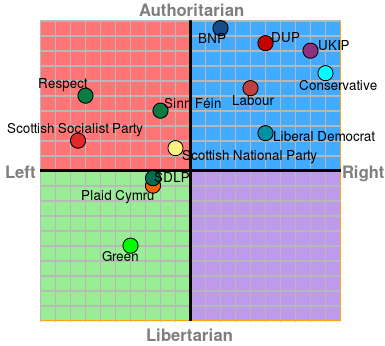
In our current politics, the five parties which I would expect to emerge from the data would be: Green; Labour; Liberal Democrat; Conservative; Faragistes. It is possible that the SNP could make the cut, but parties such as Plaid Cymru, and other regionally based parties such as Sinn Fein, the DUP and the Alliance Party, would not. A party such as the DUP might affiliate to the Faragistes, the Alliance Party perhaps to the Liberal Democrats, and thus maintain their right to stand in Westminster elections. Affiliation would be more difficult for separatist parties, who would be consequently liable to lose out on influence in the national Parliament. This said, I would personally consider it important that the right of the SNP, and Plaid Cymru to seek independence should be protected, perhaps by legislation which would trigger an independence referendum following a majority vote in the relevant devolved parliament. It would be reasonable, however, for this legislation to place a formal limit on the frequency with which such referenda could be conducted, let’s say, no more than once every 25 years.
But why five parties? Why not six? Or four? Well there is of course room for debate as regards the ideal number of parties, and to some extent I am looking at a left right spectrum, with two parties on the right, two on the left and one from the center as the likely candidates to emerge from the data gathered in local elections. Five parties should be able to offer a spread of policies from which only the constitutionally unclubbable and disaffected will be unable to make a selection. In the context of the actual election, a manageable set of options would then be on offer. Following the election, the formation of coalitions should be relatively straightforward and arise easily from negotiations reflecting the relative strength of the parties. It is easy to imagine the Green Party in Coalition with the Labour Party, but equally easy to imagine both of these parties in coalition with the Liberal Democrats: and so on.
Under this regime, there would be a clear interest in parties holding together, though I can imagine there being drift between parties at the margins of policy. Those parties which were losing influence would be under pressure to reinvent themselves, to develop fresh ideas, or a sharper organisational base to connect more effectively with the electorate, or risk relegation and replacement by a newer and fresher force emerging from the politics of local government.
I must be honest: the chances of such a proposal actually being adopted, are on a par with the survival of the proverbial snowball in hell. But perhaps there are better solutions to the problem to which I am drawing attention? And perhaps, as was suggested in the Labour Party’s 2019 Election Manifesto, there should be a Citizens Assembly to consider such constitutional matters: who knows what might emerge from such an Assembly?

 Carruchan

I would not be surprised if a Youth Party concentrating on climate change in particular might not feature in the near future. At that time maybe the libdems might not exist and if the SNP fail to separate from the UK, then I could see them leave in droves. Politics is and always will be unpredictable, decisive and thoroughly engaging.
Pingback: Unclubbable | Carruchan