
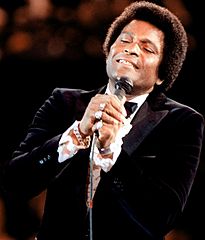
I stumbled across this programme recently, having some awareness of Charlie Pride’s career as a black Country and Western singer, but knowing little about him or even that he was still alive and touring.
Growing up in Northern Ireland, country music was a big deal, but not something I was personally paying much attention to. Indeed I rather looked down my nose at the whole genre, seeing it as terminally sentimental and conservative. The conservative aspect was confirmed by my encounter with Merle Haggard’s Okee from Muscogee:
We don’t smoke marijuana in Muskogee
We don’t take our trips on LSD
We don’t burn our draft cards down on Main Street
We like livin’ right, and bein’ free
Yet, I’d have to admit, Merle Haggard, has a distinctly unsentimental style and perhaps I even detect a little irony in his delivery.
Gradually my view of country music has altered. Perhaps Dylan’s Nashville Skyline had some influence, or Leonard Cohen’s Tower of Song.
I said to Hank Williams, how lonely does it get?
Hank Williams hasn’t answered yet
But I hear him coughing all night long
Oh, a hundred floors above me in the Tower of Song
But where does Charlie Pride fit into this. “He was born to sharecroppers in Sledge, Mississippi in 1934.” In one of several interviews in this programme he recalls walking four miles to school, and being overtaken by the white kids – who were all bussed – and who would lean out the window and jeer at him. “Nigga”.
However, the music his father listened to on the radio was the Grand Ole Oprey and it was through this education that he acquired his love and developed his talent for country music.
A particular detail of this programme that appealed to me is the esteem in which he is held, to this day, in the country music scene in Ireland, on both sides of the border and on both sides of the political and religious divide.
So how, in the first place, did he become a revered figure in American country music? Country is a genre dominated by white musicians and rooted in the communities of the deep south where, as Charlie Pride’s career was just starting off, segregation was still openly defended and the old attitudes of prejudice still lingered.
Somehow Charlie Pride navigated these alligator swamps without anger, or bitterness. If you are at all interested in his story, then give Jacqueline Springer’s beautiful programme a listen.

 Carruchan