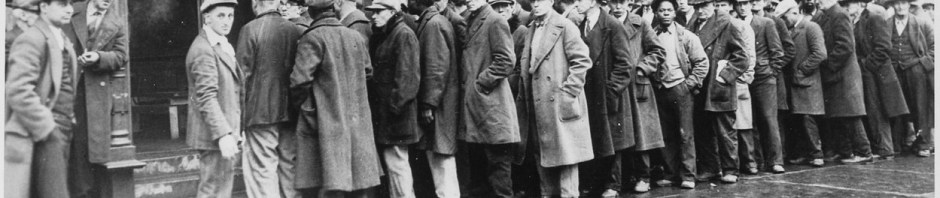
There is rising concern for the fate of our economy in the wake of the current crisis. The 6 o’clock news on BBC Radio 4, opened with some alarming headlines warning of the “unprecedented” recession which is awaiting us once we emerge from the current crisis. Unprecedented, apparently, since “the Second World War” … well that’s not unprecedented then, but I am writing not to carp about the use of this currently much over used word, but to quibble with the expert analysis, including comment from such as George Osborne, warning of huge debt, and unemployment, to rival the depression of 1929.
I am not an economist, and yet I have some confidence that, properly managed, we can recover from the present crisis without the suffering that characterised the Great Depression; indeed I am confident that hardship similar to that of the 2008 recession, can be avoided.
The flaw in the analysis which predicts a recession to rival that of the 1930s is that it focuses on the problem of where we will get the money from, rather than on the more critical matter of where the labour, the resources, the creativity will come from.
If we focus on the latter problem, it is obvious that we have a large and generally well trained workforce; we have enormous productive capacity, offices, factories, computers, machinery, particularly when considered in comparison to the production systems of the 1930’s. Yes, some of our productive capacity is currently lying dormant, but clearly we have not suffered catastrophic damage to our infrastructure, our housing, our hospitals, our schools, our hotels, as happened, for example, in the Second World War.

One does not have to be a socialist to recognise that the policies adopted by the Roosevelt administration, which brought the USA out of its profound recession, and which funded the war economy, can be adapted to speed our own recovery. The financial system is the means to activate the true wealth of our nation, it’s workforce, it’s tools, its creativity. A balance between taxation, borrowing from our own central bank, and investment in those aspects of our future which are generally accepted as important; the environment, public transport, broadband, etc.; this investment can be the engine of our regeneration.
It is only those who are trying to prepare us for a further round of austerity who apply the wisdom of Mr Micawber to our national economy, as though it should be managed like a household budget. The UK economy lacks none of the resources and financial levers that a developed nation has at its disposal; it is using them now to deal with the COVID-19 Crisis and it can use them again to restore our economy, when the time is right.
The Micawber Principle From the Dickens character Wilkins Micawber, noted for his inability to work his way out of poverty. Two of his enunciations have become elevated to “principles”:
“Something will turn up.”
“Annual income twenty pounds, annual expenditure nineteen pounds nineteen and six, result happiness. Annual income twenty pounds, annual expenditure twenty pounds nought and six, result misery.”

 Carruchan
