I was recently told a story about a medical professional who, whilst explaining the benefits he was experiencing from a “low carb” diet, disclosed that it was his intention not to take the coronavirus vaccine; he was “…not going to take the risk of putting something as artificial as a vaccine into his body.” This seemed a little shocking to me, that someone trained as a health professional should have such a sceptical response to a vaccine.
Having taken some interest myself in various dietary models I am aware that a kind of tunnel vision can set in if one is drawn into one dietary paradigm or another. On the one hand, arguments in favour of a diet are frequently set out with reference to scientific studies, but on the other, there is a tendency to imply that even minor dietary infractions will have disproportionate negative impacts.
In the face of such zealous council, I like to remind myself of my late Mother in law, who passed away at the very respectable age of 89, surviving in her latter years largely on a diet of white bread, sweets and biscuits. Despite much encouragement from those who cared for her health that she should include a few vegetables and whole grains in her diet, she had a superstitious resistance to such nostrums, to the end.
Those whole grains though, that well meaning relations were trying to press on my Mother in law, from Dave Asprey’s perspective were not a good idea: For most people, though, the majority of grains have more downsides than upsides. They don’t offer much bioavailable nutrition, they cause inflammation and intestinal damage, they trigger cravings, they’re often full of mold toxins, and there’s a good chance you’ll be better off without them. [1]
Asprey’s story is an interesting one; he has turned his own health journey around dramatically by adopting a ketogenic diet that, as his Bulletproof website declares, challenged everything we knew about nutrition. To the extent that I have studied his site and philosophy, I would say that it is smartly presented, carefully argued and supported by well referenced scientific studies — though I cannot vouch for the quality of those studies.
Dave Asprey has turned his own very positive story into a successful business, marketing a range of attractively packaged products, food, drink and supplements, of which the brand leader is his Bulletproof Coffee. I have actually tried a home made version of this; coffee with a dash of butter and coconut oil, whizzed up together with a stick blender: I found it a surprisingly good start to the day; the butter and oil as Dave Asprey suggests, fuels you until lunchtime and your first actual meal of the day. The caffeine stimulus certainly triggers the expected sense of mental sharpness and energy — always welcome. My only regret is that, personally, I don’t seem to be able to cope with more than one cup a day. I do occasionally chance a second but a third cup leaves me feeling distinctly edgey.
My home brew however falls short of the Bulletproof coffee which Dave Asprey will sell you in the form of a kit costing $56.60. His website tells us that Bulletproof Coffee is a blend of clean coffee and quality fats that satisfies hunger, kick-starts fat-burning and supports cognitive function. This Bulletproof ground coffee kit contains Brain Octane C8 MCT Oil, Grass-Fed Ghee and Bulletproof Original ground coffee. I haven’t thought it necessary to try authentic Bulletproof coffee yet, but would admit that I am tempted by the sound of that Brain Octane C8 MCT Oil. But wait a minute! This product description implies that the coffee I normally drink may not be clean, that the fats I normally ingest may not be of the best quality, and the ghee(clarified butter) I normally consume may not be grass fed, and that all of these things really matter for my health. Actually, having read a little of Dave Asprey’s website I can say that he makes a persuasive case in favour of this evaluation. As it happens, I have already switched to Kerrygold grass fed butter on the basis that it provides more omega-3 oils than the more industrially produced grain fed variety, and I apply a similar critical evaluation in my choice of fats in general; but should I be investing in “clean” coffee? … whatever that may be?
It is at such moments, that I feel it necessary to call to mind my aforementioned Mother-in-law and her diet of white bread, sweets and biscuits.
A heart for the NHS – photo EMK
The website, Healthline.com, contains a list of “7 toxins in food that are actually concerning”. Reassuringly they say: You may have heard claims that some common foods or ingredients are “toxic.” Fortunately, most of these claims are not supported by science. However, there are a few that may be harmful, particularly when consumed in large amounts.
That phrase, particularly when consumed in large amounts, deserves repetition; I also note that the list does not include coffee as a source of toxins. [2]
There is increasing acknowledgement that our personal and unique metabolism is a key factor in determining what we should include and exclude from our diet. It follows that the fine tuning of diet is a responsibility we must take on at an individual level. In our personal odyssey towards a diet which offers both the enjoyment of food and the prospect of good health, the more extreme ends of dietary advice should probably be taken with a, (small, of course,) pinch of salt, particularly where such advice is directed towards turning you into a customer.
The New Scientist magazine has recently published an article titled Low-carb diets: An easy way to lose weight or, recipe for heart attack? It surveys the evidence, and concludes that low-carb diets can help people to lose weight, can be effective in the treatment of type 2 diabetes and can in some instances alleviate otherwise untreatable epilepsy. However there is also some evidence of heart risks associated with such diets. The article points out, however, that for some time, there have been growing concerns that the cholesterol theory of heart disease was on shaky ground. This theory is the basis on which advocacy of low-fat diets has been the medical establishment’s long held orthodoxy. [3]
Scientists do their best to make recommendations on the basis of the research data available but can be slow, in some cases, to modify or overturn ideas, as new and contrary evidence emerges. In the early stages in the life of a new hypothesis, studies may be small, sometimes poorly designed, written up with insufficient detail, and therefore difficult to replicate. Interest groups start to take sides, for example those drug companies which are liable to lose out if a new treatment emerges; or chancers who can see opportunity to step into a gap in the market where doubt is being cast on an existing model of treatment.
In the midst of all this unsettling and messy process we would like our Doctors to be god like in their dispensation of knowledge, but the truth is that keeping up with all the developments in medical and dietary science and adjudicating them, is a big challenge.
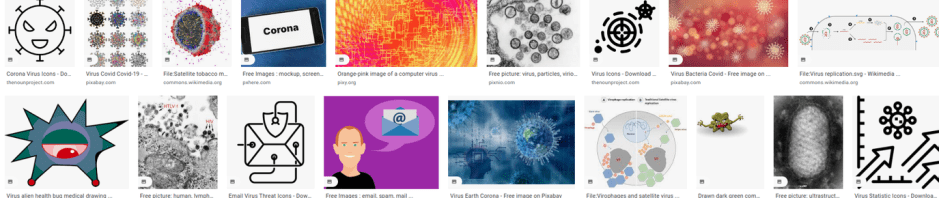
Crop of google search on “vaccine”; images, open source.
This probably has some relevance to that vaccine sceptic medical professional, who, doubtless through research on the internet, has discovered a diet which works well for him, despite that diet being somewhat demonised by the medical establishment: it should be no great surprise then that he has become a skeptic with regard to other aspects of what the medical establishment has on offer.
Personally I think that a degree of scepticism as regards what the Doctor may prescribe is wise and though I listen carefully to my Doctor’s advice I also think carefully before I start taking the medicines I am offered: can I recover with my own resources? seems like a good question to ask. Whilst the medical profession has come a long way from it’s early reliance on very crude remedies, we are probably all aware of contemporary treatments which, whatever their benefits may be, are also the cause of significant harms: antibiotics which damage our microbiome, or pain killers which are addictive, for example. I will have no hesitancy however in taking a Covid 19 vaccine.
Vaccines in my mind do not come into the usual category of medicines. They are designed to be minimally invasive and have the single purpose of stimulating an immune response, and providing protection from the much more serious threat posed by the Covid 19 virus, which may someday insinuate its way into your body, or that of your elderly parents, whether you wish it or not.
There are I believe others out there, who don’t simply distrust the medical establishment, but who believe that vaccines are some kind of international or establishment plot, and indeed that Covid 19 has been spread maliciously etc.etc. I don’t suspect our vaccine sceptical medic as having strayed into that much darker territory, and I really have no advice to offer to those who do, other than perhaps, to refer them to the Protocols of the Elders of Zion and the history of the Third Reich. [4]
I am a retired College lecturer, having worked originally in supported programmes but latterly having taught social science subjects, Psychology and Politics, though my degree was in Sociology. I am from Newry in Northern Ireland, but now live in Dumfries in South West Scotland. https://carruchan.wordpress.com/about/

 Carruchan
Science and nonsense: diet, viruses and vaccines
I was recently told a story about a medical professional who, whilst explaining the benefits he was experiencing from a “low carb” diet, disclosed that it was his intention not to take the coronavirus vaccine; he was “…not going to take the risk of putting something as artificial as a vaccine into his body.” This seemed a little shocking to me, that someone trained as a health professional should have such a sceptical response to a vaccine.
Having taken some interest myself in various dietary models I am aware that a kind of tunnel vision can set in if one is drawn into one dietary paradigm or another. On the one hand, arguments in favour of a diet are frequently set out with reference to scientific studies, but on the other, there is a tendency to imply that even minor dietary infractions will have disproportionate negative impacts.
In the face of such zealous council, I like to remind myself of my late Mother in law, who passed away at the very respectable age of 89, surviving in her latter years largely on a diet of white bread, sweets and biscuits. Despite much encouragement from those who cared for her health that she should include a few vegetables and whole grains in her diet, she had a superstitious resistance to such nostrums, to the end.
Those whole grains though, that well meaning relations were trying to press on my Mother in law, from Dave Asprey’s perspective were not a good idea: For most people, though, the majority of grains have more downsides than upsides. They don’t offer much bioavailable nutrition, they cause inflammation and intestinal damage, they trigger cravings, they’re often full of mold toxins, and there’s a good chance you’ll be better off without them. [1]
Asprey’s story is an interesting one; he has turned his own health journey around dramatically by adopting a ketogenic diet that, as his Bulletproof website declares, challenged everything we knew about nutrition. To the extent that I have studied his site and philosophy, I would say that it is smartly presented, carefully argued and supported by well referenced scientific studies — though I cannot vouch for the quality of those studies.
Dave Asprey has turned his own very positive story into a successful business, marketing a range of attractively packaged products, food, drink and supplements, of which the brand leader is his Bulletproof Coffee. I have actually tried a home made version of this; coffee with a dash of butter and coconut oil, whizzed up together with a stick blender: I found it a surprisingly good start to the day; the butter and oil as Dave Asprey suggests, fuels you until lunchtime and your first actual meal of the day. The caffeine stimulus certainly triggers the expected sense of mental sharpness and energy — always welcome. My only regret is that, personally, I don’t seem to be able to cope with more than one cup a day. I do occasionally chance a second but a third cup leaves me feeling distinctly edgey.
My home brew however falls short of the Bulletproof coffee which Dave Asprey will sell you in the form of a kit costing $56.60. His website tells us that Bulletproof Coffee is a blend of clean coffee and quality fats that satisfies hunger, kick-starts fat-burning and supports cognitive function. This Bulletproof ground coffee kit contains Brain Octane C8 MCT Oil, Grass-Fed Ghee and Bulletproof Original ground coffee. I haven’t thought it necessary to try authentic Bulletproof coffee yet, but would admit that I am tempted by the sound of that Brain Octane C8 MCT Oil. But wait a minute! This product description implies that the coffee I normally drink may not be clean, that the fats I normally ingest may not be of the best quality, and the ghee(clarified butter) I normally consume may not be grass fed, and that all of these things really matter for my health. Actually, having read a little of Dave Asprey’s website I can say that he makes a persuasive case in favour of this evaluation. As it happens, I have already switched to Kerrygold grass fed butter on the basis that it provides more omega-3 oils than the more industrially produced grain fed variety, and I apply a similar critical evaluation in my choice of fats in general; but should I be investing in “clean” coffee? … whatever that may be?
It is at such moments, that I feel it necessary to call to mind my aforementioned Mother-in-law and her diet of white bread, sweets and biscuits.
The website, Healthline.com, contains a list of “7 toxins in food that are actually concerning”. Reassuringly they say: You may have heard claims that some common foods or ingredients are “toxic.” Fortunately, most of these claims are not supported by science. However, there are a few that may be harmful, particularly when consumed in large amounts.
That phrase, particularly when consumed in large amounts, deserves repetition; I also note that the list does not include coffee as a source of toxins. [2]
There is increasing acknowledgement that our personal and unique metabolism is a key factor in determining what we should include and exclude from our diet. It follows that the fine tuning of diet is a responsibility we must take on at an individual level. In our personal odyssey towards a diet which offers both the enjoyment of food and the prospect of good health, the more extreme ends of dietary advice should probably be taken with a, (small, of course,) pinch of salt, particularly where such advice is directed towards turning you into a customer.
The New Scientist magazine has recently published an article titled Low-carb diets: An easy way to lose weight or, recipe for heart attack? It surveys the evidence, and concludes that low-carb diets can help people to lose weight, can be effective in the treatment of type 2 diabetes and can in some instances alleviate otherwise untreatable epilepsy. However there is also some evidence of heart risks associated with such diets. The article points out, however, that for some time, there have been growing concerns that the cholesterol theory of heart disease was on shaky ground. This theory is the basis on which advocacy of low-fat diets has been the medical establishment’s long held orthodoxy. [3]
Scientists do their best to make recommendations on the basis of the research data available but can be slow, in some cases, to modify or overturn ideas, as new and contrary evidence emerges. In the early stages in the life of a new hypothesis, studies may be small, sometimes poorly designed, written up with insufficient detail, and therefore difficult to replicate. Interest groups start to take sides, for example those drug companies which are liable to lose out if a new treatment emerges; or chancers who can see opportunity to step into a gap in the market where doubt is being cast on an existing model of treatment.
In the midst of all this unsettling and messy process we would like our Doctors to be god like in their dispensation of knowledge, but the truth is that keeping up with all the developments in medical and dietary science and adjudicating them, is a big challenge.
This probably has some relevance to that vaccine sceptic medical professional, who, doubtless through research on the internet, has discovered a diet which works well for him, despite that diet being somewhat demonised by the medical establishment: it should be no great surprise then that he has become a skeptic with regard to other aspects of what the medical establishment has on offer.
Personally I think that a degree of scepticism as regards what the Doctor may prescribe is wise and though I listen carefully to my Doctor’s advice I also think carefully before I start taking the medicines I am offered: can I recover with my own resources? seems like a good question to ask. Whilst the medical profession has come a long way from it’s early reliance on very crude remedies, we are probably all aware of contemporary treatments which, whatever their benefits may be, are also the cause of significant harms: antibiotics which damage our microbiome, or pain killers which are addictive, for example. I will have no hesitancy however in taking a Covid 19 vaccine.
Vaccines in my mind do not come into the usual category of medicines. They are designed to be minimally invasive and have the single purpose of stimulating an immune response, and providing protection from the much more serious threat posed by the Covid 19 virus, which may someday insinuate its way into your body, or that of your elderly parents, whether you wish it or not.
There are I believe others out there, who don’t simply distrust the medical establishment, but who believe that vaccines are some kind of international or establishment plot, and indeed that Covid 19 has been spread maliciously etc.etc. I don’t suspect our vaccine sceptical medic as having strayed into that much darker territory, and I really have no advice to offer to those who do, other than perhaps, to refer them to the Protocols of the Elders of Zion and the history of the Third Reich. [4]
Like, comment or share at this facebook link!
References
[1] The complete Bulletproof guide to grains.
[2] 7 Toxins” in Food That Are Actually Concerning
[3] Low carb diets: an easy way to lose weight or recipe for a heart attack
[4] https://en.wikipedia.org/wiki/The_Protocols_of_the_Elders_of_Zion
Featured Image
A cropped version of this image should appear as a header on this page. If not, and you wish to view it in situ, please follow this link.
Share this:
About Stephen Shellard
I am a retired College lecturer, having worked originally in supported programmes but latterly having taught social science subjects, Psychology and Politics, though my degree was in Sociology. I am from Newry in Northern Ireland, but now live in Dumfries in South West Scotland. https://carruchan.wordpress.com/about/