

Having “done Brexit”, the intervention of the pandemic has deflected Boris Johnston from what might be his second great project, securing the Union of the United Kingdom. The early signs are, that his political vision falls a long way short of what will be required to keep Scotland in the UK; indeed, he has emerged less as a political superhero and more like a character out of the Dandy or the Beano, his wizard wheeze being, a buccaneering post Brexit Britain delivering an economic miracle, with just enough of the resulting bounty spilling over the border, to settle the pesky Scots.
There is however much scepticism in Scotland as regards the miracle happening in the first place, and as to the possibility of prosperity being equally spread across the realm, well, that suggestion is likely to produce much scoffing in Scotland and elsewhere.
One somewhat unglamorous correction to our politics, occasionally discussed, but profoundly underestimated in its potential for encouraging us to work together, is the introduction of a proportional voting system for the House of Commons. It is fair to say that where proportional representation[PR] is concerned, the electorate are mostly disinterested, the popular press largely hostile and for reasons of obvious self interest, MPs, in general, unenthusiastic or staunch opponents of the idea, delighting in directing our attention to the more dire implementations, of which there are a few. [3]
There are more fashionable reforms; an elected second chamber to replace the House of Lords; or Devo Max, where Scotland would have full fiscal autonomy. But neither of these measures has the restorative potential that electoral reform can bring, through the simple impact of ensuring all votes have equal value.
The current electoral system for the UK Parliament, First Past the Post (FPTP), has many defects, but let’s just talk about a single one: its polarising tendency.
Even before Scottish Nationalism really came to the fore, British electoral politics was characterised by division between the working class inner city Labour strongholds and affluent suburbs and rural areas which have become Conservative strongholds. In saying this, it is important to remember that there is significant support for other parties within these stronghold constituencies, but citizens resident in a stronghold, who choose to support other parties than the dominant one, are on a hiding to nothing. They might as well not turn up to vote, and in all probability, many of them lose interest, and do not.
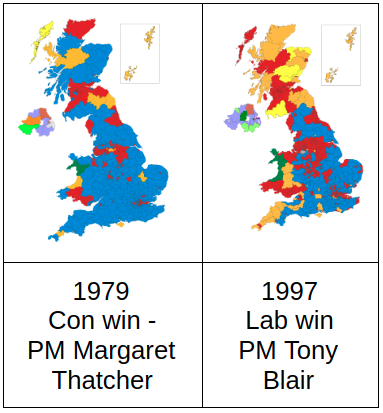
Since the 1980s this polarisation has developed a further tentacle, as the Conservative Party in Scotland, once a country with many safe conservative seats, now holds only six out of a total of fifty nine. Forty seven of these are currently held by the Scottish National Party. [2]
The effect of such polarisation is that seats judged to be unwinnable by a party, become less important to their strategic thinking. At our next UK General Election, for example, why should Boris Johnston bother about Scotland? Though there are Tory votes to be won, winning seats would be a lot more difficult. He knows that his real priority must be to retain the so-called “red wall”, won from Labour at the 2020 election, for that is how he can hold on to power.
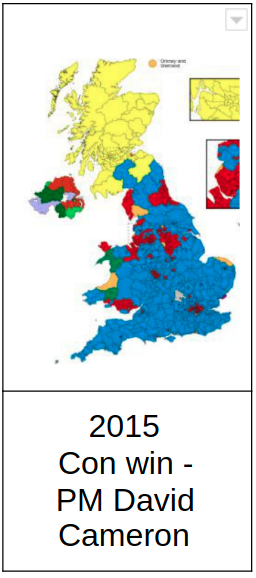
Since the rise of Margaret Thatcher in the 1980’s, Scotland had become a Labour stronghold until, at the 2015 election, a tipping point was reached and Labour, who in the previous election held forty seats, found themselves in possession of just one, to the SNP’s fifty six.
This political earthquake was the culmination of growing support for independence built on the very strong Yes campaign in the 2014 referendum. It is also frequently suggested that the Labour Party had become complacent about its strength in Scotland, assumed that they would always hold Scotland, and failed to pay attention to growing disillusion in the Scottish electorate. This was a faultline on which the Scottish National Party have capitalised.
Choosing a system for the UK Parliament
There are good and bad systems of PR, but most proportional systems will oblige all parties who seek to form a government, to treat all votes, regardless of where a citizen is situated, as equally important.
The Additional member system, as currently used for the Scottish and Welsh Parliaments, has its critics, but in general has worked well. It is constituency based, with regional party lists being used to adjust proportionality following the election. However, the implementation of a voting threshold would be a stabilising feature from a UK Union point of view.
Thresholds are common in PR, designed to avoid fracturing of parties and the election of single issue pressure groups, which can lead to problems building coalitions, and result in frequent crises, governments suddenly collapsing and election fatigue for everyone concerned. For UK wide elections, a threshold could filter out parties unable to gain support across all of the constituent regions of the Union. Such a threshold would ensure that only those gaining significant support in every region of the Union, would be eligible for a seat in the UK Parliament.
The threshold would be low, probably about 2% of votes cast in each region, but as a consequence parties whose vote is concentrated only in one region would find it difficult to win a seat and would be unlikely, I imagine, to even field candidates outside their own territory.[4] It might seem that this threshold would exclusively impact secessionist parties, but it is probable that a party such as the DUP, which held sway over Brexit negotiations in our last Parliament, would be unlikely to find support outside its Northern Irish fiefdom, and so could not win seats in the House of Commons. The DUP however would continue to stand for and have every hope of winning seats in the Stormont Assembly.
To ensure fair representation, such a system would allow preference based voting, so that, where a citizen’s first preference was for a party falling short of the threshold, there would be a second or third choice, for a party with a Union wide profile. This vote would then be counted towards the election of that citizen’s constituency MP and the weighting given to party lists when adjusting the final outcome for proportionality.
In Northern Ireland, Sinn Fein have always adopted an abstentionist position. They contest UK elections but do not take up the seats they win. To my own personal frustration they stuck obstinately to this position even when their presence in Parliament might have tipped the outcome of Brexit negotiations in a manner more favourable to their own supporters. The proposed voting system would ensure that Sinn Fein supporters would have an option to cast another vote for a candidate to represent them in the UK Parliament.
The Labour Party, the Liberal Democrats, and perhaps, the least likely choice for the Sinn Fein demographic, the Conservative Party, would be obliged to organise and field candidates throughout Northern Ireland. Sinn Fein would continue to participate in the Stormont Government while making their case for Irish Unity. The SNP and Plaid Cymru, equally, would continue to make their case for independence through their participation in the Scottish and Welsh Parliaments respectively. [5]
But is it worth the bother?
Having suggested how it might be done, I return to that thorny question of whether saving the Union is worth the bother. Actually, the answer depends on whether the UK Parliament is capable of any reform which might realistically encourage the Union to come together rather than to fracture. I currently see electoral reform as the most effective way of achieving this outcome, albeit gradually, but I am not hopeful that such a reform will be made in the near future. For this reason, I will certainly think seriously about voting for Scottish Independence when the inevitable referendum comes along; but make no mistake: given the challenges which our world is facing, we should really be building and reforming trans-national unions, not breaking them up.
You are welcome to comment on this article using your WordPress account or like comment or share at this facebook link! All comments will be moderated.
References and Footnotes
[2] List of MPs for constituencies in Scotland (2019–present)
[3] The Liberal Democrats have consistently supported PR, as of course do the Green Party. Many well known figures in the Labour Party have supported PR over the years, and it may be that this number is growing. Following the 2010 election however, Labour were resistant to coalition with the Liberal Democrats on the basis of an agreement to have a PR referendum. The Labour Party Campaign for Electoral Reform (LCER) has, however, campaigned for many years for reform of the electoral system and advocates for PR. I am a member. More information on LCER
For dire implementations, see Israel, which has a single constituency for the entire country and, Turkey, which has a 10% threshold, the highest of any country.
[4] Thresholds of this type are commonly used in national elections, for example in Poland, Germany and New Zealand. Their purpose in general is to prevent dislocation of the party system, such that coalition building following an election becomes problematic. More detail: Electoral Thresholds – Wikipedia
[5] I do not think it too much of a stretch to suggest this voting system would accelerate a movement away from sectarian voting patterns in Northern Ireland. It is probable that the Unionist Party might integrate more fully with the Conservative Party, [though the Conservative Party already organise in Northern Ireland], and the Alliance Party with the Liberal Democrats. The Labour Party’s position would be more difficult at the outset, as their most natural ally is the SDLP, which is committed to Irish Unity. However, as a party of the left, Labour should be able to establish the required minimum percentage at their first outing even discounting the likely second preference votes they would get from SDLP and Sinn Fein supporters.
Featured Image
This image should be displayed at the head of the post, but if you have accessed it via a home page link, it may not be visible. To see the image in its intended place in the post please follow this link.


 Carruchan
Pingback: Time up for the House of Lords, and an end to “nostalgic deference.” | Carruchan