The Beautiful Game
In my middle teenage years, I had a girlfriend, Emma, but it was a short-lived affair. She was a year below me in school but, though I liked her and was grateful for her interest in me, I never really settled into the relationship and my involvement, consequently, was half-hearted. Unsurprisingly, we drifted apart.
Part of the problem, perhaps, was that the fate of those in Newry High School who were “going steady” in the late 1960s seemed to be to spend their breaks and lunch hours standing in the school yard, lined up along the red brick wall of the old High School building, in — what seemed to me — an enchantment of mutual admiration. I really couldn’t visualise myself in this amorous company and was mystified as to how this practice could be sustained over months, if not years. But there was, so far as I was concerned, a further problem with the wall of love: lunch hour was for football.
It was the chance of a game before school which got me there early most days, and the opportunity for a further game at the end of the day which kept me late most evenings; but that was clearly not enough, and I was unready to sacrifice my lunchtime to anything other than football. Football — soccer that is — occupied a unique position in the culture of Newry and District for it was not an official game in any of the schools, whether Catholic, where Gaelic football and hurling were played, or state schools, such as Newry High School, where the official sports were rugby and hockey. I’d played both of these in my first year and opted for hockey, which I enjoyed; but my first love was “the beautiful game”.
My passion for the game was a common one amongst my friends and so we sought opportunities for a more organised expression of this shared interest. This we found in the Carnbane League, a phenomenon of voluntary organisation worthy of an OBE, though I suspect that those who might have been offered the award, would have felt it necessary to decline it and the accompanying trip to the palace.
My friends and I entered teams in the appropriate age groups in the Carnbane League over several seasons. The sides that I played in were conspicuous only by their lack of success. The team names in general were like those I see listed today: Camlough Rovers; Rossowen Celtic; Millburn United. On one occasion I persuaded my friends to enter a team under the name of River Plate, which I knew to be one of the top Argentinian teams. I knew nothing about them, but I was very taken with the ring of the name. It must have been a knockout competition, for I remember playing only one game as River Plate in which we were well thrashed, 6-1. In this particular match, however, somewhat to my own astonishment and late in the “second moiety”, as the man from the Newry Reporter would surely have recorded the moment — had he been present — I shimmied past a couple of players and slotted the ball into the corner of the net for our only goal. I watched the Newry Reporter very closely that week on the day it came out, to see if the panel who awarded “goal of the week” had heard of the glories of my own effort. Apparently, no one had seen fit to pass on the good news.
The fact that football has such a strong cross-community profile in Northern Ireland made it all the more mystifying to me that the national soccer team was, and continues to be, divided, a Northern Irish team and a team for the Irish Republic. This does not mirror the situation in other sports such as rugby and hockey, where a single team represents the island of Ireland. In my teenage years, this was a matter of distress to me. In the late 1960s and early 1970s, George Best was indisputably the greatest player in the world. Newry’s own Pat Jennings was a goalkeeper — the Newry Reporter would have called him a “custodian” — in the very top rank. It seemed obvious to me that if we could just add John Giles of Leeds United and the Republic of Ireland, we would have a midfielder of world class who could stitch the whole team together. With these three very great players and the best of the rest, there was no doubt in my mind that — to paraphrase Marlon Brando in On the Waterfront — “we coulda been contenders.” I don’t just mean that we could have got to the final stages of the World Cup; this was a once in a thousand-year opportunity for a small nation to go all the way, squandered, as far as I could see, on the altar of an archaic squabble.
A Legend in Blue and White Stripes
In August 1983 my eldest brother Michael and I set off to watch a pre-season friendly between Newry Town and Shamrock Rovers. As a teenager I had occasionally joined the small crowds which went to the Showgrounds to watch the Town play. Regardless of their lowly status in the B-Division, I knew that my footballing talents would never win me a place in the team but that didn’t prevent me from daydreaming occasionally that I might become their manager and lead them to promotion to the Irish League and then eventually glory in Europe — but let’s not get carried away with this fantasy.
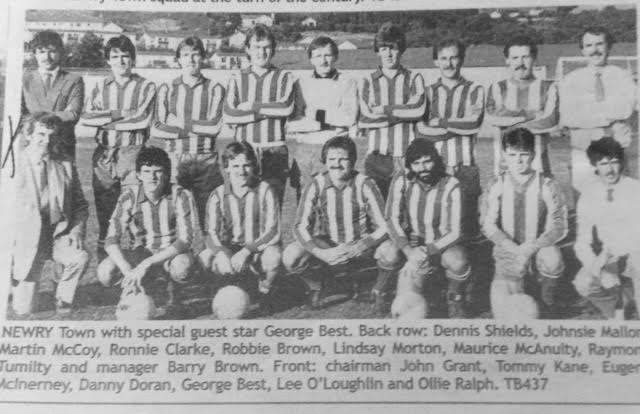
The real thrill of the match in question was that, in the twilight of his career, George Best had been inveigled, for that game only, into playing for Newry Town. I believed this coup had been the work of the club chairman, John Grant. I remembered John from when he had been a technician in the chemistry lab at Newry High School. This was not a position greatly respected by High School pupils, but John had defied all expectations by becoming a significant figure in the world of Newry’s hospitality industry, first of all by helping to run the Copper Grill on the corner of Sandy Street and Downshire Road, and then as manager of the Ambassador Restaurant in Hill Street. In the years before I was of age to enter licensed premises I had whiled away many hours in the Copper Grill in the company of friends drinking coffee and eating sugar lumps, the latter being provided gratis for the customers in little bowls placed conveniently on each restaurant table. I don’t imagine this type of custom was either particularly welcome or a significant contribution to John’s rise in Newry’s business world, but we were tolerated and grateful for the respite from the cold on winter evenings.
It seemed hardly believable but, on a lovely summer evening, Michael and I turned up at the appointed hour to watch as Shamrock Rovers warmed up at one end in their green and white hoops and at the other end in the blue and white stripes of Newry Town was George, swapping passes with his temporary teammates. He was perhaps carrying a little more weight than in his heyday and who knows what he had been doing earlier in the day by way of match preparation, but he seemed in good shape.
I have searched hard on the internet to see if I could find the result of that game, but though the event is noted in various places, I have been unable to confirm a final score, suggesting, perhaps, that was the least of anyone’s concern. Surely the man from the Newry Reporter was there? My own recollection is 3-2 in favour of Shamrock Rovers, with the Town’s first goal being scored by George from the penalty spot. But maybe I am just imagining that.
What I do remember was that in the second half George’s progress towards goal was halted by an over-enthusiastic tackle just outside the right-hand edge of the penalty area, not far from the touchline where Michael and I were standing. The whistle blew for a free kick. It was a position where a shot at goal would have been possible, but a little too close to curve a ball over a wall of defending players. George had another idea; almost in the same moment the kick had been awarded, he had taken it, gliding the ball across to a player in blue and white who stood loose at the other corner of the box and who had time to calmly fire a shot low into the back of the net past a wrong-footed defence and a bemused keeper. It was an unspectacular assist but nevertheless a little piece of magic which I felt privileged to witness.
These are slightly edited extracts from my recently published memoir, Remembered Fragments available on Amazon as both an e-book and paperback. Whilst I hope these extracts may interest you in reading the full memoir, you should probably check the synopsis on Amazon before purchasing. It’s not all about football!
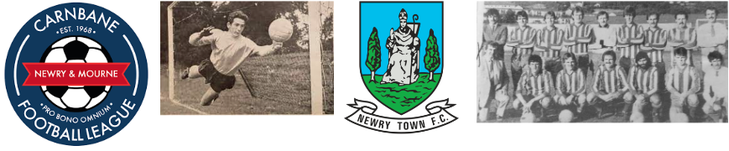
Sources for header composite image.
- Carnbane League logo [Pro Bono Omnium, Established 1968]
- A “very young” Pat Jennings
- Newry Town badge
- Newry Town F.C. with special guest star George Best. Original picture includes full team listing.

 Carruchan
M Y, I did not know you were a multi active sportsman .i got two caps for Rugby but they were for two wins over Nigerian and Sierra Leone. I was capped for Ghana. A most interesting story. Well doneMillerSent from my iPad