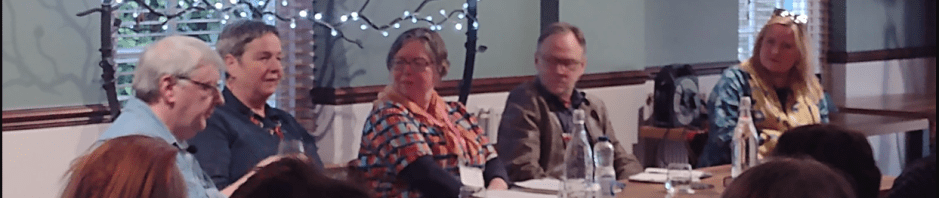
Kirkcudbright Book Week, Selkirk Arms
9th March 2025
Is it truly impossible for aspiring writers to break into the publishing industry? At this, the penultimate event in Kirkcudbright Book Week 2025, the panel of experts seemed to think so.
The programme information referred to the “rapid change” which the world of publishing is undergoing, “providing authors, readers, publishers and bookshops with unprecedented opportunities and challenges.” I looked forward to a wide ranging conversation. Yet though I enjoyed the discussion, from the point of view of aspirant writers, what I heard was mostly a counsel of despair. It is nearly impossible to get a publisher, we were told. Fiction does not sell, said Ian Spring of Rymour Books, though non-fiction can sell, for example books about the Scottish mountains. This was stark realism in spades.
There was very little analysis of the sub genres of non-fiction – biography, memoir, travel, history philosophy and so on. According to Gerry Hassan, writing on popular music is enjoying something of a golden age and may be treated as an exception. To self publish, on the other hand, is to accept that you will only ever be read by friends and family. One member of the audience did claim to have sold four hundred copies of a self published book. There was general assent from the panel that that was a pretty impressive outcome. Nevertheless, said panel member, Anstey Spraggan, you can tell, often by just reading the first line of a book, whether it is a work of self publication or has gone through the rigours of editing on which a proper publisher will insist.
The comment of the panel on the difficulties of finding a publisher is something on which I have a personal story to tell. Indeed, having attempted unsuccessfully to get a publisher for my memoir, Remembered Fragments, I have some sense of just how competitive the world of publishing is.
My book was written during the pandemic when, we can be sure, many similar projects were being worked out. The central narrative was my coming of age in Newry, Northern Ireland, with my earliest memories from the late 1950s through the 1960s when the Troubles were just beginning to kick off.
For whatever reason I had settled on the idea that Belfast’s Blackstaff Press would love what I had to say. On consulting their website it became clear that they were not taking any further submissions for that year, as they were already overloaded. When I checked up in January of the following year, the message had been updated to say that Blackstaff would only be accepting submissions in April and May, and that a maximum of 30,000 words should be submitted. I waited patiently and submitted my 30,000 words and in due course was turned down. I received no comment on the quality of the work.
The panel at the Selkirk Arms in Kirkcudbright was clearly representative of a fairly traditional model of publishing for fiction and non-fiction books. There was a general assumption that, unlike myself, would-be writers are intent on a career as an author. If you are in that category, then get yourself an agent who will act as an intermediary between you and potential publishers. So far as I can tell this system of agents as intermediaries continues to work well for many established writers. The main challenge for new writers is the increasing number of people out there who believe, rightly or wrongly, that they have a book in them, perhaps even a future as a writer. This inevitably makes the problem of getting the attention of a publisher more difficult.
Publishers in general take the view that they are already skimming the cream and that great writing will inevitably find its way to the top. There is of course a market for celebrity biographies, cookbooks, and the like. For the rest, there is self publishing in its various forms. The possible merits of this option were not really explored other than as a refuge for the desperate. The panel warned us in particular against the blandishments of those who will take money in exchange for proofreading and typographical services. I’d say that was sound advice.
But even if we restrict our idea of publishing to the written word, the age of change has had impacts well beyond the bastion of mainstream traditional publishing. For those with an impulse to blog on whatever subject takes their fancy, a world of opportunity has opened up with the internet. My own efforts as a blogger have had limited reach, but I follow a couple of local blogs which I think are well written and of significant interest and which clearly have a substantial audience. Increasingly even professional writers are using Substack and similar platforms to cut out the middlemen and get paid directly by their readers.
Panelist Ian Spring, made it clear that poetry can sell, though this is usually reliant on energetic promotion by the poet. In Dumfries and Galloway, and I am sure elsewhere, the writing of poetry is supported by workshops which offer an apprenticeship of sorts and undoubtedly a first level of quality control. Southlight Magazine is a secondary filter on the local literary scene offering a forum to new writers of poetry and indeed of short stories. Southlight provides opportunities to read at the Magazine’s launch events. Small publishers such as Drunk Muse Press deserve honourable mention having brought some of the fine poetry which is being written in obscure corners to a wider audience.
While small specialist publishers have long existed, they have been made more viable by the computing technology used to prepare work for publication which, combined with modern methods of printing, would appear to make short print runs an affordable proposition. Since poets never expect to become best sellers, this model of publishing works well for them.
When question time came I was keen to ask the panel how they thought Artificial Intelligence might affect the publishing industry. The question was understood more as being concerned with the threat posed by AI rather than the opportunities which it might offer. I was advised that asking Chat GPT or Deep Seek for comment on drafts for my blog, as I do, was “feeding the beast” … well the word “beast” wasn’t used, but that was the implication.
It does seem possible that Artificial Intelligence may begin to replace writers in a range of circumstances and that is indeed an alarming thought. Yet at the current stage of its development, AI has the capability to assist writers in shaping their work, just as a friend or editor will assist us by making corrections and suggestions – for example that chapter 3 is a pointless and self indulgent digression which should be cut out entirely; and so on. Used in this way, we control the AI and get it to do what we want. If you don’t like what it says, by all means, plough your own furrow.
Ian Spring pointed out that the publishing industry is already shaping the work of writers, moving it towards what will be more digestible, more saleable. At the more extreme end of this “management,” publishing may already be doing the very thing that we fear most from AI, crushing creativity and promoting a product which is shaped entirely by the demands of the market.
Where creative writing is concerned, the end point impact of Artificial Intelligence is indeed hard to predict. AI can, in its current incarnation, rattle off poems to order, no doubt, making some attempt at the style of T.S.Elliot, or W.B.Yeats, if required. Yet I don’t see a serious threat to the writing of poetry from this quarter. Perhaps AI will independently produce work to feed a public appetite for crime, romantic or science fiction. Much of the publication in these genres already betrays a strong element of formula in its construction. That, possibly dark day, of ubiquitous AI created content has not yet arrived. In the meantime we will probably do better if we take control of AI and exploit its obvious potential as a researcher, an editor and a critic of our work.
Many of the audience for this event, I suspect, had attended with some hope of gaining advice on how to gain a foothold for their own work in the world of publishing. Well not James Robertson, who was present mostly because he was the main attraction in the following event, though his contribution to the discussion was welcome, so far as I was concerned.
I felt particularly for the lady who had turned up with a complete manuscript in her bag. It was, she declared, the work of a deceased aunt. She had discovered it gathering dust in an attic and, having read it, was sufficiently impressed to believe it was deserving of a wider audience. The panel listened to her story politely, and made some encouraging noises. The phrase “friends and family” may have figured yet again, but no one rushed forward to claim the document for their own press.
I imagine this was a handwritten manuscript. My advice to that lady would be, type it up, or pay to have it typed up if you can afford to do so. Feed the manuscript into ChatGPT or Deep Seek asking for advice on spelling, grammar, readability and structure. Work through the advice and make whatever corrections and changes you yourself feel are appropriate.
This will be quite a job of work, which would usually be undertaken by the author. Indeed the process brings to mind a recent cartoon in the Guardian by Tom Gault on Finishing a Book. This makes it clear how an author is obliged to revise and rework at every stage of their engagement with an agent and a publisher.
If, as I eventually did, you use Amazon Print on Demand for publication of your book, Amazon will assist you with cover and book design. However, don’t expect this necessarily to do justice to your aunt’s work. If you are prepared to pay money, employ someone to assist you with the design and typography. I might approach a local artist, even for advice on this subject. In my own case, I paid my nephew Joe, who works in graphic design in London. That was the most expensive part of my own project, but I think well worth it.
Once you’ve got a copy of the book in your hands, think about a launch event. Invite all your friends, acquaintances, family, members of the local book club, indeed anyone who seems remotely interested. Print enough copies to sell to the number you believe will be likely to attend. Better too few than too many. You can always take orders. You definitely don’t want to be tripping over boxes of unsold books for years to come. At the event you should tell the story of how you found the book, came to believe in its worth, and explain the process by which you published it. Offer a short reading.
This done, write a press release summarising the story of the book’s publication as you have told it at the launch event. Send the press release to local and national newspapers and television. They’ll love your story and the book will maybe even sell a few copies on Amazon. Don’t expect the book to be reviewed but, just possibly, word of mouth will spread and you will have an extraordinary success on your hands.
But that’s not likely. In a previous post on the subject of blogging I quoted writer Hamilton Nolan who said: “most books sell shockingly few copies…You should not write a book to get rich or famous. That won’t happen.” He then goes on very powerfully to explain why this should not put a writer off. I think what he has to say might equally be applied to the project of publishing your aunt’s legacy.
I wish you luck and am confident that your finished book will for you be an important achievement whether it sells or not.
Endnotes
Chair: Rosie Ilett, writer, editor and co-director of the Kirkcudbright Fringe Festival.
Panel: Publisher Ian Spring, the founder of Rymour Books, Elizabeth Parsons, of Kirkcudbright Book Shop Gallovidian, and authors Anstey Spraggan and Gerry Hassan.
A New Year’s Wish for the Blogisphere in which the quote from Hamilton Nolan appears in full.
Blogs I read and would recommend!
Remembered Fragments Available on Amazon as a paperback or ebook.
Note – text edited in response to comment on the use of the word “cherry picking,” now removed.

 Carruchan
Many thanks for this interesting post Stephen. I am sure it echoes the experiences of many aspirant writers. As an academic I have written, co-authored and edited around 25 books. I never had too much trouble finding a publisher for my work and developed good relations with several editors over time. Some approached me for book ideas and invariably responded quickly to my book proposals, often providing detailed feedback from external reviewers. Of course, sales were usually modest (though one book in its first year provided enough royalties to enable me to buy a handmade guitar, of which I am still unworthy). On the whole I enjoyed good relations with my editors and still help them out occasionally reviewing book proposals that come to them in my field of expertise.
A few years ago, as I began to shift some of my writing into more creative works of fiction and non-fiction, I decided to establish my own imprint, Pennyland Press, named after the burn that runs through my garden. I bought ten ISBNs, hooked up with an excellent local printer that also provides a design service and have so far published an illustrated book about a year in my garden, a COVID memoir of April 2020, and a collection of short stories and reflective pieces. These have made handsome gifts to give to family and friends. I have also made the pdf of each of them freely available on my blog, and to date they have collectively had 2,500 downloads: quite gratifying.
The story of trying to get a publisher and/or an agent to show interest in my debut novel has been rather different. I wrote the book in 2023 and then spent a lot of time through 2024, crafting ‘pitches’, writing blurbs, revising the text and trying to interest people in what I had written. Many publishers would only accept proposals through an agent. Many agents were currently not open to applications from authors. From the 22 applications I made to either publishers or agents, some received no reply and the rest, often after many months, produced formulaic rejections. At the Boswell Book Festival I met a senior editor with huge experience and even a Booker Prize winner under his belt. He kindly offered to read my work, was as good as his word and got back to me within a fortnight. I still cherish his positive and helpful feedback, albeit he felt unable to take my manuscript any further and wished me luck, going forward. With this to buoy up the spirits, I persevered and by the end of the year had signed a contract with Beaten Track, an Indie publisher that releases about 10 books a year. Its 100 or so authors make up a community of interest in which people offer help with proof reading, social media promotion and that priceless commodity – mutual encouragement.
Regarding Stephen’s comments on making a living from writing, I suspect this has long been as parlous as it is now. Today there are simply more moving parts in the system, which Stephen lists in detail: self publishing, commercial interests, AI, the shaping of creativity to fit with perceived market demands, and so on. At the same time we know that a best seller can appear apparently from nowhere, and I guess this is what drives on many writers. Perhaps we should celebrate the many and varied platforms on which writers can place their work, not least when making use of well tried and sometimes free facilities, in particular the in the world of blogging – thanks also for the mention Stephen.
Here in Dumfries and Galloway we are blessed with several literary events and book festivals, writers’ groups seem to be thriving, and local booksellers are mainly sympathetic and encouraging of our efforts. Stephen’s post gives us all a lot to think about – and also spurs us on to work at our writing, to share our ideas and to learn from others.
Pingback: A lively debate – Kirkcudbright Book Week