I’d never heard of the improvisational guitarist Derek Bailey until I encountered his story on BBC Radio’s Great Lives programme. Amongst other things, the programme was memorable for a short and fractious exchange between the presenter Matthew Parris, and comedian Stewart Lee, who had selected Bailey as his “Great Life.” According to Wikipedia “As an adult [Bailey] worked as a guitarist and session musician in clubs, radio, and dance hall bands, playing with Morecambe and Wise, Gracie Fields, Bob Monkhouse, Kathy Kirby, and on the television program Opportunity Knocks.” Stewart Lee suggests – though this is not substantiated – that Bailey played as a session musician on Petula Clark’s 1964 international hit, Downtown. But that was before he abandoned such bread and butter work and set off on his improvisational journey into the musical avant-garde, and obscurity.
On listening to a snatch of Derek Bailey’s music on the programme, it would appear for the first time, Matthew Parris, usually a genial and open-minded host, suggested the it sounded as though it might have been played by a “chimpanzee.” Stewart Lee was not having that but, rather than walking out, he complained bitterly at Parris’ crass response.
Matthew Parris appeared unable to apologise or moderate his position. He might, for example, have admitted that he found the music challenging, difficult even. That, at least, would have been an acknowledgement that the failure was his and not Derek Bailey’s.
Don’t get me wrong. Following the programme I’ve been taking a listen to Derek Bailey on Spotify. For someone like myself, whose musical inclinations have been shaped by the Beatles and the top twenty of the 1960s, Bailey’s music is a challenge. But, to paraphrase Scottish Composer James McMillan, to appreciate great music requires effort.
McMillan, by the way, also featured in a recent edition of Great Lives, but in that case the Great Life, chosen by him, was Jock Stein, manager of the “Lisbon Lions.” This was the Celtic team that defeated Inter Milan 2-1 in the final of the European Cup in 1967 at the Estádio Nacional, Lisbon. At that time I considered myself a supporter of Liverpool and Newry Town, but I am proud to say that, as a fourteen year old, I watched that game and shared every second of its high drama on the black and white television of my family home. But I digress.
I was reminded of my recent acquaintance with Derek Bailey when I visited the Scottish Landscape Awards 2025 Exhibition, currently showing at the Kirkcudbright Galleries. It’s a stunning collection of work but I’d have to confess that I entered the gallery with the lazy expectation of encountering lots of dramatic coastlines, mountains, huge skies, maybe a few trees bent by the prevailing wind, and wee white cottages, all done in a range of styles and media. There was a certain amount of that but much of what was on offer seemed, on superficial encounter, to have only a very tenuous connection indeed to scottish landscape. But when I came away I found myself grateful that my prior expectations had been so completely confounded. I suppose landscape was the inspiration but what came next was as varied and wonderful as can be imagined. If you can’t get to the exhibition before it closes on September 28, then at least you can take a look at the pictures online.
If you don’t make it to the Landscape Exhibition, then at least be sure you don’t miss the show hiding away on the top floor of Kirkcudbright Galleries. It tells the story of four women living in Kirkcudbright in the early part of the 20th Century. They were outspoken supporters of women’s suffrage and, as artists, unafraid of expressing themselves flamboyantly and with originality in their life and their work. However, and this is clearly part of the story the exhibition intends to draw to our attention, in their friendship they were not bound by the heterosexual conventions of the time. This aspect of their friendship remained hidden and encoded in the archive of their artworks, diaries, letters and photographs. What the exhibition makes clear is that these women were as much a part of the story of Kirkcudbright Artists’ Town as are E.A.Hornell, E.A Taylor and Jessie M King.
The Home of Jessie M King and E A Taylor, 38 High St, Kirkcudbright.
As one of the interviewees says, in the film which accompanies the exhibition: “Kirkcudbright was just a few streets at that time.” He reflects on the impact these women must have had in a small rural fishing port in the wake of the First World War.
For me, three remarkable, bold, confident canvases were an eye-catching highlight of the exhibition. There must surely be other work hidden away in private collections and gallery storerooms around the country which deserves an airing.
My only complaint was the sound quality of the video – to be clear, not the recording of the sound, but its broadcast on rather tinny speakers. The poor quality of the soundsystem made the interviews quite hard work to follow and produced a rather disagreeable soundscape which reverberated through the main exhibition. But I don’t wish to overstate this. All credit to DJ McDowall of the Imaginarium who co-produced the exhibition with the help of young people from Kirkcudbright Academy, and the support of The Holywood Trust.
Coming Out of the Archives This exhibition celebrates the bohemian lives of the women artists who spent their summers in Kirkcudbright in the early 20th century. The Story of a Fairy Family
I am a retired College lecturer, having worked originally in supported programmes but latterly having taught social science subjects, Psychology and Politics, though my degree was in Sociology. I am from Newry in Northern Ireland, but now live in Dumfries in South West Scotland. https://carruchan.wordpress.com/about/

 Carruchan
Great Lives, The Lisbon Lions, Scottish Landscape and Bohemia in a Small Scottish Town
I’d never heard of the improvisational guitarist Derek Bailey until I encountered his story on BBC Radio’s Great Lives programme. Amongst other things, the programme was memorable for a short and fractious exchange between the presenter Matthew Parris, and comedian Stewart Lee, who had selected Bailey as his “Great Life.” According to Wikipedia “As an adult [Bailey] worked as a guitarist and session musician in clubs, radio, and dance hall bands, playing with Morecambe and Wise, Gracie Fields, Bob Monkhouse, Kathy Kirby, and on the television program Opportunity Knocks.” Stewart Lee suggests – though this is not substantiated – that Bailey played as a session musician on Petula Clark’s 1964 international hit, Downtown. But that was before he abandoned such bread and butter work and set off on his improvisational journey into the musical avant-garde, and obscurity.
On listening to a snatch of Derek Bailey’s music on the programme, it would appear for the first time, Matthew Parris, usually a genial and open-minded host, suggested the it sounded as though it might have been played by a “chimpanzee.” Stewart Lee was not having that but, rather than walking out, he complained bitterly at Parris’ crass response.
Matthew Parris appeared unable to apologise or moderate his position. He might, for example, have admitted that he found the music challenging, difficult even. That, at least, would have been an acknowledgement that the failure was his and not Derek Bailey’s.
Don’t get me wrong. Following the programme I’ve been taking a listen to Derek Bailey on Spotify. For someone like myself, whose musical inclinations have been shaped by the Beatles and the top twenty of the 1960s, Bailey’s music is a challenge. But, to paraphrase Scottish Composer James McMillan, to appreciate great music requires effort.
McMillan, by the way, also featured in a recent edition of Great Lives, but in that case the Great Life, chosen by him, was Jock Stein, manager of the “Lisbon Lions.” This was the Celtic team that defeated Inter Milan 2-1 in the final of the European Cup in 1967 at the Estádio Nacional, Lisbon. At that time I considered myself a supporter of Liverpool and Newry Town, but I am proud to say that, as a fourteen year old, I watched that game and shared every second of its high drama on the black and white television of my family home. But I digress.
I was reminded of my recent acquaintance with Derek Bailey when I visited the Scottish Landscape Awards 2025 Exhibition, currently showing at the Kirkcudbright Galleries. It’s a stunning collection of work but I’d have to confess that I entered the gallery with the lazy expectation of encountering lots of dramatic coastlines, mountains, huge skies, maybe a few trees bent by the prevailing wind, and wee white cottages, all done in a range of styles and media. There was a certain amount of that but much of what was on offer seemed, on superficial encounter, to have only a very tenuous connection indeed to scottish landscape. But when I came away I found myself grateful that my prior expectations had been so completely confounded. I suppose landscape was the inspiration but what came next was as varied and wonderful as can be imagined. If you can’t get to the exhibition before it closes on September 28, then at least you can take a look at the pictures online.
If you don’t make it to the Landscape Exhibition, then at least be sure you don’t miss the show hiding away on the top floor of Kirkcudbright Galleries. It tells the story of four women living in Kirkcudbright in the early part of the 20th Century. They were outspoken supporters of women’s suffrage and, as artists, unafraid of expressing themselves flamboyantly and with originality in their life and their work. However, and this is clearly part of the story the exhibition intends to draw to our attention, in their friendship they were not bound by the heterosexual conventions of the time. This aspect of their friendship remained hidden and encoded in the archive of their artworks, diaries, letters and photographs. What the exhibition makes clear is that these women were as much a part of the story of Kirkcudbright Artists’ Town as are E.A.Hornell, E.A Taylor and Jessie M King.
As one of the interviewees says, in the film which accompanies the exhibition: “Kirkcudbright was just a few streets at that time.” He reflects on the impact these women must have had in a small rural fishing port in the wake of the First World War.
For me, three remarkable, bold, confident canvases were an eye-catching highlight of the exhibition. There must surely be other work hidden away in private collections and gallery storerooms around the country which deserves an airing.
My only complaint was the sound quality of the video – to be clear, not the recording of the sound, but its broadcast on rather tinny speakers. The poor quality of the soundsystem made the interviews quite hard work to follow and produced a rather disagreeable soundscape which reverberated through the main exhibition. But I don’t wish to overstate this. All credit to DJ McDowall of the Imaginarium who co-produced the exhibition with the help of young people from Kirkcudbright Academy, and the support of The Holywood Trust.
Endnotes
Great Lives: Comedian Stewart Lee on Derek Bailey
Wikipedia Derek Bailey (guitarist)
Great Lives: Jock Stein, first British football manager to win the European Cup
Scottish Landscape Exhibition 2025 109 works
Coming Out of the Archives This exhibition celebrates the bohemian lives of the women artists who spent their summers in Kirkcudbright in the early 20th century. The Story of a Fairy Family
About The Imaginarium https://www.theimaginarium.world/about
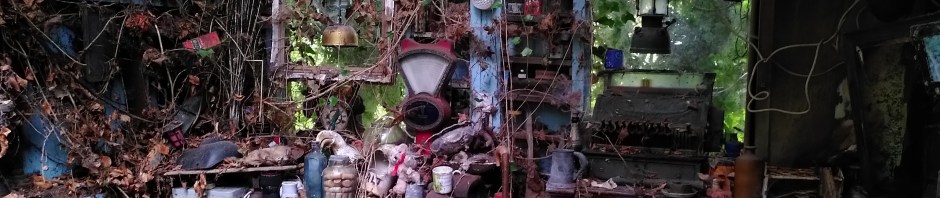
Header image taken in the back garden of Jessie M King’s and E. A. Taylor’s house, 38 High St, Kirkcudbright.
Share this:
About Stephen Shellard
I am a retired College lecturer, having worked originally in supported programmes but latterly having taught social science subjects, Psychology and Politics, though my degree was in Sociology. I am from Newry in Northern Ireland, but now live in Dumfries in South West Scotland. https://carruchan.wordpress.com/about/