Two Tales from Wigtown
In his book, Against Identity, Alexander Douglas quotes Upton Sinclair: “It is difficult to get a man to understand something, when his salary depends upon his not understanding it.”
Douglas goes on to say: “Well, try getting somebody to understand something when their identity depends upon not understanding it. If they do not even realize that they are protecting their identity, their mind will confabulate prolifically to explain their resistance to understanding. It will tell itself a story, for example that the source of the proffered understanding is an unreliable creep, a dangerous manipulator.”
Douglas’s book is not an attack on identity per se, but rather questions the significance it has for many of us. We live in a world where we are encouraged at every turn to “discover our true self – to be all we can be – to live authentically.” There is an assumption at the centre of these exhortations that this identity we seek to uncover is the very core of our being and is deserving of discovery, respect and expression.
In the United Kingdom there is a current fascination with the idea of being British. The Labour Party’s recent conference saw the delegates clutching and waving a variety of the nation’s flags, a preponderance of Union Jacks but also Welsh and Scottish flags. It was a fairly blatant attempt to reclaim these expressions of identity from Reform and other factions on the extreme right of our politics. As a member of the Labour Party I find myself somewhat squeamish in the face of this flag-waving. Yes, I was born in Northern Ireland and so, I am de facto, British. Somewhere in a drawer I have an out of date British Passport. But as for “feeling British,” what does that even mean? Does my heart swell at the playing of Jerusalem? I will admit some fondness for the hymn tune to which Blake’s great poem is set and for the sentiments expressed in its lines. But such emotion as this raises in me has nothing to do with ‘feeling British’.
Perhaps though, I feel Irish. I have sometimes considered applying for an Irish passport, to which I would be entitled. I’ve never got around to it but may yet do so. I have strong family and sentimental connections which cross the Irish border and which, in my mind, seem to encompass the entire island. I will admit to a surge of emotion on hearing reference to the singing of “Galway Bay” when Fairy Tale of New York rings out once again in the supermarket as Christmas time approaches. I like to see Irish teams win in sport. It pleases me when people first notice that I still speak with an Irish accent. I might say, with some honesty, that I love Ireland.
But then I also love Dumfries and Galloway where I have lived for the past forty years. So to claim Irish as an identity seems just as bogus as to claim Britishness.
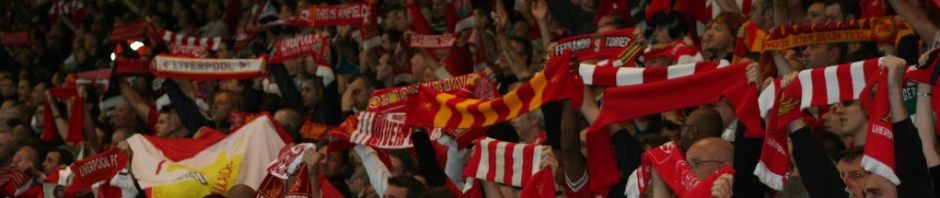
When I was twelve or thirteen I became an ardent supporter of Liverpool F.C. The precise reasons for this need not concern us, though it may have had something to do with the fact that the popular choice in Newry High School in the late 1960s was to support Manchester United. George Best was working his magic for them at the time. However, despite my admiration for Best, I clearly wanted to distinguish myself and with guidance from Nicholas Pipkin, an exile to Northern Ireland from the Wirrel, I was persuaded of the greatness of Bill Shankly, of the near sanctity of Ian St. John and of the magnificent camaraderie one might experience standing in the choir at the Spion Kop end of Anfield football ground.
Looking back I’d say that being a Liverpool supporter became part of my identity, sharpened no doubt by theatrical banter that took place following the drama of the results each Saturday afternoon.
A football identity such as this follows many through their entire lives. There were stories of Liverpool supporters who, on their demise, were buried in the team colours. Living now in Scotland I am regularly reminded that substantial sections of the populace have Rangers or Celtic written right through the core of their being.
And yet my own attachment to Liverpool F.C. has fallen away. I continue to keep half an eye on football results. I was lucky enough to be present when Queen of the South defeated Aberdeen by four goals to three to reach the final of the Scottish Cup in 2008. In the company of most of the population of Dumfries, I shared the thrill of watching them in the final, losing only by a single goal to Rangers. But in truth I pay very little attention now to what goes on in football and have tired of the predictability of the same teams repeatedly contesting the top honours. So much for my identity as a supporter of Liverpool F.C.
I heard Alexander Douglas interviewed by journalist and writer Stuart Kelly on the subject of his book at the recent Wigtown Book Festival. The full title says much about its central argument. Against Identity: The Wisdom of Escaping the Self. Douglas draws out his theme from the writings of three individuals: the Chinese sage Zhuangzi, who lived around the 4th century BCE, the 17th-century Dutch philosopher Benedict Spinoza, and the 20th-century historian-critic René Girard.
I’ll risk summarising. Identity is a social construct. It arises from conscious or unconscious mimetic behaviour. This mimetic behaviour is an expression of admiration of those encountered. Once an identity has become established the natural impulse for an individual is to become a source of admiration and identity for others.
As the title implies, identities stick. They are like a comfort blanket, a source of security. However they also function as a shackle on our further development. Though it may be desirable, cutting oneself adrift from an identity is not easily done.
I could not help thinking about these ideas when the following week, also as part of the Wigtown book festival, the same Stuart Kelly interviewed Jenny Lindsay on her book Hounded. I had never heard of Jenny Lindsay, but was familiar with at least some of the elements of her story. A successful performance poet, she became embroiled in 2019 in the arguments over gender identity. She comes to this controversy from a gender critical perspective which holds that being a woman is a biologically defined category. Gender identity activists, by contrast, argue that people should be accepted as the gender they believe themselves to be, regardless of their biology.
This self-identification is not particularly problematic in itself. However, gender identity activists insist that someone self-identifying as a woman is entitled to access spaces hitherto reserved for women on the basis of biologically defined gender. A trans woman, according to this reasoning, should be entitled to use women’s toilets, to participate in women’s sport or to be employed as a counsellor in services offering support to women who have been raped or physically abused by men.
The story that Jenny Lindsay tells is that she and many other women who have spoken out from a feminist and gender critical point of view have been systematically abused on-line and in person, subjected to extremely hostile picketing of their public appearances and in many cases obliged to resign their jobs for allegedly using non-inclusive language. All this for merely expressing a point of view. The gender-critical critique itself, regardless of how it is framed, is read as hostile, abusive, and harmful to transgender women.
I had heard of others who have been on the receiving end of such “houndings,” in particular J.K. Rowling, Germaine Greer and Joanna Cherry QC. I have felt puzzled by the extremity of the language directed at them. I have felt sympathy for the argument they make.
I am sure that not all gender activists are implicated in the more extreme end of hounding behaviour, but there does seem to be a lot of it about. I could not but admire Jenny Lindsay for the courage she shows in telling her story.
Endnotes
Alexander Douglas – Against Identity
Jenny Lindsay – Hounded
Header Image, open source, cropped from The Kop Closeup

 Carruchan
Questioning Identity
Two Tales from Wigtown
In his book, Against Identity, Alexander Douglas quotes Upton Sinclair: “It is difficult to get a man to understand something, when his salary depends upon his not understanding it.”
Douglas goes on to say: “Well, try getting somebody to understand something when their identity depends upon not understanding it. If they do not even realize that they are protecting their identity, their mind will confabulate prolifically to explain their resistance to understanding. It will tell itself a story, for example that the source of the proffered understanding is an unreliable creep, a dangerous manipulator.”
Douglas’s book is not an attack on identity per se, but rather questions the significance it has for many of us. We live in a world where we are encouraged at every turn to “discover our true self – to be all we can be – to live authentically.” There is an assumption at the centre of these exhortations that this identity we seek to uncover is the very core of our being and is deserving of discovery, respect and expression.
In the United Kingdom there is a current fascination with the idea of being British. The Labour Party’s recent conference saw the delegates clutching and waving a variety of the nation’s flags, a preponderance of Union Jacks but also Welsh and Scottish flags. It was a fairly blatant attempt to reclaim these expressions of identity from Reform and other factions on the extreme right of our politics. As a member of the Labour Party I find myself somewhat squeamish in the face of this flag-waving. Yes, I was born in Northern Ireland and so, I am de facto, British. Somewhere in a drawer I have an out of date British Passport. But as for “feeling British,” what does that even mean? Does my heart swell at the playing of Jerusalem? I will admit some fondness for the hymn tune to which Blake’s great poem is set and for the sentiments expressed in its lines. But such emotion as this raises in me has nothing to do with ‘feeling British’.
Perhaps though, I feel Irish. I have sometimes considered applying for an Irish passport, to which I would be entitled. I’ve never got around to it but may yet do so. I have strong family and sentimental connections which cross the Irish border and which, in my mind, seem to encompass the entire island. I will admit to a surge of emotion on hearing reference to the singing of “Galway Bay” when Fairy Tale of New York rings out once again in the supermarket as Christmas time approaches. I like to see Irish teams win in sport. It pleases me when people first notice that I still speak with an Irish accent. I might say, with some honesty, that I love Ireland.
But then I also love Dumfries and Galloway where I have lived for the past forty years. So to claim Irish as an identity seems just as bogus as to claim Britishness.
When I was twelve or thirteen I became an ardent supporter of Liverpool F.C. The precise reasons for this need not concern us, though it may have had something to do with the fact that the popular choice in Newry High School in the late 1960s was to support Manchester United. George Best was working his magic for them at the time. However, despite my admiration for Best, I clearly wanted to distinguish myself and with guidance from Nicholas Pipkin, an exile to Northern Ireland from the Wirrel, I was persuaded of the greatness of Bill Shankly, of the near sanctity of Ian St. John and of the magnificent camaraderie one might experience standing in the choir at the Spion Kop end of Anfield football ground.
Looking back I’d say that being a Liverpool supporter became part of my identity, sharpened no doubt by theatrical banter that took place following the drama of the results each Saturday afternoon.
A football identity such as this follows many through their entire lives. There were stories of Liverpool supporters who, on their demise, were buried in the team colours. Living now in Scotland I am regularly reminded that substantial sections of the populace have Rangers or Celtic written right through the core of their being.
And yet my own attachment to Liverpool F.C. has fallen away. I continue to keep half an eye on football results. I was lucky enough to be present when Queen of the South defeated Aberdeen by four goals to three to reach the final of the Scottish Cup in 2008. In the company of most of the population of Dumfries, I shared the thrill of watching them in the final, losing only by a single goal to Rangers. But in truth I pay very little attention now to what goes on in football and have tired of the predictability of the same teams repeatedly contesting the top honours. So much for my identity as a supporter of Liverpool F.C.
I heard Alexander Douglas interviewed by journalist and writer Stuart Kelly on the subject of his book at the recent Wigtown Book Festival. The full title says much about its central argument. Against Identity: The Wisdom of Escaping the Self. Douglas draws out his theme from the writings of three individuals: the Chinese sage Zhuangzi, who lived around the 4th century BCE, the 17th-century Dutch philosopher Benedict Spinoza, and the 20th-century historian-critic René Girard.
I’ll risk summarising. Identity is a social construct. It arises from conscious or unconscious mimetic behaviour. This mimetic behaviour is an expression of admiration of those encountered. Once an identity has become established the natural impulse for an individual is to become a source of admiration and identity for others.
As the title implies, identities stick. They are like a comfort blanket, a source of security. However they also function as a shackle on our further development. Though it may be desirable, cutting oneself adrift from an identity is not easily done.
I could not help thinking about these ideas when the following week, also as part of the Wigtown book festival, the same Stuart Kelly interviewed Jenny Lindsay on her book Hounded. I had never heard of Jenny Lindsay, but was familiar with at least some of the elements of her story. A successful performance poet, she became embroiled in 2019 in the arguments over gender identity. She comes to this controversy from a gender critical perspective which holds that being a woman is a biologically defined category. Gender identity activists, by contrast, argue that people should be accepted as the gender they believe themselves to be, regardless of their biology.
This self-identification is not particularly problematic in itself. However, gender identity activists insist that someone self-identifying as a woman is entitled to access spaces hitherto reserved for women on the basis of biologically defined gender. A trans woman, according to this reasoning, should be entitled to use women’s toilets, to participate in women’s sport or to be employed as a counsellor in services offering support to women who have been raped or physically abused by men.
The story that Jenny Lindsay tells is that she and many other women who have spoken out from a feminist and gender critical point of view have been systematically abused on-line and in person, subjected to extremely hostile picketing of their public appearances and in many cases obliged to resign their jobs for allegedly using non-inclusive language. All this for merely expressing a point of view. The gender-critical critique itself, regardless of how it is framed, is read as hostile, abusive, and harmful to transgender women.
I had heard of others who have been on the receiving end of such “houndings,” in particular J.K. Rowling, Germaine Greer and Joanna Cherry QC. I have felt puzzled by the extremity of the language directed at them. I have felt sympathy for the argument they make.
I am sure that not all gender activists are implicated in the more extreme end of hounding behaviour, but there does seem to be a lot of it about. I could not but admire Jenny Lindsay for the courage she shows in telling her story.
Endnotes
Alexander Douglas – Against Identity
Jenny Lindsay – Hounded
Header Image, open source, cropped from The Kop Closeup
Share this:
About Stephen Shellard
I am a retired College lecturer, having worked originally in supported programmes but latterly having taught social science subjects, Psychology and Politics, though my degree was in Sociology. I am from Newry in Northern Ireland, but now live in Dumfries in South West Scotland. https://carruchan.wordpress.com/about/