
Political Parties. Why we need more of them—But not too many!
There was a time when, despite my coming of age journey in the 1960s through the First Newry cubs, boy scouts and senior scouts, I considered myself an unquenchable individualist and, to all intents and purposes, unclubbable.
In the early 1970s, as a student at Reading University, I circled round the rich pickings of left wing politics. I enjoyed the exchange of ideas and arguments between the many factions, but could not align with any of them. They were too inflexible, too prone to gestural extremes. Most importantly, from my point of view, where Northern Ireland was concerned, they were too ready to buy into a perspective that unceremoniously wrote off the interests of the Unionist community in which I had grown up.
Somewhere beyond the periphery of that ferment of University politics, was the Labour Party. By the rhetorical standards of the prevailing debate in University politics, they seemed pedestrian and irrelevant and, other than to note their benighted existence, I gave them little thought.
As it happens the Labour Party were in government from 1974 through to 1979. Political parties are always easier to support when in opposition. In government they are inevitably dealing with a realpolitik which involves compromise, a certain amount of muddling through, a gaff or two and the occasional change of course (or U turn, as we must now call such willingness to rethink a policy).
It will come as no surprise that I continued to eschew the Labour Party throughout that decade. And yet, my recollection of the 1970s and Labour’s governance during that period seems a great deal sunnier than the stain which has subsequently spread across our collective memory of the decade. The particularly murky lens through which the period is viewed no doubt owes something to the final throes of the Callaghan government and the so-called “Winter of Discontent”—1978-1979.
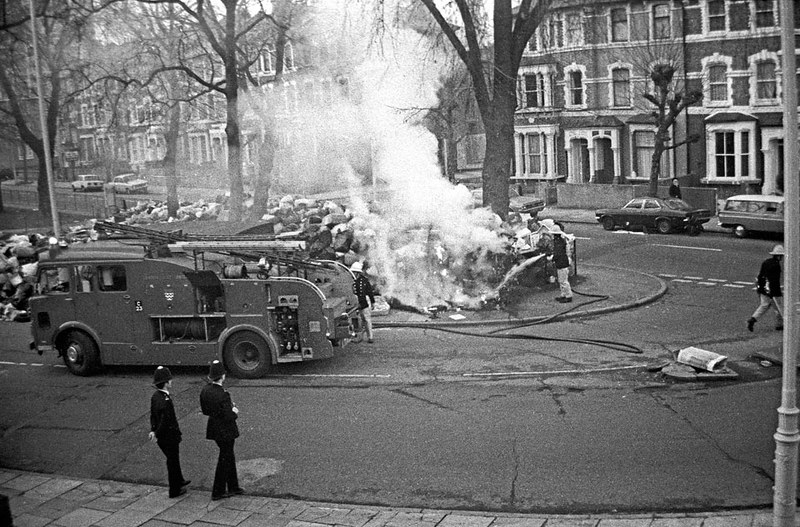
There was indeed an exceptionally cold winter that year. This coincided with a period of widespread industrial turmoil. Accumulations of rubbish arising from the strike of refuse collectors have, over the succeeding decades, provided helpful imagery for those who wish to characterise the period as the last throes of a failed socialist experiment. I was myself unemployed at the time, but somehow life didn’t seem that bad.
It was the rise of Margaret Thatcher which prompted me to reconsider my dilettante alignment on the left of British politics. It is not my intention here to litigate the rights and wrongs of Thatcherite politics, but rather to observe that it was in that context that I began—very gradually it should be said—to think that, just maybe, the Labour Party should be my political home. Sometime in about the middle of the 1980’s I caved in and became a member. And that is what I have remained in the passing years, through thick and thin.
The extent of my active participation in Labour Party politics over this period has waxed and waned a good deal. Membership of political parties is like that. Some people devote their existence to the party, whilst others are members in name only. I have never been an enthusiast for the regular meetings which form the basis of party activity, though I do try to engage. Still less have I felt inclined to become an office bearer within the party or an active politician. Mostly my role has been to pay my dues and, in the run up to elections, to offer my services to the Labour candidate by delivering leaflets or canvassing. I should not overlook the social dimension to membership and, over the years, I have made good friends in the party though I can equally say that I have friends who have taken a different political course or declined to align themselves with any party.
Which brings me to the present. Keir Starmer’s generally flat-footed leadership, and currently his embarrassment at having given a top job to that talented, mercurial—and it would now appear—terminally untrustworthy dissembler, Peter Mandelson. Perhaps this is the moment to leave. But to what other party should I give my allegiance?
Where the environment is concerned, I think the Green Party sets an important standard. But for the time being they remain, in my estimation, a pressure group with the luxury of being able to indulge in gestural politics without any real prospect of becoming a governing party. That may change.
I live in Scotland, where the SNP offer a tempting alternative to Labour. I find myself in reasonable alignment with much of their policy and indeed with much of their criticism of the Labour Government. However their raison d’etre is to gain independence and my own commitment is to argue for reform of the UK political system—an objective that is, in fact, anathema to the SNP. They have no serious interest in the reform or success of UK politics. It would destroy them.
What then of the Liberal Democrats? I can’t honestly say that I find Ed Davey’s zip-wire-parachute-jumping approach to grabbing attention particularly appealing. And yet I very much agree with their longstanding commitment to electoral reform. I believe their policy on the environment is credible. Their current economic policies may even be somewhat to the left of Rachel Reeves cautious fiscal positioning. However, the electoral system has, for now, marginalized their chances of forming a government. And yet it is quite possible that, given the peculiar unpredictability of our current politics, a Labour-Lib Dem coalition could turn out to be the basis of a radical reforming government. That is an outcome I might even hope for given the current government’s dismal commitment to constitutional reforms.
But let’s not forget the Conservative Party. I have staunchly opposed them over several decades and believe they have done much damage to the country. Yet even I would admit that, had Rory Stewart not taken his tie off in the 2019 Tory leadership debate and instead found a way to knock Boris Johnson from his ridiculous perch, then the country, indeed perhaps even the World, would now be in a much better place. [1] But the real problem was not Rory’s failure to keep his tie on, but the lack of solid support within the Conservative Party for his candidacy.
This Labour Government has presented many challenges to members who campaigned enthusiastically for their election. I share these frustrations but have chosen to remain a party member. I think that has a great deal to do with my faith in the qualities and aspirations of the membership. It is the membership which persuades me that the Labour project continues to be worthy of my support. But my loyalty to the party also has something to do with my belief that political parties and their membership have, more generally, an important role to play in our democracy.
Members choose candidates to stand for election. They choose the party leader. They establish the political culture from which policies and manifestos emerge. This framing of contesting policies by the political parties at elections offers citizens a manageable set of options on the basis of which those with a more passing interest in politics may make wise choices.
This said, it is impossible to ignore the disproportionate and unfair representation of political parties in the UK Parliament. We need electoral reform in order to bring more parties into contention. This would certainly engage many individuals discontent with the old order and the sclerotic domination of two parties. I am an advocate of such reform, as is the Labour Party membership. I can also see, however, that reform risks splitting parties into factions and, ultimately, confusing the electoral offer by fomenting an excess of choice.
Such dissenting splinters are liable to be little more than pressure groups. Israel is the most obvious recent example of the problems this can create. Such factions have little concern for a balanced political programme but rather are driven by zealous interest in single or limited issues. The anti-abortion party. The anti-migrant party. Well, in truth, we already have one of those.
Elsewhere on this blog I have discussed ways of preventing these kinds of splinters proliferating and capturing political debate. [2] [3]
But if we want to encourage broader representation, we must also address the toxic issue of party funding. That would be controversial, I know. But think about it: an end to the Labour Party’s dependence on funding from Trade Unions; an end to the purchase of political influence by the rich and powerful. The potential for parties to flourish with a focus on policy rather than financial survival.
Given the significant part political parties play in our politics, what we really need is a Citizens Assembly to consider their role and to make recommendations accordingly. The result might be a party system capable of drawing in the politically unclubbable. That, in due course, could lead to a less polarised and more productive national discourse.
Endnotes
[1] Rory Stewart removes his tie in the 2019 Conservative leadership debate.
[2] How Many Political Parties do we Really Need? This article suggests one approach to managing the number of political parties in our politics.
[3] Sunlit uplands: a vision for the renewal of electoral and party politics A longer discussion on the subject of electoral reform, again offering a suggestion as to how the number of political partie
Header Unclubbable image based on this image from Pixabay.

 Carruchan
A reflective and enjoyable piece Stephen, which made a splendid pipe opener to the political events of the following week!