Art, Science and the Long View of our Carbon Future
You may have noticed the recent news that China’s emissions of CO2 have “been flat or falling for 18 months”. [1] Good news surely? I was prompted to suggest to some climate aware friends that we were approaching a benign tipping point with respect to our transition to net zero carbon emissions. China’s rapid adoption of electric vehicles and installation of renewable energy technology has been extraordinary. Surely now, whatever Donald Trump may have to say on the matter, the floodgates of renewable installation must burst open on an international scale and cascade us all to a net zero future?
“Well actually,No!”, said Jack. “In India, I think a huge issue is concrete & cement technology. As folk get richer, they want more modern buildings. China has built loads already – arguably too many, given the state of their real estate market – but concrete and cement is some of the most carbon intensive product. I worked on India for a bit and there were some efforts to find a less carbon intensive cement but not enough. Not sexy at all, but more carbon friendly cement is where it’s at for me!”
To tell the truth, that was a bit of a slap in the face for my Pollyannaish approach to the matter. But with my newly sharpened critical faculties I pointed out to Jack that even “carbon friendly cement” may not provide a simple answer. Who is going to invest in an untested new material given what we are experiencing with the failure of RAAC concrete in so many buildings in the UK? [2]
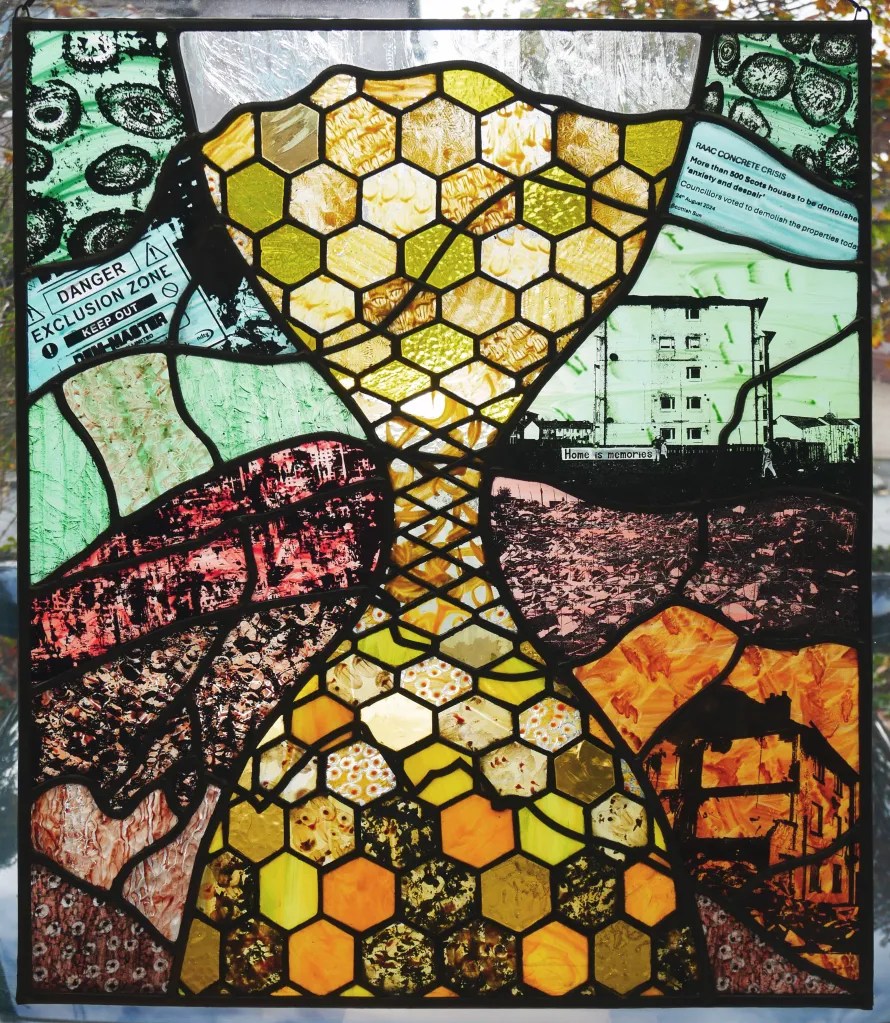
I thought about this exchange when I went along to Dumfries Climate Kitchen where the opening presentation was led by locally based visual artist and writer Andy Brooke. Andy was talking about his most recent stained glass panel, The Concrete Window.
My exposure to stained glass art in the past was mostly in the form of religiously inspired work firmly located in Church buildings. Andy, it became clear, is committed to embedding a message of a different kind in his work, a message concerning the destruction wrought by our obsession with building in concrete.
His imagery is taken directly from the subject matter but not always in ways that we might anticipate. As Andy explains on his blog: “It is not a beautiful window in the expected sense; there is ugliness portrayed in some imagery as well as some of the colours and patterns created.” [3]
Running throughThe Concrete Window are profiles of Scottish mountain ranges which have been plundered for the materials to make concrete. These include our own coastal sentinels, Criffel and Knockendoch, small as Scottish mountains go, but rising dramatically from the Solway.
The panel draws attention to demolished concrete structures and structures threatened with demolition in Lochside, Dumfries. Little thought has been given to repurposing or upgrading these structures. The cycle of build in concrete and then demolish to rebuild, has become depressingly common. It is an enormously wasteful strategy, but often cheered on by those who, with some justice, have come to hate neglected structures thrown up in a previous era of cheap, utilitarian construction. Indeed at least one of those present at the event recalled with some feeling that he had grown up in a poorly constructed prefabricated concrete house in Dumfries, which could not possibly have been redeemed by any modernising refurbishment. It deserved only to be knocked down.
The conversation following Andy’s introduction of his work touched on other possible ways of extending or renewing the built environment. What about timber frame construction? [4] What about bricks? It would seem that many of our bricks are now produced abroad, with little consideration for the pay and conditions of those labouring in the industry. This seems extraordinary given that there is a rich history of brick manufacture in the United Kingdom.[5]
Where concrete is concerned, perhaps there should be more thought given to reusing, repurposing or otherwise upgrading existing concrete buildings? We all know about the tragedy of Grenfell Tower. The business imperative of providing a cheap insulation retrofit almost certainly sealed Grenfell’s fate. But there are alternative ways of retrofitting insulation and conscientious regulation could ensure the job is done properly. No doubt, were sufficient attention given to the matter, new products and techniques could be brought forward to do the job better. It is too easy to just knock a building down and rebuild. Perhaps there should be a financial penalty for doing just that, which would make refurbishment a more viable option.
Andy Brooke’s Concrete Window is a striking image in its own right, full of contrasting colour and complex structural elements. Yes, it is marked by discordant shapes, but its central hourglass is an elegant reminder that time for changing our ways is not unlimited. Sand, an ingredient of glass and concrete is literally and metaphorically, running out. There is, it is fair to say, a great deal of sand in the world but, as Andy explained, only a tiny fraction of it is the sharp sand required for making concrete. Desert sand is too smooth and regular to do the job. [6] [7]
The themes which are woven into The Concrete Window do not immediately grab your attention. It is only when you draw closer that details become clear. It is these details which provoke the very questions we must answer before the sands have finally run through the glass.
Endnotes
- The Concrete Window is currently on display at The Stove Network & Café, 100 High Street, Dumfries
- Andy Brooke’s blog may be viewed at: https://andyljbrooke.com/
- For more information on the Climate Kitchen, please visit https://climatekitchen.co.uk/
- Thanks to Jack for his contribution to the discussion – That’s Jack McConnell, Labour Candidate for Galloway in the forthcoming Holyrood election.
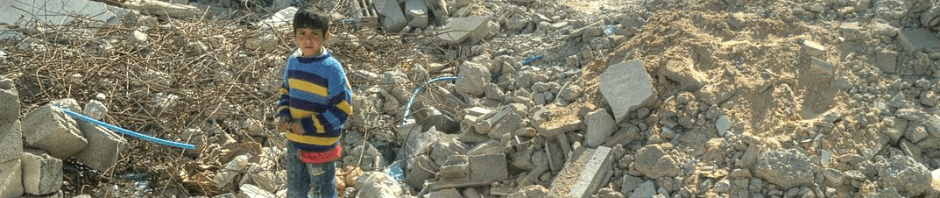
- Header image cropped from Destruction of Gaza, photographer, gloucester2gaza original image available from Wikimedia
- Reference 4 was added on 26th February, following the initial publication of the essay on 22nd February.
References
[1] Carbon Brief: Analysis: China’s CO2 emissions have now been flat or falling for 18 months
[2] BBC News What is RAAC concrete and why is it a safety risk?
[3] Blog post: The Sands of Time are Running Out In this blog post, Andy talks in detail about the ideas embedded in The Concrete Window
[4] BBC Business Daily How modular homes are rebuilding Portugal’s ruins This short programme provides an excellent introduction to the new techniques being employed to create factory built modular wooden buildings, using laminated wood and entirely avoiding the use of steel and concrete construction.
[5] Scotland’s Brick and Tile Manufacturing Industry
[6] BBC News: Why the World is Running out of Sand
[7] Wickes – A brief explanation of the importance of sharp sand in making concrete.

 Carruchan

Pingback: FEBRUARY: Andy Brooke stained glass window artwork launch + environmental board games demo session – Dumfries Climate Kitchen