I may not have been paying much attention in my school English literature lessons, but these lines from The Rime of the Ancient Mariner, seemed suddenly to resonate with a number of themes which have been capturing my recent extracurricular attention. In short: the Channel 4 documentary Dirty Business; the publication of a book—The Waterlands—by Dumfries-based naturalist, Stephen Rutt, and the existential jeopardy of the Gulf states, thrown into relief by Iran’s threat to attack desalination plants. The US attack on Iran was initially predicated on an alleged imminent threat of attack by a beleaguered autocracy. The consequent war has devolved into a struggle to control the supply of oil. And now it becomes clear that it’s not just about oil; it may also be about water. Donald Trump has underestimated the ability of his weakened and cornered enemy to lash out in ways that have unanticipated implications for the wider world. His principal cheerleader and influencer, Benjamin Netanyahu, who is actively extending the conflict, seems criminally unconcerned about the possible consequences of all this destruction.
Revisiting Coleridge’s epic poem I note the two verses which follow those well known lines:
The very deep did rot: O Christ!
That ever this should be!
Yea, slimy things did crawl with legs
Upon the slimy sea.
About, about, in reel and rout
The death-fires danced at night;
The water, like a witch’s oils,
Burnt green, and blue and white.
What can he have been thinking? Opium, one suspects, may have had some part to play in the matter.
Wikipedia has a page entirely devoted to the topic of Water Conflict. It is not a complete surprise to find that “the Middle East has only 1% of the world’s fresh water shared among 5% of the world’s population.”[1] Needless to say, if those Gulf State desalination plants are destroyed the populations depending on them will not revert to living in tents in the desert. Many who may be displaced are likely to find their way to countries like the United Kingdom where water resources, however poorly managed, are definitely not in short supply. It is an odd paradox that those who seem most relaxed about destroying the means to life in the Middle East are also those most exercised by the imagined threat migration poses to their culture.
Poor management of our own water resources takes me to Channel 4’s docudrama, Dirty Business. As a media phenomenon it has yet to capture the public imagination in the way that the drama about the postal scandal, Mr Bates vs The Post Office, was so successful in doing. As portrayed, the two central characters in Dirty Business, retired police officer Ash Smith and Professor of Computational Biology Peter Hammond, never sought attention. They are not particularly charismatic. But their determination and ingenuity in unravelling and exposing what is really going on with the routine discharge of untreated wastewater into English rivers, is heroic.
In the course of their investigations they encounter institutional and regulatory obfuscation reminiscent of the bureaucratic nightmare that traps K, in Franz Kafka’s, The Castle. In this modern version of the story, Ash and Hammond painstakingly reveal an under-resourced regulator, ineffectual in its dealings with the managers entrusted with control of the privatised water companies of England and Wales.
It is difficult not to see these managers as anything other than dubious in their character. Drawn by the lure of large salaries and bonuses awarded by shareholders they will, no doubt, have said at interview, whatever may have been necessary to secure their lucrative positions. Thus primed for the task, they prove themselves unable or unwilling to see what is blindingly obvious to everyone else: the dysfunctionality and corruption of the systems they have put in place. In the meantime, engineers servicing water treatment infrastructure wade knee deep in shit. Support staff still fortunate enough to find themselves in a job, look on in disbelief. [2]
Stephen Rutt’s interest in water goes a good deal deeper into the subject than either of these two dystopian stories. As a little boy growing up in Cambridge, he fell in a river in pursuit of a riverbank flower, and nearly drowned. Despite this trauma, in the interim he has developed a passion for ornithology and become an acclaimed and award winning writer. He now lives in Dumfries. His latest book, The Waterlands, explores the subject of water in all of its complex manifestations throughout the natural world.
The narrative follows the journey of a raindrop from source to sea. Raindrops fall — perhaps on a hilltop, a bog, or a woodland or, more prosaically, in a puddle. Regardless, raindrops find their way through streams, rivers and lakes to the sea. At every phase of this journey some of that water evaporates and mingles with evaporated water from the seas and oceans of the world. All this accumulated airborne moisture then cycles back to be rained down on some other terrain where water is equally an integral part of all of the living things on which it falls.
The Waterlands was published on Thursday 26th March of this year. I was fortunate to be in attendance at its launch in Waterstones, Dumfries. The author read from his book, spoke about its genesis, and answered questions from a packed audience.
In order to write the book, he explained, he had been obliged to move well beyond his core interest in ornithology and has set himself on course to be a botanist and a chemist.
I haven’t finished reading The Waterlands yet but I’ve got far enough into it to confirm the authenticity of the many excellent reviews. I think Roger Morgan-Grenville, best summarises my own feeling thus far: “A gripping observation of our most important element, at once informative, balanced, angry, hopeful and lyrical.”
When he spoke at Waterstones, Stephen Rutt was keen to explain the source of his optimism. Using the River Clyde as his example he reminded us that 19th Century industrialisation had exploited and destroyed this great West of Scotland waterway. Yet the situation has been recovered. Salmon once again spawn in the headwaters of the river. “If we have done this once” he told us, “We can do it again.”
This optimism however should not be confused with complacency. In his introduction to The Waterlands Stephen Rutt sounds the alarm: “Water, nurturer of civilisations, is becoming an increasingly contested thing: threatening in both its surplus and deficit—and quality.” He then goes on to quote Ismail Serageldin, a former president of the World Bank. “If the twentieth century’s wars were about oil, the twenty-first’s will be about water.”
Endnotes
Stephen Rutt The Waterlands
Stephen Rutt Blog
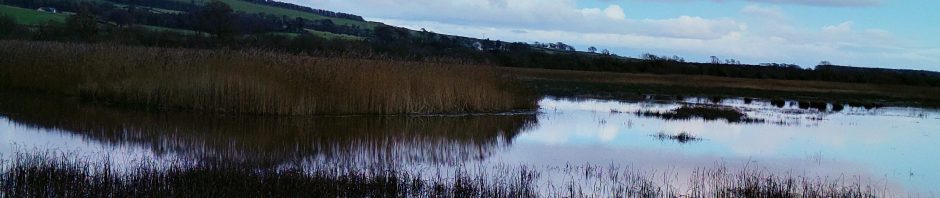
Featured Image: RSPB Mersehead, Southwick, Dumfries Picture SPS
References
[1] Wikipedia – Water Conflict
[2] Channel Four Dirty Business

 Carruchan
Water, Water Every Where, Nor any drop to drink
I may not have been paying much attention in my school English literature lessons, but these lines from The Rime of the Ancient Mariner, seemed suddenly to resonate with a number of themes which have been capturing my recent extracurricular attention. In short: the Channel 4 documentary Dirty Business; the publication of a book—The Waterlands—by Dumfries-based naturalist, Stephen Rutt, and the existential jeopardy of the Gulf states, thrown into relief by Iran’s threat to attack desalination plants. The US attack on Iran was initially predicated on an alleged imminent threat of attack by a beleaguered autocracy. The consequent war has devolved into a struggle to control the supply of oil. And now it becomes clear that it’s not just about oil; it may also be about water. Donald Trump has underestimated the ability of his weakened and cornered enemy to lash out in ways that have unanticipated implications for the wider world. His principal cheerleader and influencer, Benjamin Netanyahu, who is actively extending the conflict, seems criminally unconcerned about the possible consequences of all this destruction.
Revisiting Coleridge’s epic poem I note the two verses which follow those well known lines:
What can he have been thinking? Opium, one suspects, may have had some part to play in the matter.
Wikipedia has a page entirely devoted to the topic of Water Conflict. It is not a complete surprise to find that “the Middle East has only 1% of the world’s fresh water shared among 5% of the world’s population.”[1] Needless to say, if those Gulf State desalination plants are destroyed the populations depending on them will not revert to living in tents in the desert. Many who may be displaced are likely to find their way to countries like the United Kingdom where water resources, however poorly managed, are definitely not in short supply. It is an odd paradox that those who seem most relaxed about destroying the means to life in the Middle East are also those most exercised by the imagined threat migration poses to their culture.
Poor management of our own water resources takes me to Channel 4’s docudrama, Dirty Business. As a media phenomenon it has yet to capture the public imagination in the way that the drama about the postal scandal, Mr Bates vs The Post Office, was so successful in doing. As portrayed, the two central characters in Dirty Business, retired police officer Ash Smith and Professor of Computational Biology Peter Hammond, never sought attention. They are not particularly charismatic. But their determination and ingenuity in unravelling and exposing what is really going on with the routine discharge of untreated wastewater into English rivers, is heroic.
In the course of their investigations they encounter institutional and regulatory obfuscation reminiscent of the bureaucratic nightmare that traps K, in Franz Kafka’s, The Castle. In this modern version of the story, Ash and Hammond painstakingly reveal an under-resourced regulator, ineffectual in its dealings with the managers entrusted with control of the privatised water companies of England and Wales.
It is difficult not to see these managers as anything other than dubious in their character. Drawn by the lure of large salaries and bonuses awarded by shareholders they will, no doubt, have said at interview, whatever may have been necessary to secure their lucrative positions. Thus primed for the task, they prove themselves unable or unwilling to see what is blindingly obvious to everyone else: the dysfunctionality and corruption of the systems they have put in place. In the meantime, engineers servicing water treatment infrastructure wade knee deep in shit. Support staff still fortunate enough to find themselves in a job, look on in disbelief. [2]
Stephen Rutt’s interest in water goes a good deal deeper into the subject than either of these two dystopian stories. As a little boy growing up in Cambridge, he fell in a river in pursuit of a riverbank flower, and nearly drowned. Despite this trauma, in the interim he has developed a passion for ornithology and become an acclaimed and award winning writer. He now lives in Dumfries. His latest book, The Waterlands, explores the subject of water in all of its complex manifestations throughout the natural world.
The narrative follows the journey of a raindrop from source to sea. Raindrops fall — perhaps on a hilltop, a bog, or a woodland or, more prosaically, in a puddle. Regardless, raindrops find their way through streams, rivers and lakes to the sea. At every phase of this journey some of that water evaporates and mingles with evaporated water from the seas and oceans of the world. All this accumulated airborne moisture then cycles back to be rained down on some other terrain where water is equally an integral part of all of the living things on which it falls.
The Waterlands was published on Thursday 26th March of this year. I was fortunate to be in attendance at its launch in Waterstones, Dumfries. The author read from his book, spoke about its genesis, and answered questions from a packed audience.
In order to write the book, he explained, he had been obliged to move well beyond his core interest in ornithology and has set himself on course to be a botanist and a chemist.
I haven’t finished reading The Waterlands yet but I’ve got far enough into it to confirm the authenticity of the many excellent reviews. I think Roger Morgan-Grenville, best summarises my own feeling thus far: “A gripping observation of our most important element, at once informative, balanced, angry, hopeful and lyrical.”
When he spoke at Waterstones, Stephen Rutt was keen to explain the source of his optimism. Using the River Clyde as his example he reminded us that 19th Century industrialisation had exploited and destroyed this great West of Scotland waterway. Yet the situation has been recovered. Salmon once again spawn in the headwaters of the river. “If we have done this once” he told us, “We can do it again.”
This optimism however should not be confused with complacency. In his introduction to The Waterlands Stephen Rutt sounds the alarm: “Water, nurturer of civilisations, is becoming an increasingly contested thing: threatening in both its surplus and deficit—and quality.” He then goes on to quote Ismail Serageldin, a former president of the World Bank. “If the twentieth century’s wars were about oil, the twenty-first’s will be about water.”
Endnotes
Stephen Rutt The Waterlands
Stephen Rutt Blog
Featured Image: RSPB Mersehead, Southwick, Dumfries Picture SPS
References
[1] Wikipedia – Water Conflict
[2] Channel Four Dirty Business
Share this:
About Stephen Shellard
I am a retired College lecturer, having worked originally in supported programmes but latterly having taught social science subjects, Psychology and Politics, though my degree was in Sociology. I am from Newry in Northern Ireland, but now live in Dumfries in South West Scotland. https://carruchan.wordpress.com/about/