Basic income – an important idea, recommended in particular by Paul Mason. This Finnish experiment will be well worth watching

Two thousand jobless Finns are being given a basic income instead of welfare.
BBC.CO.UK|BY BBC NEWS
Basic income – an important idea, recommended in particular by Paul Mason. This Finnish experiment will be well worth watching
Revised 20th March 2016
Democratic balancing – a mechanism for creating a democratic balance between the European parliament and the member state parliaments of the European Union which would allow, in certain circumstances, an opt out from legislation. The decisive factor permitting opt out would be whether opposition to the legislation in the member state Parliament was stronger than the support for the legislation coming from the European Parliament.
Where support for legislation at the European Parliament level was strong – for example 70% of the Parliament voting in its favour, then, it would be difficult for a member state to opt out; in this example an opt out would require more than 70% opposition to the measure to be registered by a vote in the member state parliament. It seems unlikely that a measure so strongly supported elsewhere would not have a substantial basis of support within the member state. On the other hand, where support for legislation in the European Parliament was weak – let’s say 51% then it would be relatively easy for a member state to opt out.
For the most part national parliaments would not waste their time attempting to opt out of legislation which is broadly uncontroversial and in the mutual interest of the community. However there are issues, such as the right of prisoners to vote, where the UK population, for example, does appear exercised by the imposition of European Law and where the UK Parliament might just take a contrary view. Should the UK Parliament gain an opt out on the basis suggested, no great harm would be done to the general function of the European Union and a sense that member state parliaments can challenge the view from the centre would counter the widespread belief that the European Union is an inevitably undemocratic steam roller.
Of course it follows that if such an opt out was considered damaging to the wider interests of the European Union that the matter could be challenged at the centre and a further European Parliament vote taken in an attempt to trump the opt out. Needless to say, British MEPs would have their say on the matter.
Such a measure would create a greater acceptance of the decisions made at the center and would be intended to lead to a more relaxed response to the idea of “ever closer union” which would be less likely to be seen as synonymous with the idea of an overbearing European super state.
It was in January 1983 that I set out on my adventure into West Berlin. Margaret Thatcher had recently won the Falklands war; the British Labour Party was shortly to suffer one of its greatest electoral defeats in post war history. Princess Di was the darling of the British public and the unfaithfulness of Prince Charles was beyond the belief of ordinary people. The Cold War was at its height and West Berlin was a fascinating enclave within the Eastern Block attractive to someone such as myself not completely at ease with the idea that I was part of the free world and that the Soviet Union and the countries of the Warsaw Pact were our implacable enemy.
I had a friend Heather who on finishing university had gone to live and work in West Germany and who was at that time sharing a house with her German boyfriend Rheiner, in Hamburg. Heather had spent time in Berlin however and knew people still living there. More important from my point of view, the people she knew had knowledge of squatted houses in West Berlin – places where I believed one could just turn up and where one might expect to secure accommodation at a reasonable price.
Having spent a few days with Heather and Rheiner in Hamburg, I hitch-hiked into West Berlin. This was possible along what I suppose was a corridor road through East Germany. I remember the thrill of seeing Russian soldiers as we passed through the outskirts of Berlin and entered the Western part of the city. I can’t quite remember how I acquired the address in Kreuzberg. It was a part of Berlin not far from the wall – Das Mauer. Though run down, and marked by contemporary graffitii, these residential streets had largely been untouched by the allied bombing. I remember my feelings clearly as I walked towards Willi-Bald Alexis Strasse, as night fell, with a sense of real excitement and adventure mixed with fear, because I wasn’t at all sure what awaited me.
Having gained entry to the squat I was brought into a large shared kitchen area. The building was a tenement, I suppose on the scale of Glasgow tenements, substantial apartments grouped around a common staircase and built round a courtyard. Plainly in a previous era it had been occupied by people of some means. At the time of my arrival it was accommodating perhaps 30 or 40 people and was in a fairly dilapidated state.
I was welcomed with some slight suspicion. Sprechen Sie Deutch? Ein Bissien I replied, although truly I did not understand how hopelessly inadequate my German was.
I had always been interested in languages but was a poor linguist. I learnt French to O-level in school, and having hitch-hiked a little in France, had consolidated this sufficiently to get by. My preparation for my trip into West Berlin however was little more than listening to a few language lessons on tape. My hope was that immersion in the real world of German language would help me to break through into some kind of fluency. Looking back from this point I can see that I underestimated the scale of the task – though perhaps, had I stayed longer in Germany, as was my original plan, I might have been more successful. In the end I was gone by July.
On the night of my arrival I agreed terms – so much per week and an agreement to share in the work, the shopping and food preparation of the household. I had enough money to make a down payment and this was well received.
I was provided with a room of my own. A large room, as I recall, low down in the building, and I suspect recently vacated by another squatter who had moved on . The furnishings were fairly primitive, but there was a rough bed and more important, given the time of year, a stove. This was not like any stove with which I was familiar. It was about 3 feet wide, covered with white tiles and stood, as I remember, taller than myself to one side of the room. I was told to fuel it with “braun kohl” which, I would have called peat briquettes, and which was apparently a common fuel at the time in West Berlin, I suppose because it was cheap. Certainly I don’t remember ever being cold during my stay in the city.
At an early stage I went to visit a Spanish friend of Heather – I forget his name, but unlike myself he was a very talented linguist, who spoke six languages and was living in West Berlin with the intention of perfecting his already very competent German. He told me that he had just that day left a job as a dishwasher at the Hotel Mondial on the Kurfuerstendam. Had he been sacked? Or had he just walked out? I can’t quite remember; what was clear was that if I were to turn up innocently at the Hotel the following morning early, taking care not to make any reference to him, I would almost certainly be pressed into service as a dishwasher or a spooler as the job was called. The plan worked perfectly and for my entire stay in West Berlin this job provided me with the income I needed to survive and to make the regular payments which kept my fellow Haus Besetzers happy.
In the world of the hotel kitchen, the Spooler was a person of low status and not always looked on very kindly by the chefs; however, I was prepared for all of this and in time made friends with some of them, one in particular, Uve, who was working in West Berlin as a means to avoid doing his army service. At morning shift, we would all stop for breakfast and the whole kitchen staff would sit down together to dine on coffee, bread cheese and sliced sausage. It was a brief and very pleasant respite from the mostly frantic activity of the kitchen.
Meals at Willi-Bald Alexis Strasse however were an even more memorable experience, in particular the breakfasts. People would take it in turns to do the shopping and would lay out on the kitchen table a very splendid selection of German bread, cheese and salamis served up with coffee from huge pumped flasks. There was no set time for breakfast; early or late, there was a pleasantly sociable atmosphere and generally enough for everyone.
Mid day meals were your own responsibility, but the evening meal was another communal event. To cook for 20 or 30 people was quite a daunting undertaking and the time gradually approached when I knew I would have to take my turn. Tastes in the household were fairly cosmopolitan. I remember for example people making their own pasta with a pasta maker, something I had never witnessed previously. The evening meals were, nutritious, and generous, and unlike the breakfasts, more cosmopolitan in character, though perhaps with something of a whole grain influence. It would not be accurate to characterise the residents of the house as “hippies” but the influence of health and whole foods was certainly there.
What could I possibly cook? I decided to try a curry. This was truly ambitious and not a cuisine particularly well known in West Berlin, where Turkish Restaurants were more characteristic than the Indian restaurants I was used to in the UK. Somehow or another I managed to pull together the ingredients to make my curry. I quite enjoy cooking generally but this a more stressful experience though the meal was politely enough received.
The other residents of the house were a very mixed group, some working, some not working. Some regarding their presence in the house as a very political statement, and others seeing the house simply as a convenient place to stay. There were spiky haired punks, long haired hippies and others with neatly cut hair. I remember them all as friendly. There was Die Renate who was part of a theatre group. Die Anka, with whom I would sometimes exchange a few words in French to prove that I could communicate in a langauge other than Englaish. There was Der Hucky who seemed mostly interested in cars and Volkswagen campers. There was red haired Volker and his girlfriend also with red hair, whose name I can’t recall and who together consumed unfeasible amounts of raw garlic on slices of bread. There was Die Christina, who was recovering from a suicide attempt following a breakup with her boyfriend and whose chief pleasure in life was reading the novels of Agatha Christie in German translation.
Opportunities to speak German were not easy to find for they all spoke good English, liked to practice it. They soon became impatient with the inadequacies of my German, as did I, given that there was so many things I wanted to talk about. It is a curious fact that the most exhilarating conversation I had in the German language whilst I was in West Berlin was with a young Turkish man who I encountered at a demonstration and who spoke very little English but whose German was probably just a little better than my own. Miraculously we seemed to be able to understand one another though I do wonder what a German speaker overhearing our conversation would have made of it.
On the other hand, living at Willibald Alexis Strasse, I did truly feel immersed in German, but the experience was one of frustrated incomprehension and not the gradual distillation into meaning that I had hoped for. On a fairly regular basis the household would gather for what they called Plenum. A particularly intense subject of discussion at Plenum was the plan to regularise the situation of the household. The squatters were in discussion with a Church organisation who were acting as an intermediary with, presumably the owners of the property, in an attempt to establish an agreement which would enable the squatters to obtain some kind of tenancy or perhaps even ownership. Their starting point was of course somewhat hostile to the owners who they believed were cynical speculators who had left the property to rot in the hope of making a windfall gain at some future time. There was evidently a need for accommodation in the city and so such a policy was regarded by my co-residents as irresponsible and immoral.
The negotiations appeared to be proceeding with optimism and hope for a successful outcome. I would sit in on them frequently straining to catch a phrase or even a word, but truth to tell I only had the faintest notion of what was being said and this was for the most part derived from my conversations in English, after the event.

I did have other strategies for improving my German. In particular I had a acquired a parallel text of short stories, with German on the left hand page and the English translation on the right. Painstakingly I worked my way through them. One story in particular I read and reread: Die Blase Anna from Heinrich Boll. Poor as my German was, from this single story I started to acquire a feeling for the atmosphere of Germany in the years immediately following the 2nd World War, permeated by a bleak sense of regret and depression but also importantly telling the story of people whose commitment to the Third Reich had always been reluctant.
I also had the idea that it would be interesting to read German children’s literature. Children learn language easily and it follows – or so I thought – that children’s literature is often well written and would offer a route into the language which could be interesting and amusing and perhaps offer some insights into the culture. And I do think there is truth in this. I have three books with me tonight: the simplest of the three: Ich und Klara und der Dackel Schuffi, is the only one I can read without constant reference to a dictionary, though I do have to guess quite a few words still. It’s very whimsical and amusing. Then comes: Papadakis, the story of Jannis, the son of Greek migrants; and finally, In Jedem Wald ist eine Maus die Geige Spielt. This last book I still find very challenging.


Being in West Berlin in 1983, the Berlin Wall was an inescapable presence and would loom up at the end of streets unexpectedly reminding me that I had not yet ventured into that other part of the city – the East. Eventually I did manage to spend an afternoon in East Berlin wandering freely about the streets, a mixture of wide Boulevards flanked by brutalist Soviet style architecture, and in some quarters, crumbling tenements not unlike the buildings in Kreuzberg where I was staying. I had time to visit what I remember as an impressive Museum on the other side of the Brandenburg Gates on Unter den Linden I found my my way out to the huge Soviet War Memorial, chatting with some East German punk rockers as I took the train back into the city centre and finally managed to get into conversation with a young German man and his friends. They were visiting Berlin and from the town of Brandenburg. We went for an evening meal together and enjoyed a relaxed conversation.
Contrary to the popular idea in the West that the people in the East were deprived of a balanced picture of world affairs, it was clear that the East Berliners, who were free to listen to television from West Berlin, were very well informed, with more freedom than one might have supposed, to express their dissatisfactions. I do remember however visiting a book shop stuffed with very reasonably priced copies of the works of Karl Marx and Vladimir Lenin and not a great deal else. One of the conversations I also remember with the friends I made that afternoon in East Berlin was about George Orwell’s Animal Farm, a revered but banned text. Perhaps the Stazi were watching but if so I had no knowledge of this and my friends seemed relaxed though clearly we did not draw attention to ourselves. I was obliged nevertheless to return to West Berlin before nightfall and dutifully – no doubt wisely – I crossed back through Check Point Charlie in good time and returned the short distance to Willi Bald Alexis Strasse.
Each day I got on the number 17 bus service which took me from Kreuzberg along the Kurfuerstendam past the Gedächtniskirche to the Hotel Mondial. The Gedächtniskirche was the remnant of a bombed church which had been left as a memorial. It reminded me of a similar bombed church in the city of Liverpool. The 17 bus was a 24 hour service and ran both ways along the KuDamm, as I heard Kurfursendamm called. I had a bus pass and it occurred to me that someone arriving in Berlin and finding work in a Hotel on the Kudam, as I had, could probably have made their home on the 17 bus service, stopped off for work at their Hotel, perhaps stolen the opportunity for an occasional shower and change of clothes and outside working hours lived off the readily available Kebabs provided by the resident Turkish Community. They could have enjoyed their pick of art, music, theatre and other entertainments in this exciting city. Another way to learn German I thought.
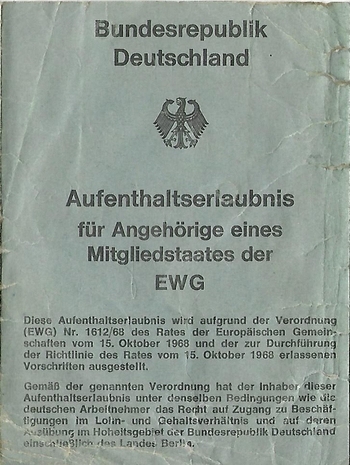
Meanwhile the negotiations rumbled on until one day, quite shockingly, from my point of view, the police – Die Polizie, or more colloquially, Die Bullen, turned us out on the street. We had had a previous visit from them, when we were marched out onto the street and the house was searched, but on that occasion we were dealt with politely enough and then allowed to return. But this second time we were properly evicted or ausgeraumt. It was I think at this time that I acquired a little blue card which I assume to be a kind of visa – I notice it had validity until 21 April 1988 – but to tell the truth I am not quite sure of the significance of this piece of paper, though I still have it.
As it turned out, many of those who had been living in Willi-Bald Alexis Strasse were able to find accommodation probably less than a couple of hundred yards from where we had been staying. I joined them there. The atmosphere though was very different. For one thing, I no longer had my own room but had to share a kind of dormitory accommodation – a schlaf zimmer – as it was known. Actually the previous house also had schlaff zimmern, and many people, even where they had their own room, would choose to sleep in the schlaf zimmer. This was mixed sex accommodation. I dare say many Irish or Scottish people observing the young squatters would have taken this as evidence that their life style was promiscuous and dissolute, but this was not my observation. The people I was encountering were not a typical cross section of the West German population; nevertheless I could compare them with the residents of a squat I had stayed in briefly in London and in general found them to be freer of the embarrassment and taboo which conditioned the behaviour of their British counterparts. For example, as the year drew on and we experienced some hotter weather I was invited to a lake out on the edge of the city where we would go swimming. Swimming costumes were definitely not a requirement and everyone seemed relaxed swimming and sunbathing naked. Yet in their personal relationships these same young people were, if anything, more discrete in their conduct with one another than comparable British young people of that era – so for the most part schlaf zimmern were exactly that – places to sleep.
Not surprisingly there were uncertainties around the future of this new accommodation. The old household had been broken up and scattered about the city. Some residents had decided to leave Berlin. I on the other hand was coming under pressure to return home to Northern Ireland where my eldest brother Michael had not been well. My parents seeing that I had no serious commitments in Berlin were, I am sure, doubtful that their 29 year old son was spending his time profitably. They saw no reason for me to linger.
And so with some reluctance I took leave of the city. Over the years I have watched the news of Berlin with interest. During the Cold War, West Berlin was closed in and claustrophobic; perhaps because of this unique atmosphere it became a magnet for bohemia, for people who did not fit in elsewhere and who were in search of the freedom to be themselves. In the midst of this ferment it is not surprising that the creative arts flourished. More surprisingly, the prevailing mood of the city was exhilaration. I was lucky enough to experience this briefly. With the fall of the Berlin Wall the city has gone through a huge reconstructive transformation, with the Bundestag restored as the parliament, the Brandenburg Gates once again open for movement from East to West and crumbling areas such as Kreuzburg resurgent. Someday I would like to return.
The above text formed the basis of a talk to the Dumfries German Society on Thursday 21Feb2013. Following the talk one of the audience who had been living in West Germany at about the same time as I was visiting Berlin, remarked that she had never previously heard anything good said about Kreuzberg.
The house of Lords should be reformed. It should not in my opinion however be elected. There are a number of reasons for this. If it were elected, there would be a danger that it would, probably at some moment of crisis, claim legitimacy as the government of the country. This would be constitutionally confused and not a good basis for government. The House of Commons must remain decisive, though the revising, scrutinizing and delaying powers of the House of Lords are all valuable instruments for ensuring that legislation is well drafted, effective and representative.
A second reason for not having an elected House of Lords is that people do not have the stamina for more elections, nor do they have the wish to multiply our political class. A nominated House of Lords allows people to be brought into the political arena, who are not necessarily politicians by nature. They can however bring skills from other arenas in which they have been successful: business; sport; science; technology; entertainment; etc. I would suggest that each political party elected to the House of Commons should be able to nominate members for the House of Lords in proportion to the total number of votes cast in their favor at a general election. This would to some extent redress the unfairness of our present First Past the Post Electoral System. Of course there would be accusations of croniism, but really parties have an interest in nominating people who will be effective and in any case perceived abuse of the system by one party or another can be rolled up into the decision we make when we cast our vote at the general election.
[Response to a question, originally posted on Yahoo Questions: Link ]
Alex Salmond has pulled off a remarkable coup by leading his party to an overall majority in the new Scottish Parliament. We are told that the Labour Party designed the electoral system for the Scottish Parliament specifically to avoid this outcome. This spoiling thought may have been in Donald Dewar’s mind, but whatever is the case, a referendum must now intervene and a majority vote in favour of independence before it can come to pass.[ A majority of those who turnout to vote? A majority of the total electorate?]
I gave the SNP my third preference vote on the regional list. This is despite my distaste for nationalist politics in general. Yet I have found a good deal to admire in the conduct of the SNP: the canny game they have played in running a minority government; Alex the Salmond’s audacious plan to make Scotland self sufficient in renewable energy by 2020; his stout defence of the health service against privatisation and prescription charges. I don’t go along with the argument that the SNP are a one man band; without having made a close study, I note some other very credible figures: Fiona Hyslop [I know she lost her job in Education, but I thought she was making a good hand of it]; Mike Russell; Jim Swinney; Nicola Sturgeon. The Salmond himself though needs to take care. Following his victory his presidential swagger is becoming toad like; he seems visibly to be swelling before the cameras. But that aside, there is much to respect; yet I will not vote for independence when the chance to do so is set before me.
Not that I have a particular antipathy to the idea of living in an independent Scotland; it could be an interesting experience. Should the outcome of the referendum take us down that road, I will not be without optimism for the future. However; we are living in a time of change: technological change; climate change; rapidly increasing world population; shifting economic and political power. There is a need for social and political culture which has the openness and adaptability to respond constructively and quickly to these changes and the challenges they present. Nationalism is by its nature culturally backward looking and possessive of sovereignty at a time when nation states need to construct democratic political institutions at a supra national level and be prepared to share sovereignty.
The left of centre slant of the SNP and its focus on the goal of a prosperous Scotland as the means to seduce Scottish people into voting for independence masks the anglophobic undercurrent in Scottish society which energises the nationalist cause.
Pride in ones national identity is inevitably backward looking and rooted in an imagined past. Hugh McMillan makes the point with wit in his poem “Anglophobia”:
“But despite all that, and sober, the limp
red lions stir the blood and in a crowd of
fellow ba-heids I’ll conjure up the pantheon
of Scotland’s past and jewel it with lies.”
Anglophobia bubbles away in Scotland surfacing mostly in what we can call good humoured rivalry. Let me return again to Hugh McMillan’s “Anglophobia.”
“The Philosophy was mother’s milk to me
Our cat was called Moggy the Bruce
In 1966 my uncle Billy died on his knees
before the telly screaming “It didnae
cross the line ye blind bastard!”
But anglophobia expresses not so much pride in national identify as residual dislike of an ancient oppressor, which despite democratic institutions, when it comes to the division of spoils, can still put one over on the Scottish people.
The problem with this analysis however is that poverty, unemployment, failed housing schemes, and failed schools are not exclusively Scottish phenomena. There is a class basis to these problems which nationalism does not address, and worse still, obscures.
Let me refocus on pride in national identity and the words of, Hamish Henderson, addressing his fellow poet and Scottish Nationalist, Hugh McDiarmad.
`Just what do you stand for, MacDiarmid? I’m still not certain.
I don’ wanna step behin’ dat tartan curtain …’
Henderson, understanding McDiarmid to be a great poet, is nevertheless questioning his alignment with Scottish Nationalism and associating this with the oppression and cultural sterility of the Soviet Union. Strong stuff; but is it just to then link the modern, democratic, liberal minded Scottish National Party with the cultural failures of Soviet society?
There is I think a cultural vitality at many levels of Scottish Society. Yet the appeal of contemporary poetry, drama, literature and the arts, is limited and does not offer Nationalism the unifying mythology that can be drawn from the past. In Ireland Develera’s vision for the new Irish State was founded on the richness of the Gaelic language and literature which be believed could be regenerated and rooted in the moral authority of the Catholic Church. What transpired avoided the brutality of Soviet Russia, and was not without cultural distinction; yet the hallmarks of Irish society were poverty, outward migration, banned books, censorship in the Cinema, corruption in politics and child abusing priests.
Alex Salmond promotes a pluralist vision, inclusive of cultures which are new to Scotland. Yet can we be sure that this vision will hold into the future once the new independent Scotland is established, and the novelty and thrill of this new society has settled into the quotidian; how then will we entertain ourselves? Alex Salmond is intent on neutralising Scotland’s sectarian shame – the remnants of tensions from a previous wave of migration which originated Celtic Football Club and the Celtic Rangers axis in Scottish culture. Can he really turn Scottish football into a game which all the family may attend without fear of offensive chanting from the terraces? The same impulses that draw tens of thousands across Scotland to choose their club colours as their preferred dress, and bring them together on the terraces each week to sing songs which mock and abuse their city neighbours – are the same impulses that fuel the extremities of racism, sectarianism and yes, nationalism.
One should not gloss over the many flaws in the political structures of the United Kingdom which is at best an unfinished democratic project. Historical baggage is at the basis of many of the divisions and imbalances. Scotland though is riven with divisions and resentments of its own making. I have already referred to sectarianism, but this is just the start of a long list. Glasgow’s miles better…than Edinburgh that would be; the central belt versus the regions; the islands versus the mainland; Gaelic versus Scots; why even in little Dumfries and Galloway from where I write, while Dumfries pompously aspires to be the regional capital, Stranraer looks on bitterly and complains perpetually about being hard done by.
If Scotland does vote for independence, there will I am sure be a grand party, but it won’t be long before the fights break out.
The result of the referendum on the Alternative Vote did not come as a complete surprise to this blogger. The discussion was dominated by the conservatism of the Tory/Labour political establishment whose arguments were rhetorical rather than rational. The self interest of this group in stirring up hysteria rather than reason was obvious.
The Liberal Democrats, also clearly an interested party, fought the campaign with their reputation for principal already in tatters, and the whole issue unhelpfully identified with the deeply unpopular Nick Clegg.
The reforming elements in the Labour party who supported the Yes campaign, had a greater claim to objectivity, but never managed to really nail the arguments. Some of the strongest voices I heard in favour of the Yes vote were non politicians: Dan Snow; Armando Iannuci, Eddi Izzard but they were drowned out by the hysteria stirred up by the No campaign.
The electorate however deserve some castigation.
Before the 2010 election the electorate – every citizen member of it we might easily have supposed – was “fed up” with British politics and untrustworthy self-interested politicians [there was no other kind apparently]. Everything was going to change. Reform was on the agenda.
In a democracy, the electoral system is fundamental to the fairness of political institutions and the decisions that are made – an excellent starting point for reform. Presented with a rare opportunity for modest reform, of our electoral system, which is manifestly unfair and unfit for purpose, this movement for change has thrown the opportunity away in their enthusiasm to give Nick Clegg a bloody nose.
Politicians are fond of flattering the British People and like sleazy seducers, never miss an opportunity to say how intelligent, wise, courageous, fair minded, etc etc. they are. “You look as beautiful as ever my dear…” But it is not politicians but those who are so easily flattered that I now criticise. The result of this referendum provides only evidence of a decision made on the basis of narrow party interest, personalisation of the issue and a failure to grasp – or acknowledge simple facts.
This brings me to my main point which concerns the way we effect democratic reform and in particular the suitability of referendums as the key decision making process in this context.
The No campaign were keen to argue that AV was “complicated”; yet, to vote in an AV election is only marginally more taxing than voting in a FPTP election. Indeed, if ranking the candidates and writing 1,2,3 in the appropriate place had proven too much, then a simple and traditional X would have sufficed to ensure a vote.
To understand what is unfair about FPTP and why AV might be fairer requires a little more mental effort though this is comfortably within the capability of most people who are not being harangued by interest groups intent on confusing the matter.
I would make three points concerning democratic reforms.
National referendums are probably a necessity where matters of sovereignty are concerned [membership of the EEC; independence of Scotland; the Good Friday Agreement]. Where justice and fairness are concerned, referendums however are not an appropriate way to make decisions as they are too easily hijacked by political interest groups.
The design of institutions and electoral systems for new states has not been decided in the past by referendums, but rather entrusted to people respected for their understanding of what is required and their ability to rise above the partisan and divisive nature of party politics. Without exception, following the downfall of the Soviet Union, Eastern Block countries have adopted Proportional systems. Whilst not all of these are model democracies, their record in general is impressive.
Following partition in 1921, the Government of Ireland Act put in place electoral systems to be used both in Northern Ireland and in the the Irish Free State. The system agreed for both was a proportional one – STV – and not First Past the Post, as used elsewhere in the United Kingdom. The Unionist Government of Northern Ireland, elected by the majority protestant population, took the first available opportunity to return the electoral system to First Past the Post and proceeded to run what was in effect a single party state until the onset of the troubles in the late 1960s. This demonstrates that the provision of a vote to all citizens whilst a necessary condition for democracy, is not a sufficient one. A proportional system might have enabled a more plural politics to gradually emerge from the religious tribalism that prevailed, and could have avoided the tragedy that followed.
Had the 1997 UK election taken place under AV, would the UK have joined the United States in their invasion of Iraq? This may seem an odd question, for the Labour majority in 1997 was so great that it is difficult to see anything other than a stunnning Labour victory, regardless of the voting system used at the election: and yet, AV might have made a critical difference with respect to the decision to go to war.
The Labour victory, though decisive under FPTP, was based on a vote in their favour of just 43.2% of the votes cast. Whilst both the Labour Party and Liberal Democrats probably benefited from anti Tory tactical voting, it follows that the Labour Party, having started from the stronger position would have derived greatest benefit. The Liberal Democrats, who opposed the war polled only 16.8% of the vote. Under AV voting it is probable that the Liberal Democrats would have won significantly more seats and reduced, though not eliminated the Labour majority.
The Liberal Democrats were the only one of the major parties to oppose the war. Nevertheless, there was opposition to the war from within the Labour Party, led by the late Robin Cook. The prospect of an AV election to follow would have given pause for thought to those Labour MPs who might have feared the loss of first preference votes to the Liberal Democrats. The probability is that this would have strengthened the anti war faction within the Labour party and in all likelihood led to an an anti war alliance which would have stalled Tony Blair’s rush to join forces with George Bush.
I speak as someone who actually believed at the time that there was a genuine threat from weapons of mass destruction and that the invasion was therefore justified. I also believed that preparation for the war and more critically for stabilising the country following the invasion, would have been fully planned. How naïve can one be? The ironic thing is that had Tony Blair been dissuaded from the folly of his alliance with George W, though temporarily weakened, his reputation in the longer term would have been secured. Of course he might then have then been emboldened to dishonour his Granita contract with Gordon Brown and continuing as Pri-minister, have sailed into the midst of the waiting financial crisis….but then, had the 2005 election taken place under AV might the benign influence of Vince Cable not have been more pronounced and the banks reined in before the crash?What if, what if, what if…..
On BBC TV’s Question Time [Thursday 14th April] Michael Howard smugly declared that the Alternative Vote was “nobody’s first choice” . Given that his own party has set the agenda of the referendum on electoral reform which will take place on May 5th, restricting it to a choice between First Past the Post [FPTP] and the Alternative vote [AV] this was a particularly cynical piece of rhetoric. The Liberal Democrats’ preferred choice would have been Single Transferable Vote, though they would no doubt have been content with one of the other Proportional systems on offer.As it happens, on the same Question Time panel we heard Peter Hain declare that AV was his preferred voting system. Nevertheless there is a real danger that because AV lacks passionate support from any quarter, that the electorate will fail to engage fully with the discussion taking place and will have the wool pulled over its eyes by the Labour Tory political establishment who for the most part reject change and are desperate to hang on to a system which has served their interests well in the past.
The unfairness of First Past the Post is least apparent to those who, from time to time, have seen their chosen candidate elected and, more critically, their chosen party form a government. It is at the margins of politics where the unfairness of FPTP is most conspicuous; given that these margins are frequently populated by racists, fascists, bigots and the just plain bonkers, it is easy to portray this democratic deficiency as an asset.
The margins however are also an important route for the entry of new ideas into our political system, and are the potential stamping ground of parties who can engage those so thoroughly turned off politics over the decades by the Labour Tory double act. In UK politics the Green Party are a good example of this; in Scotland I would cite the Scottish Socialists, despite their rather spectacular fall from grace in recent times. Also, the Conservative Party, a distinctly marginal force in Scottish Politics, have gained representation in the Scottish Parliament through Party lists and have not only provided the Parliament’s speaker but also, to the surprise of many people, engaged constructively with the minority SNP administration to secure legislation compatible with their own agenda.
The margins have for many years been the location of one of the blander factions in British Politics – the Liberal Democrats. To their credit however, the fact that voting reform is actually on the agenda at this moment is only because they have managed to emerge from their marginalised ghetto to stick a toe in the electoral door, much to the chagrin of the Labour and Tory parties. The irony is that the current unpopularity of the coalition – and the Lib Dems in particular – threatens to scupper the limited – though genuine – opportunity for reform of our politics which AV presents.
Rather than analyse the unfairness of First Past the Post, let me focus on the arguments that are currently being deployed against AV. Pre-eminent amongst these is that AV increases the likelihood of coalition government and that this is undemocratic because it inevitably involves a stitch up between political parties after an election has taken place. This argument is given particular spice by reference to the current coalition and in particular to the public way in which, before the election, the Liberal Democrats sought the votes of students by signing a pledge to scrap tuition fees, and then, following the election, swiftly ditched this commitment in their coalition agreement.
This objection – undemocratic coalition building – might carry some weight if the manifestos implemented in government by successive Tory and Labour administrations over the years had actually been endorsed by a majority of the electorate. The arithmetic of FPTP however means that not only are MPs frequently elected on the basis of minority support within their constituency, but governments are elected on the basis of minority support within the country. The Labour government elected in 2005, for example, only had a 35.3% share of the overall vote.i Margaret Thatcher’s victory in 1983, following the euphoria of the Falkland’s war, gave her a mandate of only 42.4% on which basis she proceeded to drive through the most divisive political programme of the last century. The claim that AV is undemocratic should be set against the consistent and unacknowledged democratic deficit which has arisen from FPTP elections.
Analysis of an AV result will actually provide important information to parties as they seek to build coalitions following an election. Had the 2010 election been conducted under AV for example, it is quite possible that a majority of those giving their first preference to the Liberal Democrats would have given their second preference vote to the Labour Party.ii This would have amounted to a mandate for a Lib Dem, Labour, bits and bobs coalition; whilst this option may not have been popular with journalists, there is every reason to suppose that it would have been marginally more popular with the electorate than the present administration and curiously, more popular with the Lib Dems themselves – with the probable exception of Nick Clegg.
Caroline Flint raises to my mind a rather original objection to AV. On the Labour No to AV website she says: “One vote is all I need to vote for the party I believe in – Labour. Why should those who vote for fringe parties have the chance to vote again and again until their vote finally decides the outcome?” This is a rather blatant use of rhetoric to turn one of the strengths of AV on its head and misrepresent it as a weakness. AV clearly offers greater freedom than FPTP to the voter to communicate their views to politicians. First preference votes for the Green Party, for UKIP, and we must also admit, for the BNP, provide important information about the minds of the electorate from which Ms Flint and others would benefit. AV offers a voter the opportunity to express these views and still cast a vote in favour of the Labour Party or one of the other parties more likely to actually win the seat.Perhaps however Ms Flint’s lack of warmth for AV arises because in 2010 she won her Don Valley seat with only 37.9% of the voteiii…
A further argument used against AV is that it will give excessive influence to small parties who, following an indecisive election result, will ring concessions from larger parties desperate to establish a governing majority. There are certain kinds of proportional systems – notably those which make the country a single constituency – which encourage division of parties into splinter groups, each of which may hope to win a few seats at an election. Clearly – and Israel offers a good exampleiv – the proliferation of parties can greatly complicate the building of coalitions and lead to unstable governments easily held hostage by extremist factions. Other systems of PR greatly mitigate these difficulties and have consistently produced stable governments. The conflation of certain flawed systems of PR with AV is a further piece of cynicism on the part of those who oppose change. AV is less susceptible to this problem and indeed encourages people when they cast their vote to think through the compromises which government inevitably involves.
Under first past the post both the Labour and Tory Parties have actually concealed their own, sometimes bonkers factions, quite ready to extract their pound of flesh should the electoral arithmetic be finely balanced. In the case of the Thatcher government, the bonkers faction actually took control of the party and ran the whole show for more than a decade.
Let us conclude by admitting that AV is an imperfect system. It will not deliver proportional, – and therefore fair representation – in parliament. It will not reliably resolve all the other problems of FPTP. It will however increase peoples’ sense that they can safely vote for the party which truly reflects their point of view without effectively wasting their vote. This may result in some parties gradually moving from the margins to occupy the centre stage, but in other cases will result in the big parties contending for power rethinking aspects of their policies to neutralise these marginal elements. The referendum on May 5th offers an opportunity to revitalise our politics; such an opportunity will not come again within a generation.
ii Peter Hain expresses a different view as regards how he believes 2nd preference Lib Dem votes would have been cast, stating: “The evidence suggests Liberal second preferences would break pretty evenly, in the current political climate possibly more so to the Tories, so Tory opponents could not claim AV as a pro-Labour device.” http://www.peterhain.org/default.asp?pageid=195&mpageid=51&groupid=2
As an advocate of proportional representation I am a reluctant supporter of casting my vote in favour of AV – the Alternative Vote – at the forthcoming referendum. If the yes vote succeeds however, this “miserable little compromise” as Nick Clegg once called it, could just redeem itself by forming the basis for a reform of the House of Lords, in a way which would resolve the ongoing wrangle over whether the reformed upper chamber should be elected, appointed or be an amalgam of the two. Whilst this AV Second Chamber option is a late comer to the menu of reform options, it deserves consideration.
Leaving aside for the moment the merits and demerits of an elected, nominated or hybrid upper chamber, let me summarise the proposal.
First preference votes cast at a constituency level in an AV election, if aggregated into national totals for each party could be used as the basis for appointing places in an upper chamber. Parties would have the right to appoint members in proportion to the first preference votes cast in their favour. It would be up to each party to decide how they should make their nominations; appointees however could not be individuals who had stood for election to the House of Commons in the current cycle. The appointee could previously have been a member of the House of Commons, but might equally be chosen for their experience in other areas of public or business life. Nomination could be made by whatever process was agreed by each party for the purpose, though the agreed process should be a matter of public knowledge at the time of the election.
There are various merits to this approach.
If appointments to the upper chamber were made in this way the widespread cynicism about political appointees would be neutralised in a process which would be transparent and linked to the priorities of the electorate.
Whilst there is currently popular support for the idea of a wholly elected upper chamber there is also widespread cynicism directed at the political community which such an elected chamber would inevitably feed. Despite a clear commitment to democracy the electorate has little appetite to add to the existing expense and burden of elections. They are already fatigued by the work of reading manifestos and the intrusions of doorstepping politicians and election broadcasts, all of which are a necessary part of the decision making that is involved in an election. It is doubtful even that politicians and party hacks can stomach much more of the slog and expense involved in a further election.
An appointed upper chamber would be clearly circumscribed by its revising remit and could not claim – as would be likely with an elected second chamber in some circumstances – a greater authority to govern than the House of Commons, with the inevitable constitutional confusion that this would cause.
Some additional considerations.
 Carruchan