But We’re Not Quite Sure What to Do About it

So far as I am aware the only significant political party which openly opposes the monarchy in current UK politics is Alba and their ambitions are stated in orderly and respectful terms. Yet my attention was recently drawn to some angry and uncompromising remarks on our current King and his family. It was the kind of conversation where I felt invited to join in the kicking or be branded a hopeless sycophant, but I declined the offer.
I grew up in that part of Northern Irish culture which was inclined to see the British Monarchy as the only trustworthy part of the UK constitution. The word “loyalty” was all about loyalty to the Crown and nothing beyond that. To quote something I have said in another context: “In the late 1950s the Queen was young and beautiful and had a handsome husband with a distinguished war record. They were a dazzling couple, their growing family respectfully presented in a compliant media, quite unlike the aggressively intrusive paparazzi which lay waiting in their future, ready to overturn at least some of this idyll.”
In other words, in that post war era, for those who wished to be loyal to the crown, the first family was a class act in every sense of those words.
There were others in Northern Ireland, who had reason to be less easily seduced by this glamour and indeed, in my own home, there were no pictures of the Queen on the wall. I do remember, in the first house I lived in, Avoca, Balmoral Park, Newry, what seemed a huge Union Jack, folded up in the attic. However, it was never run up any flagpoles and when we moved house it must have been left behind in the flitting for I never saw it again.
I think my parents, who had lived most of their lives in the Irish Republic, at times betrayed some nostalgia for the President they had left behind. Eamonn Devalera had only escaped the death sentence following his part in the 1916 Easter Rising because he was an American Citizen. He was an uncritical observer of the prominent role taken by the Roman Catholic Church in the nascent Irish State. These credentials were an obvious challenge to the protestant and unionist heritage in which my parents had both grown up. Yet I recall my father referring more than once, during Eamonn Devalera’s tenure as President from 1959 to 1973, as “Dev”. To my young ears this seemed almost affectionate.
Whatever thoughts my parents may have had on the comparative merits of President Devalera and Queen Elizabeth, they kept them to themselves. I was given no instruction on the matter but gradually formed my own opinion. I don’t use the word “republican” to describe myself, for in the context of Irish politics, that has a very loaded meaning. But, for as long as I can remember, I have thought the British Monarchy an anachronism which should be swept away at the first opportunity. The Monarchy is a symbol of inequality and inherited privilege which has no place in a modern democracy.
Yet the angry tone of that conversation which I overheard was troubling to me. I have no particular animus against our current King who I think takes quite worthy stances on issues such as the environment. I am less enamoured of his thoughts on architecture, but I’d be perfectly happy to sit down and have a chat with him on the subject. I feel sympathy for him in his very public endurance of a prostate cancer diagnosis. Andrew, on the other hand … well I don’t really want to go there.
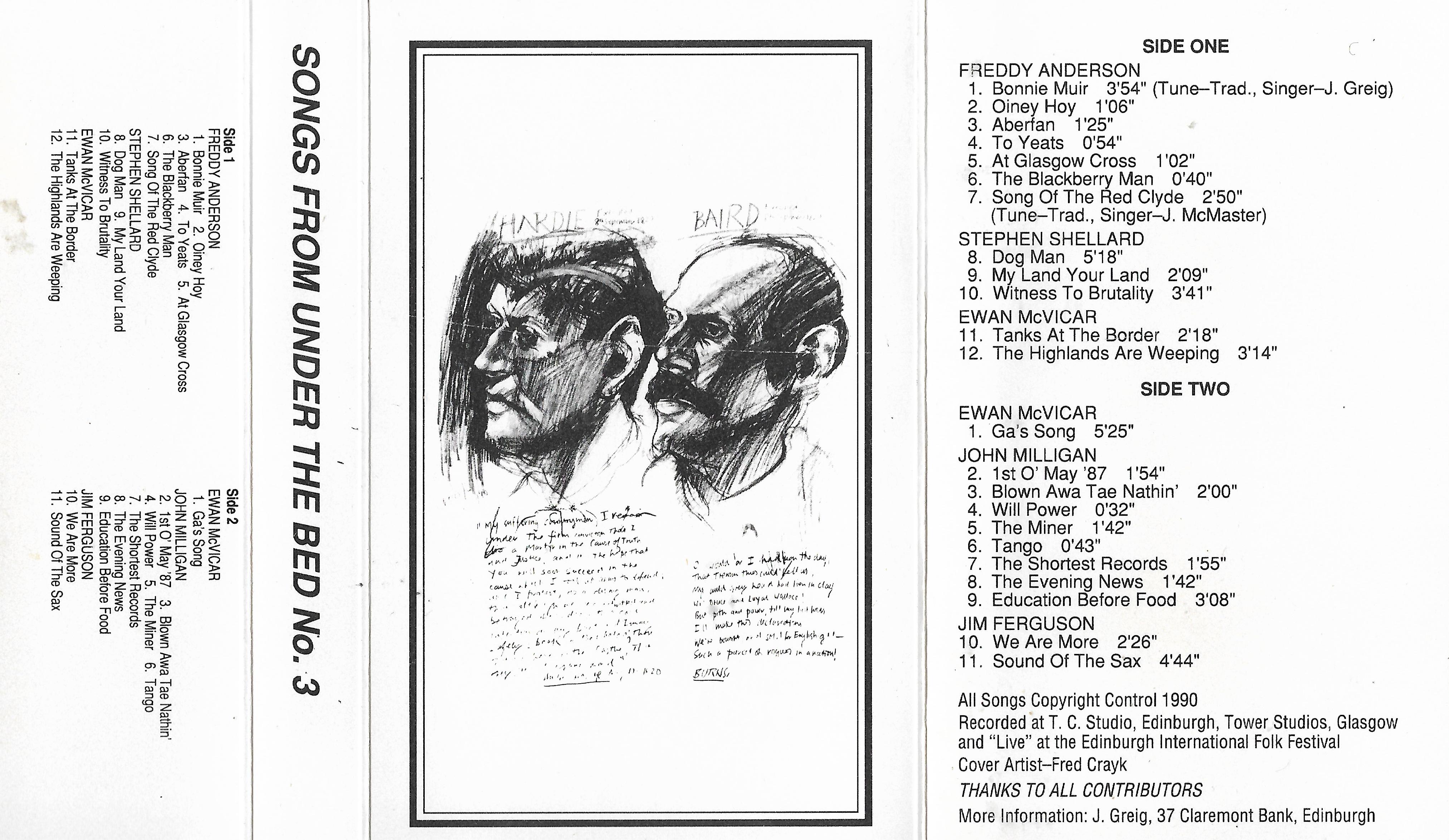
Some time during the 1980s I wrote a song about the then heir to the throne. It was at a moment when his marriage to Diana was beyond repair but his relationship with Camilla was yet to be acknowledged. I sang the song at least once at the Dumfries folk club. I won’t say it was received with great acclaim, but I thought it worthy of a tape series being organised at that time by John Grieg, formerly of Inverness, but based in Edinburgh. The title of the series was Songs from Under the Bed. I’d already recorded three songs for No. 3 in the series. However the song I’d written on the heir to the throne did not make the cut. It was rejected, I thought with some scorn, for evidently it did not sufficiently demonise the class enemy.
Whatever the merits of the song, this judgement continues to rankle. I saw the song not as an attack on the man but as a critique of the institution in all its infantalising glory.
Let’s Pension Them Off.
Quite how we deal with a redundant royal family is a minor matter. I am quite sure that we shouldn’t put them in the pillory. Let us thank them for their service and quietly pension them off, perhaps in a style somewhat less than that to which they have become accustomed.
Getting the new presidency right is a trickier and more important challenge. Where heads of state are concerned there are two types of president. The first of these has significant political power, as we see in the United States or France. Such a president would make no sense for the United Kingdom where we have a parliamentary system of government and where the monarch, as head of state, is there to provide leadership and a sense of continuity that transcends politics. That would be a starting point for the job description of a UK president.
The problem with electing a president to take on this kind of role is that they are inclined to seem unimportant and to be overlooked. Does anyone know the name of Germany’s Bundespresident for example (Frank-Walter Steinmeier) or the current president of the Republic of Ireland (Michael D. Higgins)? The elections of such presidents are often on the basis of a low turnout – Higgins, for example was elected on a turnout of 43.9%. This undercuts the perceived legitimacy of the elected individual. People just aren’t that interested in a president without real power.
It might be better to delegate the task of choosing a president to a group of people who live and breathe electoral politics. It’s just a suggestion, a conversation starter really, but why not an electoral college made up of all the people who, either in the past or in the present, have been elected to political office? I’m talking councillors, MPs, MSPs, Mayors. Let them do the work. I imagine nominations from ordinary citizens, perhaps accepted on the basis of a hundred signatories. The deliberations of the electoral college in considering the relative merits of those nominated for the role could be interesting. I imagine several rounds of voting to reduce the field. The individual who emerges on top might surprise us, and perhaps have some of the qualities we would hope for in a national leader. I could imagine a process which might generate some razzmatazz, like Sports Personality of the Year or the Oscars. Or maybe there’s a better way? Suggestions please!
Endnotes
1] The quotation referring to the youth and beauty of Queen Elizabeth II in the post war period is drawn from my memoir, Remembered Fragments available from Amazon as ebook or paperback.
2] The tape series Songs from Under the Bed is no longer available but here is the cover from tape No.3. The story of the series can be found in the book, The Eskimo Republic: Scots Political Song in Action 1951-1999, by Ewan McVicar. “Ewan McVicar is to be commended for the work of compiling this book which should be in the library of every person with a serious interest in folk music.”
3] The rejected song …
Who are Your Friends Charlie?
Who are your friends Charlie
As you stand there alone
The special branch are at your side
The world peers into your home
You could have been a bricklayer
You could have taught in school
You could have been a bus driver
But Charlie you were born to rule
***
You loved an actress, I have heard it said
But took to wife a pretty child
To please the crowds instead
I am sure you loved her
In a passing way
But who did you really love
When she had come to stay
***
Who do you trust Charlie
Are there a chosen few
Allowed to look you in the eye
To tell your confidences to
Here in the crowd
A flag in every fist
A people pressed against the rails
By a force that they cannot resist
***
Round every corner
Cheats and sycophants await
The subject nation
That is your estate
As the cameras aim
And the onlookers gape
Do you ever wish Charlie
That you could make your escape?

 Carruchan
Another interesting piece Stephen. I confess I hadn’t thought too much about the role of a President, but have rather focussed on the enduring question of how the monarchy is still with us, at least in its present form. Yes it seems to be falling apart in many ways. But there seems little will to modernise it, in contrast to what the now King was previously saying. I found his coronation a complete anachronism and ludicrous representation of modern Britain. Compare the pomposity of it all with simple transfer that took place in Denmark. So I guess my position is that the monarchy can’t easily be abolished, and perhaps shouldn’t be, but the task of radical reduction and restructuring could be achievable. A credible monarch could then act somewhat as a powerless president and symbolic leader. Something like a royal Mary Robinson?
Good wishes
David
Sent from Outlook for iOShttps://aka.ms/o0ukef
Mary Robinson … one of my father’s favourites. I think he was able to establish some tenuous connection with her but very much approved her presidency.