Three Stories from This Year’s Festival of Art and Culture
Story 1: Home Truths for Home Rule: Scotland After 25 Years of Devolution
Lesley Riddoch and Henry McLeish in Conversation
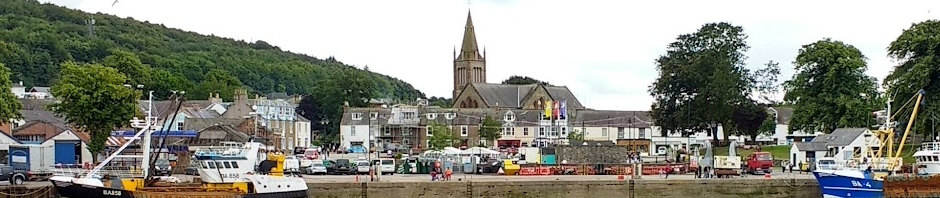
Kirkcudbright Fringe has once again presented us with a fine array of events in a picturesque and – for me at any rate – very accessible location.
My opening outing was to see Lesley Riddoch debate with Henry McLeish the highs and lows of 25 years of a Scottish Parliament.
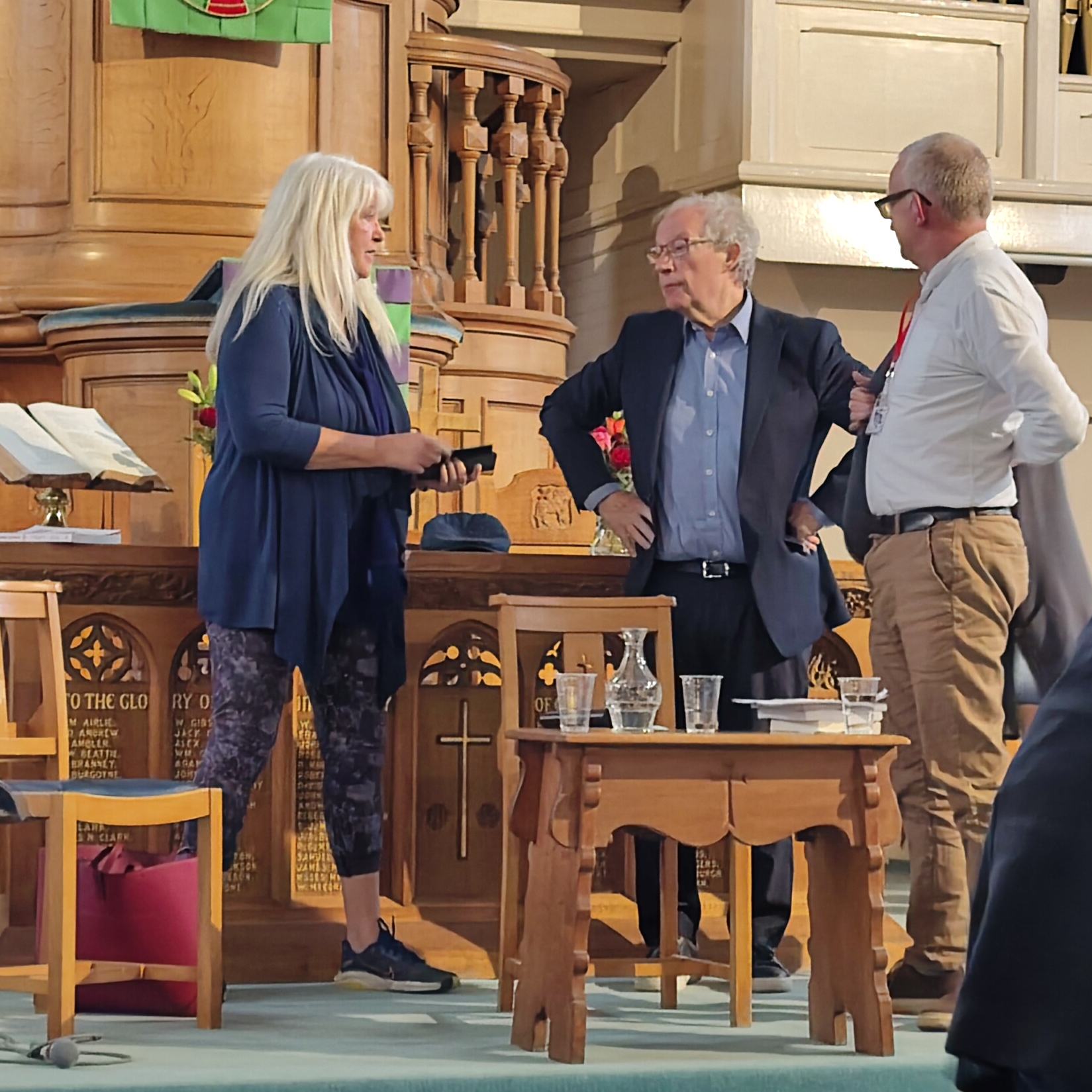
It was, contrary to the appearance of this prediscussion face-off picture, an amicable affair reminding me of the leadership debate in the 2010 UK General Election where the key takeaway was Gordon Brown declaring repeatedly: “I agree with Nick” – referring of course to Nick Clegg, leader of the Liberal Democrats. In this case it was Henry McLeish who was keen to say – without actually letting his Unionist credentials go hang: “I agree with Lesley.”
In her opening statement Lesley Riddoch outlined key failures of the UK constitution which remain unresolved. She mentioned in particular the unreformed and increasingly unrepresentative electoral system of the UK Parliament. She mentioned her interest in the question of land ownership. She illustrated this particular point by reference to the Great Reform Act of 1832 which allocated the franchise to all male citizens meeting the necessary property qualification – amounting in practice to an extension of the franchise from 1 percent of the population to 7 percent. In Norway as Lesley explained, where there were many small farmers holding their own property, a similar reform in practice extended the franchise to just over 40% of the population. But Scotland, as I am sure was Lesley’s point, has its own more extreme version of this injustice. Andy Wightmans lays out the scale of injustice involved in his book The Poor had no Lawyers. It’s a work which makes Proudhon’s provocative declaration: “Property is Theft” seem entirely reasonable.
Henry contested none of this. Indeed he sketched out further common ground in “stupidity” of Brexit, and the obvious self harm it has caused. Nevertheless, he asserted his right to be considered a proud Scot whilst simultaneously defending the Union with our English neighbours – they would after all, continue to be our neighbours in the event of Scottish Independence.
Missing from the discussion, for me, was the question of the currency. There seems general agreement that a Scottish pound, though possibly appealing to the more extreme flag wavers, is not a viable proposition. In the longer term Scotland would either have to retain Sterling, a currency over which it could no longer exercise any meaningful influence, or adopt the Euro, a currency union in which Scotland would be a very small player with very distinct island economic interests. It would have minimal influence over a currency which in any case has been conservatively managed in its short history as the Greek experience under Finance Minister Yanis Varoufakis demonstrated.
Questions from the floor, as is often the case in such events, were less questions than declarations, mostly, so far as I could tell, expressing impatience with Westminster and a desire for Scotland to go it alone. One member of the audience, however, did throw down an interesting challenge to both Lesley and Henry – full disclosure – it was me! – arguing that Holyrood could never fulfill its full promise without radical reform of Westminster politics, in particular, the electoral system for the House of Commons.
When our politics was dominated by two parties, Labour and Conservative, the First Past the Post delivered a semblance of fairness in which Scotland shared – that is before the advent of Margaret Thatcher. Our party system however, is now in crisis with First Past the Post delivering increasingly unrepresentative and unpredictable outcomes. The Scottish National Party has been the beneficiary of this chaos and its polarising impact on politics in general and Scottish politics in particular.
Were the problem to be addressed and the system reformed, I would bet that an independence referendum, 10 years on, would deliver a resounding “No” to the secessionist proposition. But I’ll be waving no flags, one way or the other, and if I am wrong I’ll still hope to be around to experience the dawn of the new and independent Scotland. I’m sure they’ll do just fine.
Story 2: The Beatles, the Sixties and Me
Philip Norman in Conversation with Ken McNab
I have read a few music celebrity biographies in my time – Dylan – more than one, Cohen, Neil Young, Bruce Springsteen, … but in more recent years I have grown weary of the genre. Yet I could not resist this event, Philip Norman, biographer of the Beatles, both the group and the individual members – well, all except Ringo, but more of that later, interviewed by Ken McNab who has also written extensively about The Beatles.

It was, perhaps unsurprisingly, an anecdote rich conversation. But what anecdotes they were. Philip Norman had encountered the Beatles in person at the earliest flowering of their celebrity, both Paul McCartney and John Lennon welcoming him, an unknown young journalist, into their inner circle, at least briefly, until firmly ejected by a professional Beatle Minder but not before gathering further evidence of George Harrison as a more taciturn presence and Ringo Starr … well, as I’ve already said, more on Ringo, later.
In fact Philip Norman was eventually to write a Beatles biography, Shout, published following Lennon’s death, in 1981. It was the first significant work on the Beatles. Subsequent Norman biographies of McCartney and Harrison were to revise some aspects of the narrative set out in Shout, which had pleased neither McCartney nor Harrison. Yet what was clear from the discussion was Philip Norman’s willingness to look for a more complex and complete version of the Beatles story.
The conversation was characterised more by jaw dropping anecdote and revelation than by brilliant insight, but given that Norman had found his way into the presence of such stellar celebrity, could it possibly have been otherwise?
A number of tantalising strands did emerge. One such was pinpointed by a question from the audience, which observed the rich evidence of John Lennon’s wit in the Beatles early years. And yet, when he formed his relationship with Yoko Ono and eventually broke with the Beatles and moved with Yoko to New York, all of this humour and whimsy, as evidenced in his early publication of the books John Lennon in his Own Write and A Spaniard in the Works, appeared to go missing.
Philip Norman, to some degree defended Lennon against this charge and yet was very clear that John was in awe of Yoko Ono’s status as a serious artist, and doubted his own claim to be an artist of any worth at all.
The discussion of Brian Epstein’s role in the rise of the Beatles touched on a similar failure of confidence. Philip Norman was very clear that Epstein was a crucial element of the Beatles rise to fame, and yet Epstein’s influence seems to me to have been a stifling one, particularly evident in insistence on Beatle suits.
Before Epstein came on the scene, The Beatles had, with the help of their booking agent, Allan Williams, found their way from the Cavern in Liverpool to a residency in Hamburg. There is strong evidence to suggest that they were capable of a discipline that might very well have carried them forward, perhaps with a different manager and without the intervention of Brian Epstein. And in those early Hamburg photographs their appearance is strikingly defined by leather jackets, jeans, Brylcreem and attitude. This is all evidence of the influence of the US film and music culture from which their own work was to grow. It was a look which could only have worked in their favour and yet Brian Epstein was to insist that they “smarten up”.
The remarkable thing is that the band went along with this regime and in John’s case it seems unexpectedly deferential.
Having said this, I’d have to admit that the cleaner look which Epstein brought to the band quite possibly did extend their reach into more conservative corners of the culture and perhaps this was crucial to the scale of their success.
Ah yes, Ringo. Not considered interesting enough, it would seem, for a Norman biography. Indeed unfavourable comparisons were made in the conversation between Ringo’s abilities and those of one of his predecessors, Stuart Sutcliffe, who left the band for reasons that are still debated, and tragically, was to die in April 1962 of a brain haemorrhage. Sutcliffe was succeeded as drummer, by Pete Best. Best already a band member, switched from bass to drums, with McCartney taking over on bass. Brian Epstein fired Best following the band’s first recording session and then, on 16 August 1962, came Ringo.[1]
Ringo has continued to be the butt of unfavourable comment. John Lennon is alleged to have said “’Ringo wasn’t even the best drummer in the Beatles.” And yet it may be that Ringo’s talent was perfectly fitted to the music that emerged and that a more brilliant or creative drummer, whilst they might have tipped the group down a musically interesting, route, would have harmed their popular appeal. I think I hear Gerry Hassan making a very similar observation about Ringo in the latest episode of Dumfries and Galloway’s very own Beatle Blethers, currently riding high in the UK podcast charts.
Story 3: The Power of Equality in the UK and Globally
Peter Tatchell in Conversation with D. J. McDowall
I arrived at this event with some sense of Peter Tatchell’s importance as a campaigner for human rights, equality and LGBT+ freedom over many years. I had not expected to find myself so impressed by the endless invention of his campaigning, and the courage, modesty and restraint he continues to show in the face of the threats and abuse directed against him.
D. J. McDowall’s thoughtfully planned sequence of questions deserves credit for a conversation which touched upon many aspects of Peter Tatchell’s 50 year career as a campaigner. Along the way we learnt about his deeply religious fundamentalist upbringing, his early protests, in Australia, against the Vietnam war, his two attempts to perform a citizens arrest on Robert Mugabe, and his unrelenting workload and commitment. “I am tired all the time. I just keep going”….I’m 73 now. I hope I’ll have another 20 years of campaigning.” The conclusion was understandably emotional. The standing ovation that followed was something I had never before experienced at such an event.
Above all, the conversation elicited from Peter Tatchell a master class in something he has raised to the level of an art form: protest and campaigning. Joy and humour were his key ideas, as exemplified in the mass kiss-in at Picadilly Circus in 1990 organised to challenge police harassment and laws that criminalised public same sex affection. His advice on how to greet an approaching policeman: with a smile and an outstretched and open palm – “It’s not what they expect.”
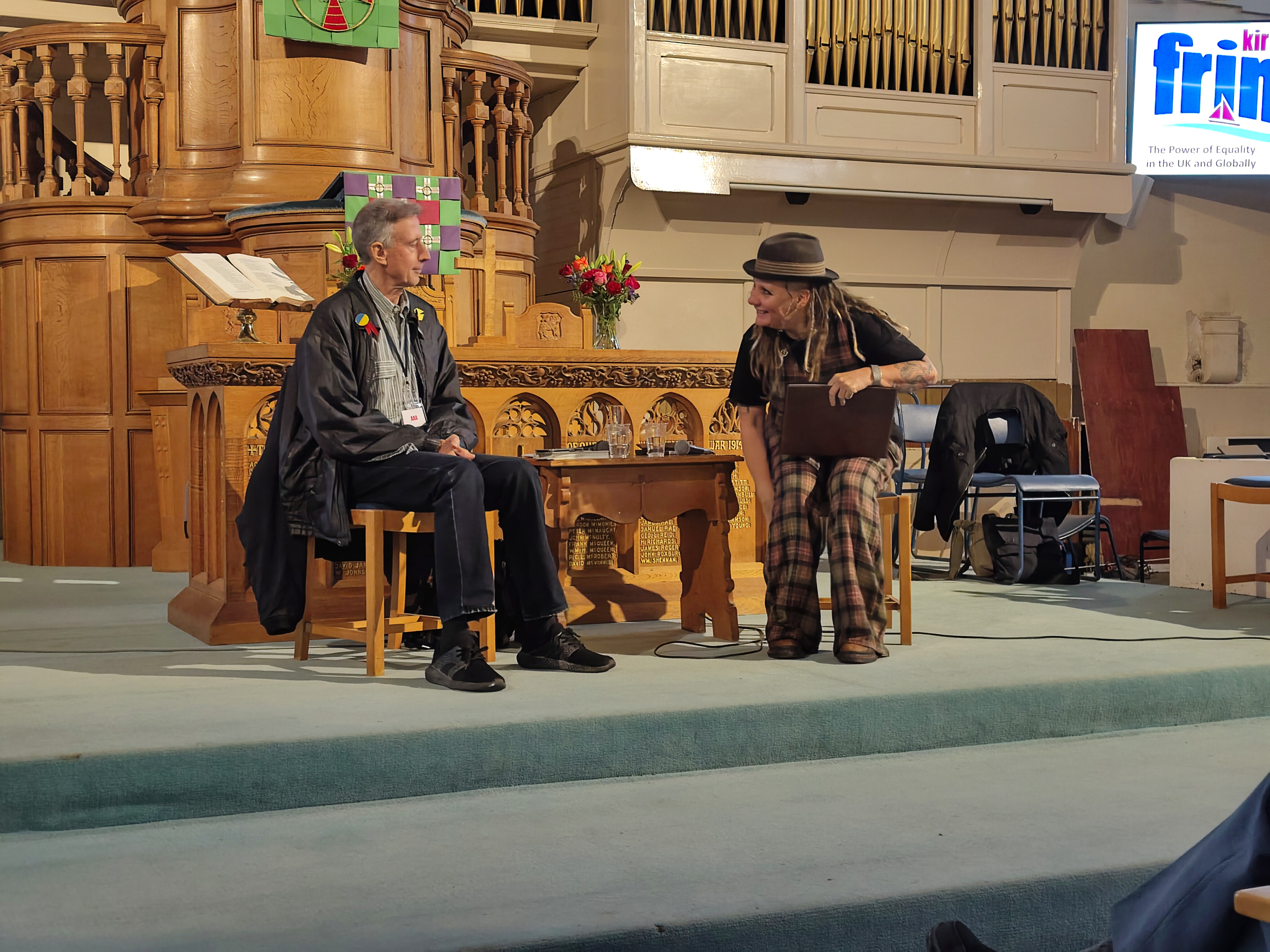
In the past, Peter Tatchell has worked cooperatively with Keir Starmer on human rights cases. He is distressed by what has become of Starmer. “I liked Keir and I don’t know what has happened to him.” A particular frustration has been the Government’s refusal to change the electoral system despite clear support from within the Labour Party in favour of reform.
Like many others, Peter Tatchell fears that the next general election will deliver an unrepresentative and backward-looking government, led by Nigel Farage. If the Government will not give us a fairer voting system, the only way to prevent this bleak outcome, he suggested, will be tactical voting and electoral pacts beween parties.
On a lighter note, D.J. McDowall somewhat ambushed Peter with a request for music that he has found inspiring or listens to in order to relax. He doesn’t really seem to do much of the latter. At any rate, here’s his impromptu playlist.
- Conleth Kane – Proud (7th Heaven Remix)
- McFadden & Whitehead – Ain’t no Stopping us Now
- The Specials – Free Nelson Mandela
- Bob Marley – Get up Stand Up
- John Lennon – Imagine
“Every day” said Peter Tatchell “I try to imagine …”
Endnotes
Note, this post was updated on 12 September, 13:55, to correct D.J. McDowall’s name and also the original elision of Pete Best from the sequence of Beatle drummers.
Further update on 15 September, with more detail on Pete Best’s presence in the band.
[1]Wikipedia entry on Pete Best https://en.wikipedia.org/wiki/Pete_Best

 Carruchan
It’s hard to keep up with your ‘roving reporter’ role, Stephen. Three thoughtful and beautifully crafted pieces in one post here. From electoral reform to the drumming of Ringo Starr is a big leap, but the themes all flow together somehow. Following hard on the heels of your Coach and Horses poetry piece, you are unmatched in reflective writing that emerges from the cultural landscape of Dumfries and Galloway. Thank you for all of this.
I don’t generally set out to “report” on events I attend – though a notebook is a useful accessory! Sometimes though there is something I want to say on the subject and in such a case it is also very nice to be able to spotlight some of the good things that happen in Dumfries and Galloway – as you have done in your series of interviews, a valuable archive which I hope you will further augment in due course.