There was a time when a person who had become mortally ill or who had reached their high old age could expect to die at home amongst family and not far from friends. In the current era this may yet be the case in communities as yet untouched by the modern world. But for those of us who do not succumb to fatal accident or heart attack, old age offers the prospect of lingering decline, often in a care home, with illness, hospitalisation and indignity all too probable at the finish.
Pain and illness have no doubt always been hazards at the end of life, but our genius for extending life, often regardless of its quality, is a defining feature of the modern world.
On the plus side, the management of pain through administration of drugs and the quality of professionalised care and support has never been higher.
Yet, the standard of what might be considered “a good death” continues to be set by the widespread belief that to die at home, within touching distance of those closest to us, is as good an end to life as we can possibly hope for.
The changing role of women, who formerly carried the greater part of this burden of care, is no doubt one of the reasons why dying has become so professionalised. Whilst attendance at the bedside of someone who is dying is as much a part of life as it has always been, hands on care for the sick and the infirm is something with which we have become less familiar.
Perhaps in time to come families and communities will evolve in such a way as to fully and unflinchingly take on this task in a way that does not gender the responsibilities for doing so. But for the foreseeable future we must rely on those aforementioned medical and care services. It is precisely for this reason that the just published Research Handbook on End of Life Care and Society is an important piece of work. In the introduction, Editors David Clark and Annemarie Samuels write:
Our Handbook is about end of life care in society. It harnesses the social sciences and humanities to a set of problems that remain dominated by medicalised and managerial solutions within healthcare systems, and in so doing it takes us into a vast range of perspectives on something that is essential to social life itself: the human encounter with dying, death and bereavement.
For me, it is this “vast range of perspectives” which makes the Handbook a project of special interest.
I was fortunate enough to attend the launch event for this book at the University of Glasgow, Rutherford McCowan Building, in Dumfries. The attendees were treated to an introduction from the editors of the Handbook, and contributions from a couple of the contributors. One in particular, which caught my attention, was from Marian Krawczyk, University of Glasgow, End of Life Studies Group, which focused on the concept of “total pain.” This I understood to be an amalgam of psychological and physical suffering arising in many cases directly from the treatment being applied to the terminally ill person.
Marian Krawczyk however is concerned with the disruption caused to the microbiome by treatments and how this disruption in turn directly influences the “total pain” experience of the subject. As she pointed out, progress into our understanding of the human gut microbiome has come on enormously in recent years. My own awareness of this subject has been mostly through the work of Professor Tim Spector. It comes as no surprise that rapidly expanding knowledge in this area of research is now being applied to find ways to mitigate the side effects of treatments such as chemotherapy, radiotherapy and antibiotics. Such treatments can devastate the gut biome and cause set backs to an individual’s progress which have hitherto gone unrecognised.
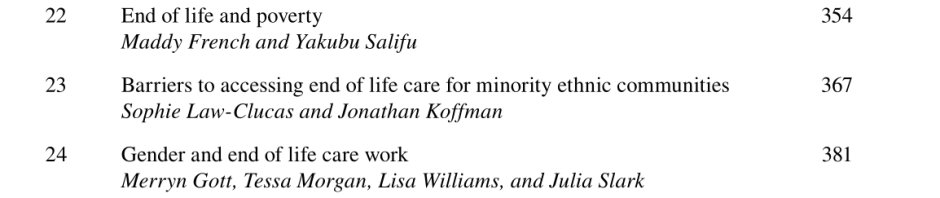
One of the exciting features of the Handbook is its international character. The contributors bring a diversity of cultural perspectives to the enterprise. A quick scan of the contents page reveals authors from Switzerland, the USA, the Netherlands, New Zealand,Denmark, Japan, Uganda, Portugal, Brazil, and Finland.
The multidisciplinary nature of these contributions is also striking. For example, the essay, Homelessness at the end of life speaks of a concern to reach into the darker corners of our world and to understand these marginal realities and perhaps even to learn something from them.
Speaking to David Clark briefly at the conclusion of the event I enquired as to the extent of anthropological study of end of life care. How has care for the dying been managed across cultures in the past? My assumption was that much of this end of life practice has been lost to progress and modernisation. I was reassured to be told that much data already exists from previous anthropological studies and that this is the discipline that determined David Clark’s own route into a focus on palliative care.
A further contribution to the launch event came from Sandy Whitelaw, based on his shared authorship – together with David Clark – of the Handbook essay titled: The opportunities and limitations of ‘choice’ at the end of life. This discussion of ‘choice’ resonated powerfully with a recent radio programme I had heard, an abridged version of Sarah Perry’s book Death of an Ordinary Man. The narrative records, in agonising detail, the experience of her father in law, David, from his initial recognition that he is not well to, just a month later, his death from oesophageal cancer. To be accurate, the book records not just David’s experience of these traumatic events, but also that of Sarah Perry and her husband, Rob, David’s son.
Interactions with the medical profession during this period were marked by good intentions and professional missteps in equal measure. For example: at the point when the stark realities of David’s situation have become clear, an attempt is made to establish whether his treatment should prioritise prolongation of life or, on the other hand, should ensure his comfort, with the consequence that death might come a little sooner.
Sarah Perry is present at the interview which attempts to spell out this choice to David and to establish his decision on the matter. The problem is that, with the rapid progress of his illness, his comprehension is failing. In fact, he is bewildered by the conversation with which he is faced. Uncertainly Sarah Perry tries to guide him towards the decision she believes he would want. Eventually he appears to grasp what is being asked of him. “I don’t want to be mucked about with,” he says. The DNR box is ticked; the interviewer seems relieved with the outcome; Sarah Perry leaves the meeting doubting the validity of her own contribution to this momentous decision.
In the question time stage of the event David Clark was able to inform me that it is quite possible in a Scottish context to have this discussion with your general practitioner long before the onset of any serious illness. Such preferences, along with other important information, can be entered into your Key Information Summary. This then forms part of your medical records and will be shared with other medical practitioners as may be required.
I’d have to admit I was completely unaware of this and will hope to raise the matter with my medical practice the next time a convenient opportunity arises. I feel sure there are others who share my feeling that, in the event of terminal illness they would prefer, like David, not “to be mucked about with”.
A hardback copy of the Handbook, as is often the case with academic textbooks, costs a small fortune. That’s not really as outrageous as it might seem, for a project on this scale has significant overheads and the publishers no doubt wish to cover their costs. However, there is a determination that the book should be more widely distributed and the necessary support has been put in place to make the book available free of charge, downloadable as a PDF. My only quibble with this is that an EPUB file would probably behave better in my Play Books App.
I don’t expect many people outside those with an academic or professional interest will be likely to read this book from cover-to-cover, but the range of perspectives represented is impressive and the care and management of terminal illness, whether our own or that of someone close to us, is something of which we might all be better informed. I suspect there may be many who will find something in this Handbook which is of interest to them.
Endnotes.
Research Handbook on End of Life Care and Society
Open Access Version of the Book
Featured Image, cropped from: Pickpik Royalty-Free photo

 Carruchan
Many thanks for this thoughtful reflection Stephen. I think the new book is a significant landmark – the first volume on this scale that brings together social science perspectives on end of life issues from many different contexts. I have enjoyed editing it with Annemarie Samuels at Leiden University and we are particularly delighted that the whole thing can be read on #OpenAccess – just go here:
https://www.elgaronline.com/edcollbook-oa/book/9781035317349/9781035317349.xml