Observations from a meeting advocating the reopening of rail links in Dumfries and Galloway.
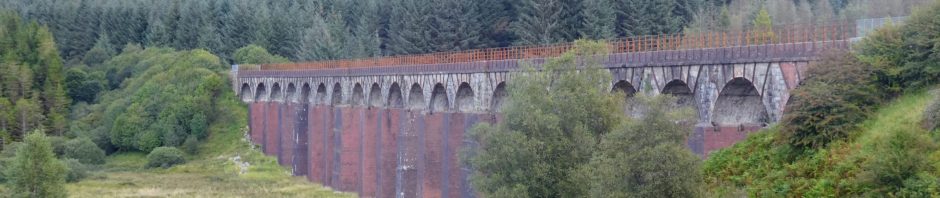
Anyone who lives in Dumfries and Galloway will be aware that a railway line once spanned the region, snaking its way from Dumfries to Portpatrick, with branch lines to Moffat, Kirkcudbright, Whithorn and the Cairnryan military link, used during the 2nd World War. [1] One does not have to be a railway archaeologist to be aware of the remnants: magnificent viaducts still standing; part demolished bridges; gloriously overgrown cuttings blasted through solid rock; repurposed sections of the track, such as the Maxwelltown Cycle Path. Many lament the slow death of this network, culminating in the Beeching review, which led to the closure of the main section of the line on 12th June 1965. In retrospect we should all surely be able to see that this was a catastrophic loss to the transport infrastructure of Dumfries and Galloway, from which it has never recovered. [2]
I was intrigued by the scheduling of a meeting in Dumfries, organised by the British Regional Transport Association. The primary objective was “to explore the potential benefits of restoring this vital rail link and to outline the necessary next steps for moving forward with the project.” [3] A wonderful pipe dream, I thought.
When the day came, a Saturday, we were enjoying a short spell of fine weather and with rain forecast for Sunday, I hesitated, but decided to attend. There’ll be a handful of people I thought. The scheduled 2 hour meeting will dissolve after about 15 minutes, and I will escape to enjoy the fine weather. How wrong I was.
When I arrived, a minute or two late, the room was packed. Things were a little slow to get started but from the outset I detected an irrepressible enthusiasm for the subject present in the room. I could see the lady taking notes was at times struggling to capture it all. But Chair Scott Borthwick – a signaller at Network Rail in Dumfries – managed to keep the lid on all this energy.
A number of apologies were given from politicians, Conservative, SNP and Labour. They are mostly engaged in campaigning for the Holyrood election Thursday 7th May 2026. Laura Moodie, a candidate for the Green Party, was one of the meeting organisers and spoke strongly in favour of reinstating the rail links.
I think it fair to say, in the intense and remarkably well informed discussion that ensued, there was a degree of scepticism coming from some quarters as regards the central proposal. But for every obstacle raised against the viability of the project, from some other part of the room came a seemingly practical way round the problem. I must be honest. I could not keep up with the detail of it all, as obscure sections of the line and arcane details of topography were discussed, problems set out, and workarounds presented.
Goldielea Viaduct
There were interesting side discussions: the problem of relying so totally on the private car; the generally overlooked cost of parking all the cars on which we have become so dependent. That’s space outside new homes that are being built for two or more cars. But also space outside supermarkets and visitor attractions. It all adds up to a great deal of costly tarmac and urban sprawl.
Potholes naturally found a place in the discussion. If we could get those timber lorries and other heavy goods vehicles off our roads and onto the railways there would be less wear and tear on our road surfaces.
Inevitably the more widely touted infrastructure project for Dumfries and Galloway, the dualling of the A75, was the subject of scrutiny. The only person openly supporting this in the room was Labour Councillor Keith Walters, the only politician in attendance, apart from Laura Moodie. Councillor Walters made it very clear that he was also supportive of reinstatement of the rail link and open to arguments relating to cost and practicality.
The consensus in the room however was against dualling. This resistance was based on fairly well established arguments. New roads, over time, generate increased traffic volume. The example of Dumfries bypass, opened in 1990, could not be ignored.
Undeniably, the bypass has reduced the passage of heavy goods vehicles through the centre of the town. It has also, however, resulted in a progressive evisceration of the commercial centre of Dumfries.
In the intervening years much town centre retail has migrated to the bypass. Dumfries and Galloway Royal Infirmary, The Premier Inn and Brasswell Office Park are more recent instances of development located on the bypass. The bypass itself is now frequently congested. Taking the town centre can often seem the better bet.
The arguments in the room suggested strongly that the cost of dualling the A75 and the logistical problems the project would encounter make the reinstatement of the railway link quite possibly a cheaper and more achievable solution.
I have another reason for favouring redevelopment of the railway. I have recently been reading the excellent Wild Galloway.[4]The book’s author, Ian Carter, is a naturalist who has moved from Devon to live in this area. Wild Galloway makes it clear that, despite the challenges posed by farming and forestry, our region contains more genuine wildness than almost anywhere in the United Kingdom apart from the Highlands.
It is important to question the impact of any infrastructure development on this precious habitat. Am I wrong in thinking that a reinstatement of railway infrastructure would be more sympathetic in this respect than a second carriageway for the A75 and all that we might expect to follow from that?
Better transport infrastructure will help to build a more prosperous small business friendly Dumfries and Galloway. What’s needed to steer this in the right direction is a proper, independent evaluation with a clear brief. That would provide informed guidance on which our political parties can make rational plans for the future.
I am a retired College lecturer, having worked originally in supported programmes but latterly having taught social science subjects, Psychology and Politics, though my degree was in Sociology. I am from Newry in Northern Ireland, but now live in Dumfries in South West Scotland. https://carruchan.wordpress.com/about/


Transported
Observations from a meeting advocating the reopening of rail links in Dumfries and Galloway.
Anyone who lives in Dumfries and Galloway will be aware that a railway line once spanned the region, snaking its way from Dumfries to Portpatrick, with branch lines to Moffat, Kirkcudbright, Whithorn and the Cairnryan military link, used during the 2nd World War. [1] One does not have to be a railway archaeologist to be aware of the remnants: magnificent viaducts still standing; part demolished bridges; gloriously overgrown cuttings blasted through solid rock; repurposed sections of the track, such as the Maxwelltown Cycle Path. Many lament the slow death of this network, culminating in the Beeching review, which led to the closure of the main section of the line on 12th June 1965. In retrospect we should all surely be able to see that this was a catastrophic loss to the transport infrastructure of Dumfries and Galloway, from which it has never recovered. [2]
I was intrigued by the scheduling of a meeting in Dumfries, organised by the British Regional Transport Association. The primary objective was “to explore the potential benefits of restoring this vital rail link and to outline the necessary next steps for moving forward with the project.” [3] A wonderful pipe dream, I thought.
When the day came, a Saturday, we were enjoying a short spell of fine weather and with rain forecast for Sunday, I hesitated, but decided to attend. There’ll be a handful of people I thought. The scheduled 2 hour meeting will dissolve after about 15 minutes, and I will escape to enjoy the fine weather. How wrong I was.
When I arrived, a minute or two late, the room was packed. Things were a little slow to get started but from the outset I detected an irrepressible enthusiasm for the subject present in the room. I could see the lady taking notes was at times struggling to capture it all. But Chair Scott Borthwick – a signaller at Network Rail in Dumfries – managed to keep the lid on all this energy.
A number of apologies were given from politicians, Conservative, SNP and Labour. They are mostly engaged in campaigning for the Holyrood election Thursday 7th May 2026. Laura Moodie, a candidate for the Green Party, was one of the meeting organisers and spoke strongly in favour of reinstating the rail links.
I think it fair to say, in the intense and remarkably well informed discussion that ensued, there was a degree of scepticism coming from some quarters as regards the central proposal. But for every obstacle raised against the viability of the project, from some other part of the room came a seemingly practical way round the problem. I must be honest. I could not keep up with the detail of it all, as obscure sections of the line and arcane details of topography were discussed, problems set out, and workarounds presented.
There were interesting side discussions: the problem of relying so totally on the private car; the generally overlooked cost of parking all the cars on which we have become so dependent. That’s space outside new homes that are being built for two or more cars. But also space outside supermarkets and visitor attractions. It all adds up to a great deal of costly tarmac and urban sprawl.
Potholes naturally found a place in the discussion. If we could get those timber lorries and other heavy goods vehicles off our roads and onto the railways there would be less wear and tear on our road surfaces.
Inevitably the more widely touted infrastructure project for Dumfries and Galloway, the dualling of the A75, was the subject of scrutiny. The only person openly supporting this in the room was Labour Councillor Keith Walters, the only politician in attendance, apart from Laura Moodie. Councillor Walters made it very clear that he was also supportive of reinstatement of the rail link and open to arguments relating to cost and practicality.
The consensus in the room however was against dualling. This resistance was based on fairly well established arguments. New roads, over time, generate increased traffic volume. The example of Dumfries bypass, opened in 1990, could not be ignored.
Undeniably, the bypass has reduced the passage of heavy goods vehicles through the centre of the town. It has also, however, resulted in a progressive evisceration of the commercial centre of Dumfries.
In the intervening years much town centre retail has migrated to the bypass. Dumfries and Galloway Royal Infirmary, The Premier Inn and Brasswell Office Park are more recent instances of development located on the bypass. The bypass itself is now frequently congested. Taking the town centre can often seem the better bet.
The arguments in the room suggested strongly that the cost of dualling the A75 and the logistical problems the project would encounter make the reinstatement of the railway link quite possibly a cheaper and more achievable solution.
I have another reason for favouring redevelopment of the railway. I have recently been reading the excellent Wild Galloway.[4] The book’s author, Ian Carter, is a naturalist who has moved from Devon to live in this area. Wild Galloway makes it clear that, despite the challenges posed by farming and forestry, our region contains more genuine wildness than almost anywhere in the United Kingdom apart from the Highlands.
It is important to question the impact of any infrastructure development on this precious habitat. Am I wrong in thinking that a reinstatement of railway infrastructure would be more sympathetic in this respect than a second carriageway for the A75 and all that we might expect to follow from that?
Better transport infrastructure will help to build a more prosperous small business friendly Dumfries and Galloway. What’s needed to steer this in the right direction is a proper, independent evaluation with a clear brief. That would provide informed guidance on which our political parties can make rational plans for the future.
Endnotes
[1] Exploring Dumfries and Galloway’s Lost Railway Heritage – A Walkers Guide – Alasdair Wham
[2] Wikipedia Portpatrick and Wigtownshire Joint Railways
[3] Dumfries and Galloway What’s Going On Public To Have Their Say On Re-opening Dumfries To Stranraer Railway
[4] Wild Galloway: From the hilltops to the Solway, a portrait of a glen – Ian Carter
Header Image – Big Water of Fleet Viaduct SPS
Main image of Goldielea Viaduct – SPS
Share this:
About Stephen Shellard
I am a retired College lecturer, having worked originally in supported programmes but latterly having taught social science subjects, Psychology and Politics, though my degree was in Sociology. I am from Newry in Northern Ireland, but now live in Dumfries in South West Scotland. https://carruchan.wordpress.com/about/