How to avoid a climate disaster…

If you have been living under a stone for the last fortnight, or have in some other manner, [and with good reason] been protecting yourself from all the world wishes to throw at you, then you may not already be aware that Bill Gates has recently published a book, How to Avoid a Climate Disaster.

In weighing up the matter of whether to buy a copy, I read a few reviews, and found them, without exception, [though somewhat grudgingly in a number of cases], positive.

The main source of grievance raised against Gates, apart from his self-evident smartness, seems to be his love of the private jets he uses to get from A to B in his mission to give away his vast wealth in the name of the Bill & Melinda Gates foundation. Despite his very frank and disarming admission that this does not sit comfortably with his concerns regarding the climate crisis,at least some reviewers felt the need to pause and consider whether this foible makes him liable to the charge of rank hypocrisy; the verdict in general was that regardless, his book is a stark but nevertheless clearly argued assessment of our climate plight.

For myself, I have never really quite forgiven Bill Gates for the Windows operating system, and those agonising hours spent in front of the circle of death wondering whether to press ctrl-alt-delete, or to cut my losses and just do a complete physical shut-down and a restart. Yet Bill Gates’s more recent record on the pandemic, where he was a source of early warnings to which we should all have been paying attention, and where he has continued to be a voice of common sense and reason, has encouraged me to look upon him with more favour. I was rather pleased therefore to find that How to Avoid Climate Disaster had been abridged for BBC Radio’s book of the week, in five parts, each under 15 minutes in length, the first extract being broadcast on 15th February.

Now quite a chunk must have been excised from the 272 pages of the original text, but I think the abridgement rather successfully covers many of the key issues picked up in the reviews, in particular his attention to the generally overlooked climate villains of concrete and steel production, and farming, where, in each case, the need for technological breakthroughs is most urgent; my only disappointment was that Bill Gates himself didn’t do the reading, as I have come to enjoy his slightly Kermit the frog like tone of authority. I dare say though, he has other things to attend to.

The book does not underestimate the scale of the challenges we face, and presents its arguments with simple clarity and without hysterical overdramitisation. I would encourage anyone with a grain of interest in the subject, who lives in the UK and who has access to BBC iPlayer, to take a listen – as I write, it’s still available for 21 days to download. If you live outside the UK, then I regret to say you’ll probably have to pay the full price for the book, though why not try the link? Their guard may be down.

How to Avoid a Climate Disaster by Bill Gates [Available from BBC iPlayer]

How to Avoid a Climate Disaster Hard Back edition £14.08

Kindle edition: £9.99

Featured Image

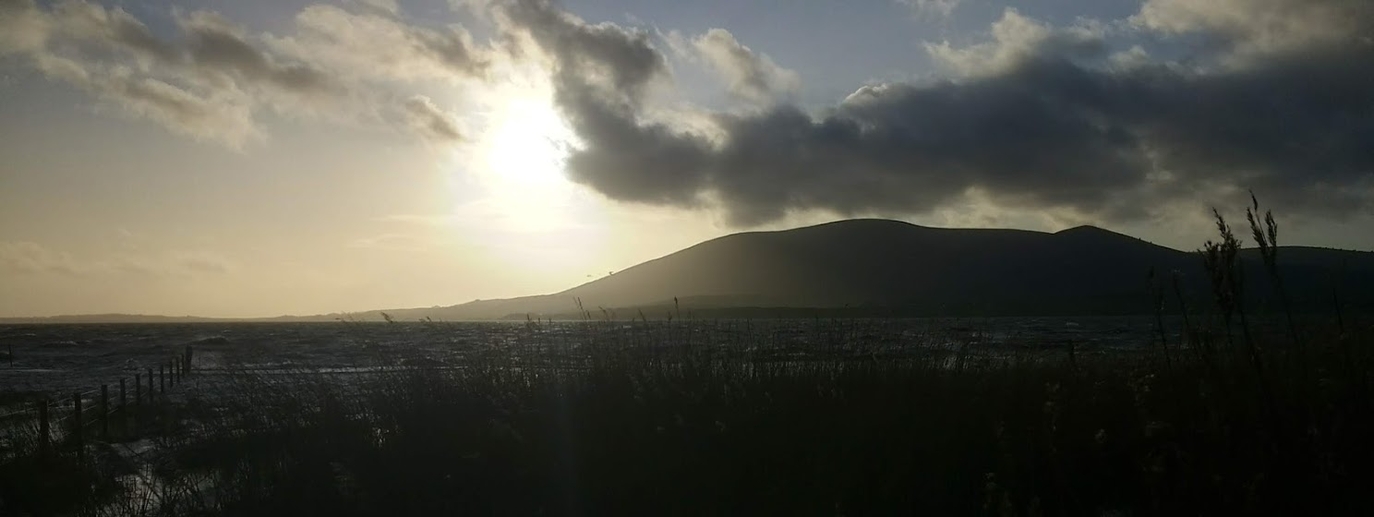
Looking west from Portpatrick across the North Channel to Ireland. Photo, SPS.
Posted in Books | Tagged , | Leave a comment

Time up for the House of Lords, and an end to “nostalgic deference.”

In a previous post [1] I speculated on the probability of Scottish Independence and on the question of whether there was any reform which might make the Union of the United Kingdom worth saving.   The answer I suggested was a simple one, widely discussed, thought not generally proposed as a solution in this context: the replacement of our current First Past the Post System [FPTP] system of electing MPs, with some form of Proportional Representation[PR]

If I can claim any originality in making this suggestion, it is that PR has the potential to secure the Union by making it work for all of its constituent parts, unlike FPTP, which has, over many years opened up a number of fault lines in the Union, the most recent and most conspicuous being that between England and Scotland. 

The great problem for PR however is that, as a reforming measure, for all its radical potential, it lacks pizzazz; it is just a little too technical a reform to have immediate appeal.  Perhaps, if it is to attract more popular attention, it needs to be wrapped up in something a little more eye-catching.   

So far as eye catching proposals, targeted at restoring the UK union and currently in circulation are concerned, I am somewhat sceptical as to the value of Devo Max [2] or Gordon Brown’s ideas on federalism, which I am inclined to think will be regarded by secessionists as further stepping stones on the journey to full independence. I do agree with Gordon Brown, however, when he says: Most of all, we need to understand that the enduring unity of our country depends not on a nostalgic deference to ancient institutions that are not working but on forging a new story about what it is to be British. [3]

The Talking Politics podcast on 4th February[4], offered  an interesting historical perspective on the Union, but what most excited me was a throwaway suggestion from the historian, Professor Colin Kidd, towards the end of the discussion, for abolition of the House of Lords and it’s replacement by an elected House of Nations, with  some equivalence to the US Senate. 

This is of course a nod to the idea of federalism. In making his suggestion, however, Prof. Kidd expressed scepticism that England could be disaggregated into regions, and when it comes to regional parliaments such as we see in Wales or Scotland, I would agree. There has been little appetite for regional assemblies in an English context. However, disaggregation of England into  regions within the context of a newly conceived second chamber would be more easily achieved and accepted as a way in which the nations and regions of the UK can exercise a restraining and corrective influence over the UK Parliament.   It is for this reason that I propose a spin on Professor Kidd’s idea, best summarised by a suggested name for the new institution: United Kingdom House of Nations and Regions

The regional elements could be based on the old European Parliament constituencies.  If there were, for example, 20 representatives from each region, this would amount to 220 seats in total, or 30 from each region, 330, and so on.  Wikipedia, I notice, provides some rather amusing facts on the somewhat bloated character of the House of Lords which Currently….has 800 sitting members…. is the only upper house of any bicameral parliament in the world to be larger than its lower house, and is the second-largest legislative chamber in the world behind the Chinese National People’s Congress. [5]

This is not the place for a detailed discussion of how such a reformed chamber might be constituted and function, but, in addition to the obvious scrutinising role of a second chamber, here’s a few possibilities.

  • Regional/national powers to delay legislation thought to be prejudicial to the interests of a particular region.
  • A remit to review constitutional matters on a cyclical basis.
  • Election of a President from within the chamber, who might be provided with some additional powers, possibly to:
    • act in the event of deadlock or crisis within the legislature [House of Commons], or in the event of difficulties in government formation following an election.
    • To assume some of the constitutional powers of the monarch
  • An intention to move the chamber to a more central location in the United Kingdom, such as Liverpool, Manchester or Leeds. 

In my own mind, it is electoral reform which would have the most radical impact on UK politics. However, abolition of the House of Lords and replacement with a chamber giving status to the nations and regions would, when combined with electoral reform, offer a more rounded package which could hope to appeal to a Scottish demographic, and help to rebuild belief in the idea that we should work with our neighbours and not separate from them.  These changes, moreover, would unlock further reform.

The implementation of such reforms, clearly intended to address dysfunction within the UK Union, would justify delaying a second Independence referendum, but not indefinitely. Any such constitutional reform intended to secure the Union, should set a date, no more than 10 years in the future, at which point Scots would have an opportunity to decide whether to stick with the auld enemy, or to sever.

Footnotes

[1] Saving the union: A job for a superhero? Nah — there could be a fix, but is it really worth the bother? 

[2] Devo Max  – Full fiscal autonomy for Scotland.

[3] Gordon Brown We need a new way to run a truly United Kingdom

[4] Talking Politics Podcast  What is the Union?  https://www.talkingpoliticspodcast.com/blog/2021/304-what-is-the-union   [Reform of the House of  Lords, discussed at 47minutes and following, though the entire discussion is worth listening to. ]

[5] Wikipedia – House of Lords 

Featured Image

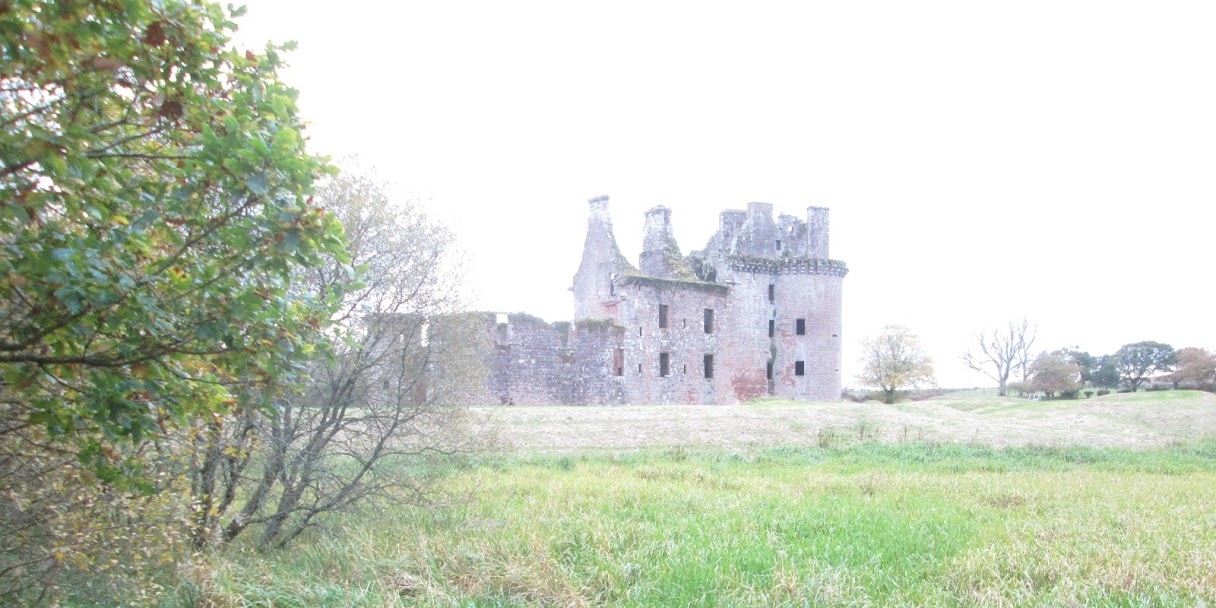
Caerlaverock Castle, located near Dumfries. Pictgure SPS

Posted in Other Constitutional discussion | Tagged , , , , | 1 Comment

The Medium and the Message

A reflection on teachers, missionaries and poets, given as a talk to St. Michael’s Church Burns Club, Tuesday 4th December, 2018.

Header image, adapted from St Michael’s and South Parish Church Graveyard, Dumfries – Billy McCrorie

My Parents were both teachers.  My Father taught Mathematics whilst my Mother, before she was married,  had worked as a primary school teacher in the Republic of Ireland.  When she came to the North, and her family were  grown, she once again wished to teach, but she could not resume her career, as her qualification was not recognised.   

Unsurprisingly I was encouraged to see University  as an appropriate ambition, though my parents were keen to assure me, and my two elder brothers, that I would be valued regardless of my academic successes or failures. As things turned out,  I made good – though not brilliant –  progress,  in my passage through Primary and Secondary Schools, before going to Reading University, to take a degree in Sociology.

Quite early in my secondary school life, a number of ideas formed.   In my evolving worldview, education had high value, and I was clear that an understanding and appreciation of  arts,  sciences, music, poetry and philosophy would contribute something important, if not vital, to my  appreciation of and success in life.  

And yet; my actual experience of education did not inspire.  I lived for the sound of the bell which would release me to play football, and for the long summer holidays, which I loved.

As I looked around me at the response of my classmates to their educational offer, it seemed broadly similar to my own.  Though some were good at it, nobody I knew truly loved learning.  We knew education was important, but despite occasional highpoints,  it was not something that we did for its intrinsic value. 

When I compared my grades with those of others, I had the uneasy feeling that, where I was doing quite well, many others were underperforming.  They seemed at least as intelligent and alert to the world as myself, but they scored less well in their exams.

In progressing to University, despite switching from the study of pure sciences to the more fashionable  Social Sciences, I found my lectures less than engaging; I fell asleep in the University library over the set texts, and I struggled to complete my essays, though always submitted on time and generally got a  credible grade. 

In my final year, a friend, Keith,  lent me a book by an American Primary School teacher, John Holt.  It was titled How Children Fail, and was a revelation to me. It’s opening words; “Most children in school fail.”   “For a great many this failure is avowed and absolute.  Close to 40% of those who begin High School dropout before they finish.  For College the figure is one in three.”

The context was of course American, but the words resonated with my own observation. Holt’s writing was simple, clear, and as I read on I could see, was based on a profound insight into the children he was teaching, and their struggles and failures to progress.

I read everything that Holt published.  I became interested in the free school movement and the Summerhill experiment, where children attended class only if they wished.  A.S.Neil, who founded Summerhill in 1921, was a Scot, not that that was greatly significant to me at the time. Summerhill continues to offer its remarkable model of education, to those parents with enough nerve – and money, it must be said –  to offer their children the freedom which Neil so prized. Kilquhanity, founded by the late John Aitkenhead, a contemporary of Neil’s is our local version of Summerhill, less famous, but nevertheless, an institution of note.  I recently encountered someone who had sent their children to Kilquhanity, who informed me that it is now closed.

Inevitably  I was drawn to explore an even more radical idea, set out in the critique of professionalised education, developed by the former Catholic Priest, Ivan Illich.  His book, Deschooling Society, by contrast with the writing of John Holt,  was difficult both in terms of the huge challenge he made to the modern compulsory education system, but also in terms of the language and metaphor he deployed. 

Illich’s first language was actually German, but he was able to write in English, French, Spanish and seemingly, to be able to acquire new languages in the way that others may acquire new clothes – as and when required.

Illich was a fascinating figure, and I wish to say something about the experiences which had formed the basis of his critique.  Following his training as a Catholic Priest in Europe he travelled to New York to work amongst the newly established Puerto Rican community during the 1950s.  His success in this work was noted by the hierarchy of the Church and he was chosen to lead a mission to the countries of Latin America, to those parts where the Church was not yet fully established, and the infrastructure of the church was not yet in place.

Illich though was deeply skeptical, and regarded the record of missionaries as one of cultural imperialism, an imposition made more destructive by  disregard and ignorance of the indigenous culture, and  arrogance born of education and membership of a culture assumed to be superior.

What then was Illich’s missionary vision?  I won’t pretend to speak with authority in trying to answer this question.  I think Illich believed the evangelising mission mounted by the US Catholic Church, would bring in its wake all the values of  a fully developed consumer capitalism,and that this contagion,rather than the message of the Christian Gospels, would be the ultimate legacy of the enterprise,   American values he appeared to believe would destroy much that was precious in the evangelised culture.

His challenge in training priests for this mission was to avoid this outcome.  And so I imagine that he gave a central importance    to the need for humility and the importance of respect for the culture encountered by the mission. The objective of the missionary should not be to teach, but rather to learn.  At base, the role of the missionary should be to practice Christian values, but not to preach them.  “The medium”,  as Marshall McLuhan said, “is the message.” McLuhan’s point was that how we behave gives the context to what we say, and is in fact, fundamental to what is transmitted.  People learn by example rather than by instruction.   

At the conclusion I think Illich  believed that both the evangelist and the evangelised could be changed for the better by their encounter, but not in ways that could be entirely under the control of either. 

Though  Illich  had a profound attachment to the Catholic Church, we should not be surprised that the approach he was fostering proved controversial, that his originality, though supported by some of his superiors, was strongly resisted by others: eventually he felt unable to carry on, and ceased to practice as a Catholic Priest, though apparently took pleasure, on occasion, in being able to celebrate Mass, in circumstances I imagine where Church buildings and infrastructure were still thin on the ground.  

I see connections in Illich’s thinking, with the Protestant reformation. We know of course that the reformation was in part a reaction against the corruption of the Catholic Church at a certain point in history.  But the ideas of the Protestant revolution either were or became something more: an expression of the freedom of each individual to interpret scripture according to their own lights. The invention of the printing press by Johannes Gutenberg, in the 15th Century, was of course critical in making this a meaningful proposition, as it democratised access to the written word, and resulted in the extension of reading and education in general, with the Bible one of the first texts to be disseminated.

As we know, the history of protestantism has itself been disputatious, and in some cases, it seems fair to say, that churches developed and promulgated their own orthodoxies in ways which may have fallen short of the humility advocated by Illich in his programme to prepare missionaries. 

Desertmartin is a small village in Ulster and Tom Paulin, in his poem of that name,  speaks of a “plain Presbyterian grace”, and its “free strenuous spirit”, qualities which were strongly  present in the Ulster of my youth.  I grew up in the Episcopalean Church of Ireland,  bound into a Unionist culture united largely  by its suspicion of the Roman Catholic minority. My family though, coming from the south, were always to some extent outsiders, and so I find it easy to follow Paulin as he goes on to make some sharper commentary.   

It’s a limed nest, this place. I see a plain

Presbyterian grace sour, then harden

As a free strenuous spirit changes

To a servile defiance that whines and shrieks

For the bondage of the letter: it shouts

For the Big Man to lead his wee people

To a clean white prison, their scorched tomorrow.

Robert Burns  was a member of this Church, but I am aware that he was fond of hearing the sermons of other churches and that he “often attended the Burgher Kirk in Loreburn Street”  – “as he could not abide the minister of the day in St Michael’s.”

When my interest in the ideas of Holt and Illich first developed, I naturally found myself discussing them with friends and relatives.  I would have to admit that I found little real welcome for these ideas, and much skepticism.  My lack of experience, in particular of teaching, was challenged, and though my experience of being a pupil seemed to me more relevant, I decided to train to be a teacher, though with some uncertainty as to whether this was really the career that I should embark on.  Indeed having obtained my PGCE,  I spent several years in other  employments, some of which were clearly transitional, and other which offered real possible career paths.  I spent a couple of years as a detached youth worker in Reading;  I spent a year as a volunteer worker in a young offenders’ centre run by Save the Children in Northern Ireland.  When I came to Dumfries, I found work as an auxiliary at Elmbank,  a department of Dumfries Academy, for pupils excluded from schools in the west of the region.  In truth, though I was not a teacher, in all of these employments, the work bore some resemblance to that of a missionary, where my role was, in some way, to imbue a positive set of values, in terms of relationships, work ethic, and character, in the young people with whom I was working. I was a part of the  professional project to tame the young people with whom I was charged.

I am a long time fan of the work of Bob Dylan.  Dylan dropped out in his first year at the University of Minnesota,  and taught  himself the conventions of the folk idiom in which he first became prominent.  In his book Chronicles, he describes finding himself sometime in the early 1960s, staying in  a household with a substantial library.  Daunted by engagement with all this learning, he would simply open books at random, and if what he read appealed, would then engage more fully with the content. This method may perhaps help to explain the extraordinarily eclectic nature of his developing work: here’s a verse from his extended song, Desolation row:

Recording of Dylan singing:

Now Ophelia, she’s ’neath the window

For her I feel so afraid

On her twenty-second birthday

She already is an old maid

To her, death is quite romantic

She wears an iron vest

Her profession’s her religion

Her sin is her lifelessness

And though her eyes are fixed upon

Noah’s great rainbow

She spends her time peeking

Into Desolation Row

Let’s look again at four lines:

To her, death is quite romantic

She wears an iron vest

Her profession’s her religion

Her sin is her lifelessness

This is a mysterious verse in a long mysterious song;  whether Dylan intends it or not, I read these lines as a sardonic comment on the way professional helpers experience a vicarious vitality from the lives that they “peek in on.”  

A similar idea  is alluded to in the title of a recently published book by a young Scottish writer and autodidact Darren Garvey.    “Poverty Safari” describes Garvey’s emergence from a life of alcohol and drug addiction, to his current status as a successful rap artist, writer and highly articulate spokesperson for his the community in which he grew up.  He first came to my notice when he appeared on the BBC Question time programme.  The opening page of his book is given over to a poem, written in the Glasgow vernacular, by the Scottish Poet, Tom Leonard, and with slight reservation, I should like to read it to you in particular for its pithy perspective on the professional helper.  It’s called:

Liaison Coordinator

Efturryd geenuz iz speel

Iboot whut wuz right

Nwhut wuz rang

A sayzti thi bloke

Nwhut izzit yi caw

Yir joab jimmy

Am a liaison co-ordinator

Hi sayz oh good ah sayz

A liaison co-ordinator

Jist whut this erria needs

What way aw thi unimploymint

Inaw thi bevvying

Nthi boayz runnin amok

Nthi hoossyz fawnty bits

Nthi wummin n tranquilisers

It last thiv sent uz a liaison  co-ordinator

Sumdy wia digreee

In  fuck knows whut

Getn peyd fur no known

Whut they fuck ti day wi it

But let us return to Illich’s critique of the school system. Illich was not attacking education per se.  Indeed in the latter stages of his life he taught in universities in both Germany and the USA.  However compulsory school, though offering a vision of, to use Dylan’s phrase, “Noah’s great Rainbow” was in Illich’s polemic, a loaded competition, providing a route to prosperity for a fortunate and generally privileged few, whilst persuading the remainder, that their failure to make better use of the free opportunity provided  for them, was a fair assessment of their value, capability and proper place in the hierarchy of social class.  This Illich referred to as “the hidden curriculum” of compulsory education.

As John Holt put it so succinctly: “Most children in school fail.”  

Implicit in this statement is that  “Most children” leave school with the greater part of their talents and potential unrecognised both by themselves and by their teachers.

I do not suggest that this outcome is intended, by anyone, least of all, those who work within the system;  yet this stark summary  continues to strike me as entirely accurate. 

An instance of how this subterfuge is achieved may be seen in the way the Scottish Education system typically treats those whose mother tongue is  the Scottish vernacular.    The language spoken by most working class Scots is a  derivative of the Scots language which Burns used to such eloquent effect.   This modern vernacular has its own idioms and is frequently punctuated with an Anglo Saxon colour, a feature which I expect did form some part of the spoken language in Burn’s day.   

Whilst there is genuine and worthy promotion of the work of Burns in our schools, the mother tongue spoken by  many of those who attend, which they use to address their parents and grandparents, their close friends and neighbours, is treated as something unworthy of a classroom  setting, a debased remnant of the language in which Burns was fluent.  

As Scottish working class children enter the education system, they are hobbled from the outset, and expected, to learn to read and to express themselves in Standard English.  In the contest which school sets running, it is the children from middle class families who find the way into the written word is simple and straight forward, whilst those brought up in the modern scots vernacular will find that, in their first steps in education, they will be more likely to experience stumbles and humiliation.

 Writers like  Tom Leonard and the novelist Jim Kelman challenge the idea that this language cannot have literary importance, but their work is too authentically a representation of the language we can hear daily in our high street, for it to be deemed, in general, suitable for educational purposes.  

The world of great literature, it is fair to say, is dominated by the writing of those who have charted a successful course through their education.  But there are notable exceptions.  I think of Patrick Kavanagh an Irish poet, who farmed until he was thirty, and then walked the sixty miles to Dublin, to become part of the literary scene which he had, until that point, admired from afar. Here is a verse from his poem “Shancoduff” which I assume to be the name of his farm in County Monaghan, just across the Border from Newry, in Northern Ireland, where I grew up.

The Sleety winds fondle the rushy beards of Shancoduff

While the cattle drovers sheltering in the Featherna Bush

Look up and say: “Who owns them hungry hills?

That the water-hen and the snipe must have forsaken?

A poet? Then, by heavens he must be poor

I hear and is my heart not badly shaken

 I think also of William Blake, the period of whose life crossed with that of Burns, but who was largely unknown in his lifetime.   According to Wikipedia  Blake “attended school only long enough to learn reading and writing, leaving at the age of ten, and was otherwise educated at home by his mother Catherine Blake.”   I am particularly fond of his proverbs of hell. An example: “The road of excess leads to the palace of wisdom”  Old fuddy duddy that I am, I feel compelled to add a cautionary note….”if it doesn’t kill you first” – but when I look at someone like Darren McGarvey and read his aforementioned “Poverty Safari” I know that Blake, though seemingly not a person of excess himself, was onto something, and did not disdain excess in those around him..  Burns was no stranger to excess. John Syme, on the second Galloway tour recalled:

“’We left Kenmure, and went to Gatehouse.  ….. In a little while the rain began to fall. It poured in floods upon us. For three hours did the wild elements rumble their bellyful upon our defenceless heads. Oh, oh! ’twas foul. We got utterly wet; and, to avenge ourselves, Burns insisted, at Gatehouse, on our getting utterly drunk.”

 I will finish with a little counter factual in relation to the life of Burns. Let us suppose some Ayrshire landowner had spotted the gifts of the young Robert Burns, and decided to bestow on him the benefits of an education, beyond that which he was able to afford.  With his great talents we may speculate that Burns would have progressed to university, would have become prominent in his field of study, perhaps a Professor of Literature or of Philosophy.  He might indeed have written poetry.  He might have become famed for his rise from humble origins just as in the case of Alexander Murray, born on a sheep farm near Newton Stewart in 1775,  who rose, more by his own efforts than any philanthropy, to become a Professor of Oriental Languages at Edinburgh University.  Burns’ life might have been longer, healthier, more prosperous. 

Had this been the course of his life, we might still memorialise him: but the entire corpus of the  work we know, based so fundamentally on his lived experience, would have been lost.

i will finish by reciting just a single verse from just one of Burns’ poems.  It is from perhaps his best known poem and though I do not say that it is the greatest poetry ever written,  it touches me more than any other, and for this I value it more than any other.

I’m truly sorry Man’s dominion

Has broken Nature’s social union

An’ justifies that ill opinion

Which makes thee startle

At me, thy poor, earth-born companion

An’ fellow-mortal!

[from: To a Mouse]

Posted in Misc | Tagged , , , , | 2 Comments

Saving the union: A job for a superhero? Nah — there could be a fix, but is it really worth the bother?

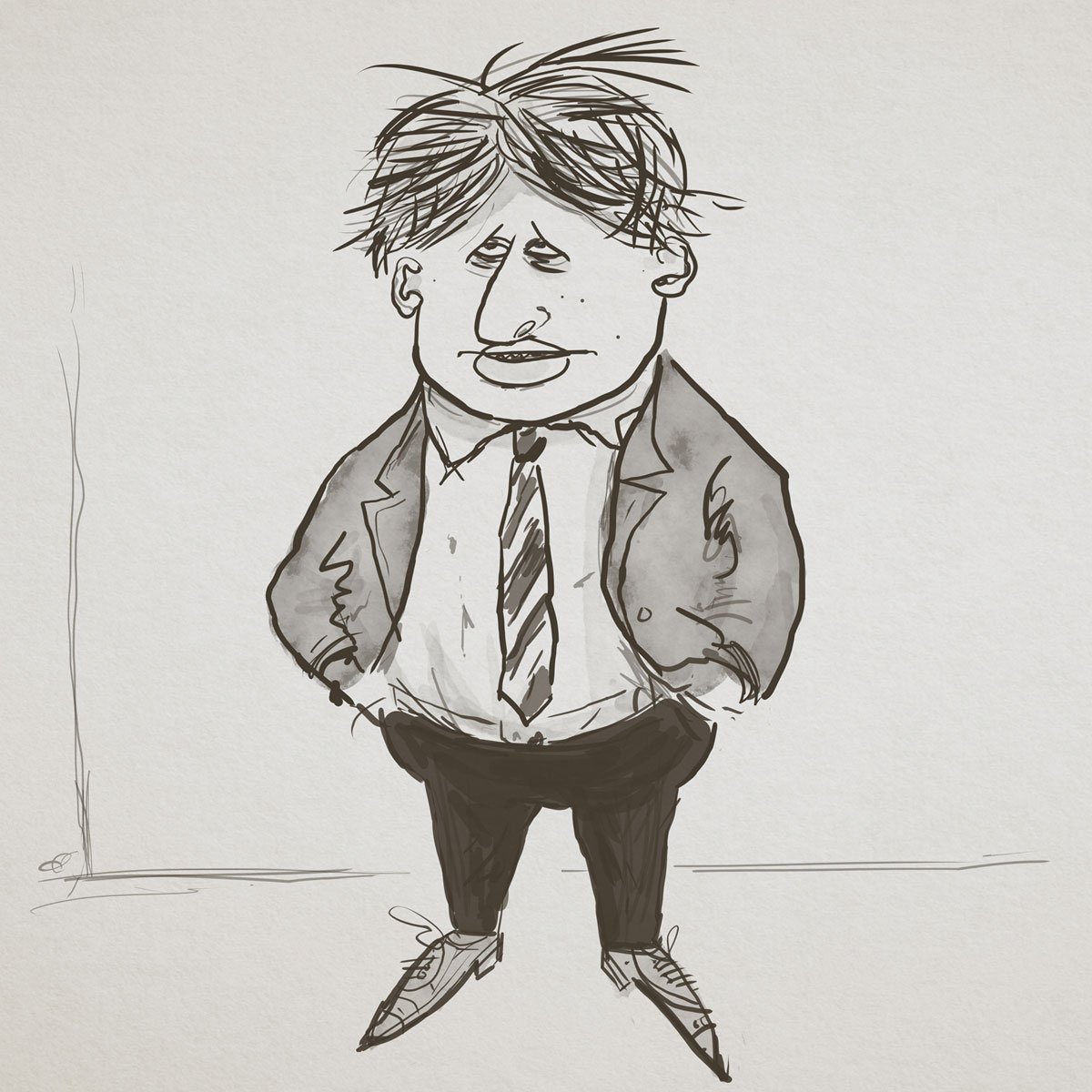
Boris, possibly thinking about his wizard wheeze…drawing, after Ronald Searle, by  Richard Littler

Having “done Brexit”, the intervention of the pandemic has deflected Boris Johnston from what might be his second great project, securing the Union of the United Kingdom. The early signs are, that his political vision falls a long way short of what will be required to keep Scotland in the UK; indeed, he has emerged less as a political superhero and more  like a character out of the Dandy or the Beano, his wizard wheeze being, a buccaneering post Brexit Britain delivering an economic miracle, with just enough of the resulting bounty spilling over the border, to settle the pesky Scots. 

There is however much scepticism in Scotland as regards the miracle happening in the first place, and as to the possibility of prosperity being equally spread across the realm, well, that suggestion is likely to produce much scoffing in Scotland and elsewhere.

One somewhat unglamorous correction to our politics, occasionally discussed, but profoundly underestimated in its potential for encouraging us to work together, is the introduction of a proportional voting system for the House of Commons. It is fair to say that where proportional representation[PR] is concerned, the electorate are mostly disinterested, the popular press largely hostile and for reasons of obvious self interest, MPs, in general, unenthusiastic or staunch opponents of the idea, delighting in directing our attention to the more dire implementations, of which there are a few. [3]

There are more fashionable reforms; an elected second chamber to replace the House of Lords; or Devo Max, where Scotland would have full fiscal autonomy. But neither of these measures has the restorative potential that electoral reform can bring, through the simple impact of ensuring all votes have equal value.

The current electoral system for the UK Parliament, First Past the Post (FPTP), has many defects, but let’s just talk about a single one: its polarising tendency.

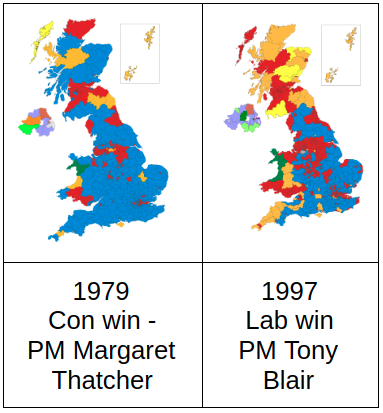
Even before Scottish Nationalism really came to the fore, British electoral politics was characterised by division between the working class inner city Labour strongholds and affluent suburbs and rural areas which have become Conservative strongholds. In saying this, it is important to remember that there is significant support for other parties within these stronghold constituencies, but citizens resident in a stronghold, who choose to support other parties than the dominant one, are on a hiding to nothing. They might as well not turn up to vote, and in all probability, many of them lose interest, and do not.

The carve up begins: Scotland turns against Thatcherite Conservatism in 1997. Images adapted from Wikipedia

Since the 1980s this polarisation has developed a further tentacle, as the Conservative Party in Scotland, once a country with many safe conservative seats, now holds only six out of a total of fifty nine. Forty seven of these are currently held by the Scottish National Party. [2]

The effect of such polarisation is that seats judged to be unwinnable by a party, become less important to their strategic thinking. At our next UK General Election, for example, why should Boris Johnston bother about Scotland? Though there are Tory votes to be won, winning seats would be a lot more difficult.  He knows that his real priority must be to retain  the so-called “red wall”, won from Labour at the 2020 election, for that is how he can hold on to power.

Tipping point!

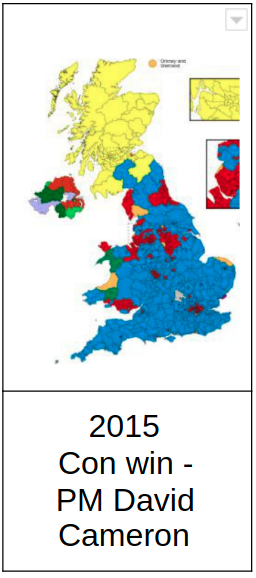
Since the rise of Margaret Thatcher in the 1980’s, Scotland had become a Labour stronghold until, at the 2015 election,  a tipping point was reached and Labour, who in the previous election held forty seats, found themselves in possession of just one, to the SNP’s fifty six.

This political earthquake was the culmination of growing support for independence built on the very strong Yes campaign in the 2014  referendum. It is also frequently suggested that the Labour Party had become complacent about its strength in Scotland, assumed that they would always hold Scotland, and failed to pay attention to growing disillusion in the Scottish electorate.  This was a faultline on which the Scottish National Party have capitalised.

Choosing a system for the UK Parliament

There are good and bad systems of PR, but most proportional systems will oblige all parties who seek to form a government, to treat all votes, regardless of where a citizen is situated, as equally important. 

The Additional member system, as currently used for the Scottish and Welsh Parliaments, has its critics, but in general has worked well. It is constituency based, with regional party lists being used to adjust proportionality following the election. However, the implementation of a voting threshold would be a stabilising feature from a UK Union point of view.

Thresholds are common in PR, designed to avoid fracturing of parties and the election of single issue pressure groups, which can lead to problems building coalitions, and result in frequent crises, governments suddenly collapsing and election fatigue for everyone concerned. For UK wide elections, a threshold could filter out parties unable to gain support across all of the constituent regions of the Union. Such a threshold would ensure that only those gaining significant support in every region of the Union, would be eligible for a seat in the UK Parliament.

The threshold would be low, probably about 2% of votes cast in each region, but as a consequence parties whose vote is concentrated only in one region would find it difficult to win a seat and would be unlikely, I imagine, to even field candidates outside their own territory.[4] It might seem that this threshold would exclusively impact secessionist parties, but it is probable that a party such as the DUP, which held sway over Brexit negotiations in our last Parliament, would be unlikely to find support outside its Northern Irish fiefdom, and so could not win seats in the House of Commons. The DUP however would continue to stand for and have every hope of winning seats in the Stormont Assembly.

To ensure fair representation, such a system would allow preference based voting, so that, where a citizen’s first preference was for a party falling short of the threshold, there would be a second or third choice, for a party with a Union wide profile. This vote would then be counted towards the election of that citizen’s constituency MP and the weighting given to party lists when adjusting the final outcome for proportionality. 

In Northern Ireland, Sinn Fein have always adopted an abstentionist position. They contest UK elections but do not take up the seats they win.  To my own personal frustration they stuck obstinately to this position even when their presence in Parliament might have tipped the outcome of Brexit negotiations in a manner more favourable to their own supporters. The proposed voting system would ensure that Sinn Fein supporters would have an option to cast another vote for a candidate to represent them in the UK Parliament.

The Labour Party, the Liberal Democrats, and perhaps, the  least likely choice for the Sinn Fein demographic, the Conservative Party, would be obliged to organise and field candidates throughout Northern Ireland.  Sinn Fein would continue to participate in the Stormont Government while making their case for Irish Unity. The SNP and Plaid Cymru, equally, would  continue to make their case for independence through their participation in the Scottish  and Welsh Parliaments respectively. [5]

But is it worth the bother?

Wall in Moiave, South West Scotland – SPS

Having suggested how it might be done, I return to that thorny question of whether saving the Union is worth the bother. Actually, the answer depends on whether the UK Parliament is capable of any reform which might realistically encourage the Union to come together rather than to fracture. I currently see electoral reform as the most effective way of achieving this outcome, albeit gradually, but I am not hopeful that such a reform will be made in the near future. For this reason, I will certainly think seriously about voting for Scottish Independence when the inevitable referendum comes along; but make no mistake: given the challenges which our world is facing, we should really be building and reforming trans-national unions, not breaking them up. 

You are welcome to comment on this article using your WordPress account or like comment or share at this facebook link! All comments will be moderated.

References and Footnotes

[1] Boris Johnson is planning radical changes to the UK constitution – here are the ones you need to know about 

[2]  List of MPs for constituencies in Scotland (2019–present) 

[3] The Liberal Democrats have consistently supported PR, as of course do the Green Party. Many well known figures in the Labour Party have supported PR over the years, and it may be that this number is growing. Following the 2010 election however, Labour were resistant to coalition with the Liberal Democrats on the basis of an agreement to have a PR referendum.  The Labour Party Campaign for Electoral Reform (LCER) has, however, campaigned for many years for reform of the electoral system and advocates for PR. I am a member. More information on LCER

For dire implementations, see Israel, which has a single constituency for the entire country and, Turkey, which has a 10% threshold, the highest of any country.

[4] Thresholds of this type are commonly used in national elections, for example in Poland, Germany and New Zealand. Their purpose in general is to prevent dislocation of the party system, such that coalition building following an election becomes problematic. More detail: Electoral Thresholds – Wikipedia

[5] I do not think it too much of a stretch to suggest this voting system would accelerate a movement away from sectarian voting patterns in Northern Ireland. It is probable that the Unionist Party might integrate more fully with the Conservative Party, [though the Conservative Party already organise in Northern Ireland], and the Alliance Party with the Liberal Democrats. The Labour Party’s position would be more difficult at the outset, as their most natural ally is the SDLP, which is committed to Irish Unity. However, as a party of the left, Labour should be able to establish the required minimum percentage at their first outing even discounting the likely second preference votes they would get from SDLP and Sinn Fein supporters.

Featured Image

This image should be displayed at the head of the post, but if you have accessed it via a home page link, it may not be visible. To see the image in its intended place in the post please follow this link.

The English Lake district seen through a gap in the hills of South West Scotland, looking over the Solway.

Posted in Other Constitutional discussion | Tagged , , , , | 1 Comment

Science and nonsense: diet, viruses and vaccines

I was recently told a story about a medical professional who, whilst explaining the benefits he was experiencing from a “low carb” diet, disclosed that it was his intention not to take the coronavirus vaccine; he was “…not going to take the risk of putting something as artificial as a vaccine into his body.” This seemed a little shocking to me, that someone trained as a health professional should have such a sceptical response to a vaccine.

Having taken some interest myself in various dietary models I am aware that a kind of tunnel vision can set in if one is drawn into one dietary paradigm or another. On the one hand, arguments in favour of a diet are frequently set out with reference to scientific studies, but on the other, there is a tendency to imply that even minor dietary infractions will have disproportionate negative impacts.

In the face of such zealous council, I like to remind myself of my late Mother in law, who passed away at the very respectable age of 89, surviving in her latter years largely on a diet of white bread, sweets and biscuits. Despite much encouragement from those who cared for her health that she should include a few vegetables and whole grains in her diet, she had a superstitious resistance to such nostrums, to the end.

Those whole grains though, that well meaning relations were trying to press on my Mother in law, from Dave Asprey’s perspective were not a good idea: For most people, though, the majority of grains have more downsides than upsides. They don’t offer much bioavailable nutrition, they cause inflammation and intestinal damage, they trigger cravings, they’re often full of mold toxins, and there’s a good chance you’ll be better off without them. [1]

Asprey’s story is an interesting one; he has turned his own health journey around dramatically by adopting a ketogenic diet that, as his Bulletproof website declares, challenged everything we knew about nutrition. To the extent that I have studied his site and philosophy, I would say that it is smartly presented, carefully argued and supported by well referenced scientific studies — though I cannot vouch for the quality of those studies.

Dave Asprey has turned his own very positive story into a successful business, marketing a range of attractively packaged products, food, drink and supplements, of which the brand leader is his Bulletproof Coffee. I have actually tried a home made version of this; coffee with a dash of butter and coconut oil, whizzed up together with a stick blender: I found it a surprisingly good start to the day; the butter and oil as Dave Asprey suggests, fuels you until lunchtime and your first actual meal of the day. The caffeine stimulus certainly triggers the expected sense of mental sharpness and energy — always welcome. My only regret is that, personally, I don’t seem to be able to cope with more than one cup a day. I do occasionally chance a second but a third cup leaves me feeling distinctly edgey.

My home brew however falls short of the Bulletproof coffee which Dave Asprey will sell you in the form of a kit costing $56.60. His website tells us that Bulletproof Coffee is a blend of clean coffee and quality fats that satisfies hunger, kick-starts fat-burning and supports cognitive function. This Bulletproof ground coffee kit contains Brain Octane C8 MCT Oil, Grass-Fed Ghee and Bulletproof Original ground coffee. I haven’t thought it necessary to try authentic Bulletproof coffee yet, but would admit that I am tempted by the sound of that Brain Octane C8 MCT Oil. But wait a minute! This product description implies that the coffee I normally drink may not be clean, that the fats I normally ingest may not be of the best quality, and the ghee(clarified butter) I normally consume may not be grass fed, and that all of these things really matter for my health. Actually, having read a little of Dave Asprey’s website I can say that he makes a persuasive case in favour of this evaluation. As it happens, I have already switched to Kerrygold grass fed butter on the basis that it provides more omega-3 oils than the more industrially produced grain fed variety, and I apply a similar critical evaluation in my choice of fats in general; but should I be investing in “clean” coffee? … whatever that may be?

It is at such moments, that I feel it necessary to call to mind my aforementioned Mother-in-law and her diet of white bread, sweets and biscuits.

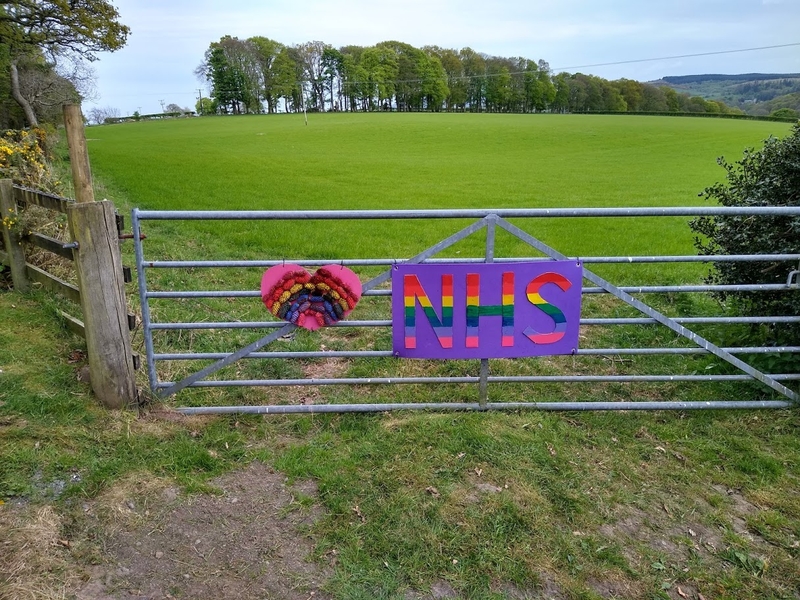
A heart for the NHS – photo EMK

The website, Healthline.com, contains a list of  “7 toxins in food that are actually concerning”.  Reassuringly they say: You may have heard claims that some common foods or ingredients are “toxic.” Fortunately, most of these claims are not supported by science. However, there are a few that may be harmful, particularly when consumed in large amounts.  

That phrase, particularly when consumed in large amounts, deserves repetition; I also note that the list does not include coffee as a source of toxins. [2]

There is increasing acknowledgement that our personal and unique metabolism is a key factor in determining what we should include and exclude from our diet. It follows that the fine tuning of diet is a responsibility we must take on at an individual level. In our personal odyssey towards a diet which offers both the enjoyment of food and the prospect of good health, the more extreme ends of dietary advice should probably be taken with a, (small, of course,) pinch of salt, particularly where such advice is directed towards turning you into a customer.  

The New Scientist magazine has recently published an article titled Low-carb diets: An easy way to lose weight or, recipe for heart attack? It surveys the evidence, and concludes that low-carb diets can help people to lose weight, can be effective in the treatment of type 2 diabetes and can in some instances alleviate otherwise untreatable epilepsy. However there is also some evidence of heart risks associated with such diets. The article points out, however, that for some time, there have been growing concerns that the cholesterol theory of heart disease was on shaky ground. This theory is the basis on which advocacy of low-fat diets has been the medical establishment’s long held orthodoxy. [3]

Scientists do their best to make recommendations on the basis of the research data available but can be slow, in some cases, to modify or overturn ideas, as new and contrary evidence emerges. In the early stages in the life of a new hypothesis, studies may be small, sometimes poorly designed, written up with insufficient detail, and therefore difficult to replicate. Interest groups start to take sides, for example those drug companies which are liable to lose out if a new treatment emerges; or chancers who can see opportunity to step into a gap in the market where doubt is being cast on an existing model of treatment.

In the midst of all this unsettling and messy process we would like our Doctors to be god like in their dispensation of knowledge, but the truth is that keeping up with all the developments in medical and dietary science and adjudicating them, is a big challenge.

Crop of google search on “vaccine”; images, open source.

This probably has some relevance to that vaccine sceptic medical professional, who, doubtless through research on the internet, has discovered a diet which works well for him, despite that diet being somewhat demonised by the medical establishment: it should be no great surprise then that he has become a skeptic with regard to other aspects of what the medical establishment has on offer.

Personally I think that a degree of scepticism as regards what the Doctor may prescribe is wise and though I listen carefully to my Doctor’s advice I also think carefully before I start taking the medicines I am offered: can I recover with my own resources? seems like a good question to ask. Whilst the medical profession has come a long way from it’s early reliance on very crude remedies, we are probably all aware of contemporary treatments which, whatever their benefits may be, are also the cause of significant harms: antibiotics which damage our microbiome, or pain killers which are addictive, for example. I will have no hesitancy however in taking a Covid 19 vaccine.

Vaccines in my mind do not come into the usual category of medicines. They are designed to be minimally invasive and have the single purpose of stimulating an immune response, and providing protection from the much more serious threat posed by the Covid 19 virus, which may someday insinuate its way into your body, or that of your elderly parents, whether you wish it or not.

There are I believe others out there, who don’t simply distrust the medical establishment, but who believe that vaccines are some kind of international or establishment plot, and indeed that Covid 19 has been spread maliciously etc.etc. I don’t suspect our vaccine sceptical medic as having strayed into that much darker territory, and I really have no advice to offer to those who do, other than perhaps, to refer them to the Protocols of the Elders of Zion and the history of the Third Reich. [4]

Like, comment or share at this facebook link!

References

[1] The complete Bulletproof guide to grains.

[2] 7 Toxins” in Food That Are Actually Concerning

[3] Low carb diets: an easy way to lose weight or recipe for a heart attack

[4] https://en.wikipedia.org/wiki/The_Protocols_of_the_Elders_of_Zion

Featured Image

A cropped version of this image should appear as a header on this page. If not, and you wish to view it in situ, please follow this link.

Screen shot of google image search of open source images: search term, virus. SPS

Posted in Comment, In the time of coronavirus | Tagged , , , | Leave a comment

Government borrowing and the sins of the fathers

According to Michael Snyder, commenting in 2010 on the scale of US Government borrowing: We have sold our children and our grandchildren into perpetual debt slavery.[1]

Government borrowing now, as a response to the pandemic is a staggering figure, significantly greater than at the time of the 2008 financial crisis, and we can hear, from many quarters, a rising chorus of the same dire predictions: that solving problems in the present, by government borrowing, is in effect passing along greater problems to our children in the form of debt. UK Chancellor, Rishi Sunak, for example, on the 5th October 2020: We have a sacred responsibility to future generations to leave the public finances strong, and through careful management of our economy, this Conservative government will always balance the books.[2] It was this logic which drove the righteous austerity of the 2010 UK coalition government and its zealously neo-liberal Chancellor, George Osborne. Yet, is it not obvious? A parsimonious chancellor, presiding over a programme of austerity. is saving up problems for future generations by the inevitable neglect of our national assets which this entails?

Even were I a climate change denier, I might accept that our national infrastructure is in sore need of investment, whether it be housing shortages, superfast broadband, an ageing transport network, crumbling sewage systems, flood mitigation measures, and so on. To the extent that government policy fails to address this “to do” list, we pass on an inheritance to our children which will be more dangerous, more uncertain, less resilient, less prosperous. There is only one adequate excuse for such a failure, and that is a shortfall in national resources, of labour, skills, tools and raw materials. These resources are the real wealth of the country and any government which fails to develop, activate and organise them in the interest of the great challenges that face us, has failed. Where a nation issues a sovereign currency, such as in the case of the UK or the United States, it need never be lack of money which is the obstacle to taking action. Write the cheque. Get on with it. And lest there be any doubt, the private sector may well be part of the solution, financed directly by the government.

In the recent history of the United Kingdom, there is no evidence that a significant shortage of resources has been the problem, but rather the superstitious resistance of Governments to activate and organise these resources, when necessary, by appropriate public spending. It is only fair to say that, though this taboo against Government spending is most acute on the conservative end of the political spectrum, the doctrinally inspired dread of government debt exists right across the political divide and has often resulted in a sclerotic government response to situations which require vision, vigour and imagination.

Rust and decay SPS

Failure to act on climate change threatens problems for our children and grandchildren on an entirely different scale, that merits the language of biblical catastrophe, even apocalypse; where the sins of the fathers will indeed be “visited… upon the children unto the third and fourth generation”. [3] The Bible, however, represents the wisdom of a former era. Those of us who view matters through a scientific lens know that it is our world which has given us life, and that it is our world that we must love and care for, if that life is to be sustained, in all its diversity, into the future.

There is still time to mitigate the worst that global warming may bring, but it is reckless irresponsibility, in a democracy, to tolerate governments which, in their Micawberish desire to balance the books, leave national assets to rust and decay, just as Margaret Thatcher left the North of England and Scotland to rust and decay in the 1980’s. I think I am not alone in believing that the UK is now paying a price for this particular ideologically inspired smash and grab, in terms of political dislocation, polarisation and uncertainty. Readers from the USA may well recognise a similar pattern in their own recent history.

Like, share or comment at this Facebook link!

References

[1]Michael Snyder, writing in Business Insider: 17 Statistics That Prove We Have Sold Our Grandchildren Into Perpetual Debt Slavery https://www.businessinsider.com/national-debt-sold-grandchildren-debt-slavery-2010-12?r=US&IR=T

[2] Rishi Sunak, UK Chancellor of the Exchequer, quoted in the Daily Mail: https://www.dailymail.co.uk/news/article-8806141/Rishi-Sunak-warns-need-balance-books-Covid-crisis.html

[3] [Exodus 20:5, St James Bible] …for I the LORD thy God am a jealous God, visiting the iniquity of the fathers upon the children unto the third and fourth generation of them that hate me;

Featured Image

A cropped version of the image below is intended to sit at the head of this post: if you wish to view the post as intended, please follow this link.

Criffel, South West Scotland.

Posted in Economics | Tagged , , , | Leave a comment

People Fixing the World … with a doughnut?

I have recently started to include in my regular podcast diet, a programme with the optimistic title, People Fixing the World. Recent episodes have included: Riding the solar railway, on how to make train journeys greener using the power of the sun; Making meat in a lab about how meat grown in labs could reduce our environmental impact. Another back number I am looking forward to listening to is How jellyfish can help us, which explains how jelly fish could be used to filter microplastics from water and develop new medicines. In a world where much of our news is depressing on an apocalyptic scale, People Fixing the World offers a lifeline to those who feel overwhelmed by the problems we face, and whose inclination is, not unreasonably, to turn away rather than to engage.

Image licensed for reuse.

The most recent episode of People Fixing the World, to which I have just listened, featured Kate Raworth’s Doughnut Economics, which visualises our economy as a doughnut, in which the centre of the doughnut ring represents those who do not have enough to survive with dignity, and the the outer edge of the doughnut represents the limits to our energy use, outside of which sustainability of our planet is at risk. This is not the first time I have encountered Kate Raworth’s ideas and, I must be honest: Doughnut Economics strikes me as a worthy, but rather slight theoretical contribution to the problems we face. The programme nevertheless provides an interesting story about the way projects in Amsterdam have used the doughnut model as a basis for providing food, clothing and sustainable housing.

Image licensed for reuse.

If you are looking for a more significant contribution to economic thinking, then I would recommend Stephanie Kelton’s The Deficit Myth, in which she explains, amongst other things, how the limit to a government’s ambition is not money, but the actual national resources at its disposal. Where these resources are being left unused or underdeveloped, there need be no limit to government spending in order to activate them, for, as she points out, governments issue the currency and are not subject to the same limits as are currency users who are obliged to balance their books. I have read several articles critiquing Modern Monetary Theory(MMT), of which Professor Kelton is an advocate, and would have to admit that I have found the arguments against difficult and obscure. Kelton’s book, is, by contrast, a marvel of clarity, and for this reader certainly, provided answers to many questions about government borrowing and the deficit, that have been troubling me for years.

John Maynard Keynes, is clearly the inspiration driving MMT. It is said, he wrote The General Theory of Employment, Interest and Money, as a weighty — and challenging — riposte to those economists who dismissed his brilliant and popular journalism as lacking real substance. This does provide some evidence that economists have a tendency to hide behind walls of jargon and complex mathematics, despite the fact that the leading arguments put forward to the public to defend austerity policies are patronising homilies concerning household budgeting and the non-existence of the magic money tree. It is almost as though there is a fear amongst those who defend the status quo, of a clear light being shone on some fundamental truths about how government finance works, and more importantly, how it could work better and in favour of us all.

The Deficit Myth at the very least offers some important insights and challenges to orthodox economists. If you are interested in fixing the world, and not merely tinkering with its problems, this is a book worth reading. In the meantime, by all means, give People Fixing the World a listen.

Like, share or comment at this Facebook link!

Links

People Fixing the World Podcast from the BBC World Service

Stephanie Kelton The Deficit Myth

References

The Price of Peace: Money, Democracy, and the Life of John Maynard Keynes
Zachary D. Carter

Featured Image

If this image is not visible in its intended location at the top of this article, then please follow this link.

Southerness Lighthouse, with Robin Rigg Windfarm, Solway Picture SPS

Posted in Economics | Tagged , , , , | Leave a comment

Freedom and the Tiger which must be Tamed

Freedom’s Just another word for nothing left to lose.

This line from  Kris Kristofferson’s  1969 song, Me and Bobby McGee, offers a memorable, if somewhat world-weary stab, at defining freedom, and then adds the further, deadpan qualification:   

… nothin’ ain’t worth nothin’, but it’s free.

Whatever freedom may be, then, it’s not something that can be tagged with a market value. 

The song, in general, is an evocation of freedom at odds with that other vision of freedom which, in the United States, has become hardwired to the idea that unfettered market capitalism is the begetter of all good things and all good things can be bought. This brasher version of the American Dream is built on the somewhat doubtful proposition that everyone, no matter how humble their origins, can, by hard work, raise themselves up to enjoy the very best that the world has to offer. Everyone is free to participate. Of course, there are winners and losers, but the implication, is that the contest is a fair one: yet as Leonard Cohen intoned his litany of what Everybody Knows:

Everybody knows that the dice is loaded.   

The same song includes the line: Everybody knows that the plague is coming. I feel sure that Cohen would have been amused by the idea that he had powers of prophecy and, no doubt, had something less specific than COVID-19 in mind when he wrote it. Certainly, the song has nothing to say about how an economy decimated by a plague can be restored to health.  This is a conundrum which is forcing many conservatives to accept the need for large scale state interventions to address the immediate economic crisis of the current pandemic, and also as the basis for building a recovery from the coming economic slump. Nevertheless, there is a persistent conservative caution with regard to the supposed threat to our freedom  which it is suggested that this growth of the state will pose. Donald Trump, in his own somewhat mystic utterings on the subject of Covid-19, has hitherto down-played the significance of the China Virus and encouraged a business as usual approach to restoring the economy, rather than a deviation from the market fundamentalism on which he has built his business empire and his rise to the Presidency. Now that he himself has succumbed to the virus, so much depends on how he fares in the coming days and weeks, but it seems, most probably, that if fortune favours his recovery, he shall bounce back with a renewed belief in his old economic creed. I shall refrain from speculation on the other possible outcomes.

Trump’s hostility towards The Patient Protection and Affordable Care Act — better known as Obama Care —  was founded upon the belief that even the provision of something as fundamental as healthcare should be left to the free market regardless of the failures of such a system to address the needs of those in a precarious financial situation.  The history of his own business career is littered with legal actions against anyone who attempted  to obstruct the growth of his property empire by invoking regulations of one kind or another. In this enterprise he was ably assisted by his ruthless and brilliant lawyer, Roy Cohn, as is documented in the scrupulously researched biography, Trump Revealed, published by New York Times  journalists, Michael Kranish and Mark Fisher, in 2016. [1] As we move towards the 2020 Presidential elections, Trump has been attacking and mocking Joe Biden on many fronts, suggesting that he is against God; that he is mentally unfit [2]; that he is Sleepy Joe. His ideological core, however, is laid bare, in his insistence that Biden is a puppet of the radical left. [3], with the unmistakable insinuation that Biden’s election is a threat to market freedoms and by extension to the liberty of US citizens. For Trump, the free market is sacred ground beyond the limits of which, his own morality has been a matter of convenience. Far from casting the traders out of the temple,Trump and his acolytes have raised up the unconstrained market place to be their temple. 

The quasi-theological status of this faith in markets to produce fair outcomes draws on the philosophy of economists such as Milton Friedman, who argued that, Better basic legal protection of business-economic rights and freedoms would be in the interests not just of economic growth and prosperity but also of democracy and freedom in society at large. [4This linkage of the freedom of business to freedom in a wider sense is deeply embedded in conservative political thought, but conveniently ignores what Everybody knows:

… the fight was fixed
The poor stay poor, the rich get rich
That's how it goes
Everybody knows

Whilst it is clear that some are able to escape poverty and to find success in one area of life or another, this requires a mixture of hard work, good luck and exceptional ability or talent, and therefore is an escape route available only to a minority.  The United States, like many other liberal democracies, is not only unequal in terms of wealth, but also, more critically, unequal in terms of the opportunity to be a successful and prosperous person. And in the meantime, many who are making a valuable contribution to the common good, or have the potential to do so, are undervalued or cast aside.

Rustbelt Reflection, Bob Jagendorf

Donald Trump’s most enthusiastic support comes from parts of the United States which in recent years have been down on their luck. It seems paradoxical that their allegiance should have been so captured by this billionaire New Yorker. Many of them, one suspects, would be more at ease in the demi-monde of Bobby McGee, singing  every song that driver knew, than in the gilded opulence of their seducer, who has, at least until this moment, managed to project a remarkable vigour for a 74 year old, strutting the stage like a pantomime devil, with his faintly orange glow, his self-satisfied smirk and his homespun philosophy, with its defining characteristic of telling it how it isn’t. No exorcist has yet appeared capable of casting out these bad spirits, but there is surely hope that many Trump supporters will awake some day from their nightmare, albeit with a pounding headache and a bad taste in their mouth: and America will move on.

*

Capitalism, certainly, by driving innovation and productivity, has extended prosperity and raised millions of people from poverty.  Yet despite the widespread embrace of the consumer lifestyle, what animates people most in the idea of freedom and liberty is not the choice offered by the cornucopia that capitalism has set before us, or the right to engage and compete in business, but rather the freedom to live according to their beliefs or to live out their identity without fear of obstruction. Yet conservatives, and conservative economists in particular, continue to insist on the alignment of  freedom and liberty with free enterprise and free markets, as though the latter inevitably depends upon some unconstrained version of the former. 

Forgive me for repeating what seems obvious: there are other important freedoms, which may prosper or be thwarted, regardless of the presence of a market economy, for example, to practice a religion or live without a religious belief; to be unconstrained by racial prejudice; to express one’s sexuality as one chooses; to live out one’s culture without impediment, or even to live at odds with one’s culture; to be eccentric and to make choices which set one apart as an individual.  All of these seem somehow more fundamental freedoms than the liberty given pre-eminence by conservative economists as a hedge against the growth of a socialist and overbearing state. A more obvious threat to individual liberty than the growth of the state is prejudice and intolerance. To be sure such prejudice and intolerance may be part of the institutions of the state, but these defects are just as likely to run through private companies and dominant subgroups at every level of a society. Unquestionably, the state can be a threat to freedom and liberty, and there are many examples where overbearing governments control the lives of their citizens and are content to use coercive power to do so. Equally though, there are many countries which are part of what is generally acknowledged as the free world and where there is a thriving state sector delivering many key services; much of Europe indeed, falls into this category.

Free markets, are no guarantee of liberty, even where they are set against the background of a liberal democracy, with free and fair elections, freedom of speech, an independent judiciary, and a bill of rights. The freedom of many groups may be compromised, restricted or abused simply as a consequence of sinks of prejudice and  intolerance which continue to exist beneath the surface.  Whether it be religious or ethnic minorities, the LGBT community, or indeed anyone who is set apart by difference of one kind or another, it is clear that despite much progress in the realm of individual liberty, many people are still not free to be themselves.  

The energy of the market does not arise from compassion or a desire to nurture the customer. The free market has no fundamental interest in this objective, whereas a democratic state has the potential to see a bigger picture and to play a part in the development of a more accepting and tolerant culture, perhaps even by regulating the practice of business and enterprise to ensure that everyone gets a fair shot. 

As Professor Michael Sandel advocated, when interviewed recently on the Talking Politics Podcast:

…a politics of the common good is not a politics that turns its back on individual freedom, but rather one that recasts our understanding of freedom to connect it with the sense in which we share a common life, and that we enjoy what success we have partly through seeing ourselves in the recognition of our fellow citizens for the contributions we are able to make to the common good. [5]

*

Freedom and liberty are words which in practice are often appropriated by individuals or groups to identify and promote their own interests. The associated ‘visions’ of freedom are often self-serving and even hostile to a broader vision which seeks to achieve a balance, by whatever means, such that everyone is able to do and say what they think. Implicit in any such balance is an understanding that freedom must always exist within a framework of checks and is at its best when it is accompanied by a culture of tolerance.

Erich Fromm’s 1976 book, To Have or to Be, highlights a dichotomy with relevance to this discussion. The central idea of the book is a simple one which identifies two basic values, having or being, that compete for a place in our nature.  These values may be cultivated, one or the other, to a greater or lesser extent, but in whatever balance they become manifest, define every aspect of a life. A human relationship, for example, may be founded on the free exchange of thoughts and ideas, or by contrast, be more concerned with domination and control, with one person gaining or having control over another. Fromm suggests that the impulse or need to control in this way is associated with the impulse to control in other areas of life, and this is most obviously expressed in the importance an individual places on private property, personal wealth and conspicuous consumption, but may even be evident in the way we eat our food, either savouring it or eating hastily, without thought, possessing the food by its consumption rather than enjoying it. Or when reading a book, do we read quickly so that we can tell others that we have read the book, or do we read at a pace which takes pleasure in the experience and which has a less acquisitive intent. 

Erich Fromm, 1974

Fromm’s preoccupation with this theme arises from his perception that the consumer capitalism stimulates our desire to have things at the expense of our enjoyment of doing things.  The desire to have things, more things, better things, is at the very heart of the expansionist vision of capitalism and inevitably feeds a competition for scarce resources. Perversely, elements of quality emerge in products which are more concerned with status than with the actual purpose of the product; for example, designer clothes, expensive cars and an entire genre of luxury items.  Many things become desirable simply because their availability is limited and they can be enjoyed only by a privileged few.

A  practical person or craftsworker may, by contrast, experience their greatest satisfaction and freedom in the act of repair, maintenance or creation. For this purpose they may need only access to tools, materials and space, not necessarily even to own these things.  

We are all, in differing degrees, a mixture of these two values, but in recognising this, it is possible to see how the balance of the two, both in ourselves or indeed, in our culture, may be shifted towards either the having or the being extreme. A culture developed around the idea of being, of providing opportunity and access to resources, has the potential to offer a more significant experience of freedom to its citizens than a society which places great importance on the acquisition of wealth and on consumption. Donald Trump is the example par excellence of this latter phenomenon, valuing people by their wealth, disparaging people as losers and speaking of and displaying his own wealth at every opportunity.

Moving our culture more in the direction of being cannot easily be done by statute, but it is clear, faced as we are by obvious limits to growth, that a society built on the idea of freedom to be, as distinct from freedom to have, offers a more viable future for our planet, and a more inclusive vision for all citizens. For freedom is an elusive idea and not the simple value that those who proclaim it most ardently would have us believe. 

*

James Rebanks in his recent book English Pastoral describes his grandfather’s resistance to the revolutionary changes which took place in UK agriculture in the wake of the Second World War. This resistance was made more possible by the character of his grandfather’s Matterdale Fell farm, set in an upland landscape not so easily tamed by the new technologies. But on his Father’s farm, where  Rebanks grew up and, leaving school aged sixteen, began his working life, he  watched progress first erode and then sweep away  traditional farming practices. His father, unlike his grandfather, accepted the inevitability of change, but grew deeply troubled by what he saw developing around him as “progress” destroyed much that was of value to him. This transformation may have been a more benign revolution than Stalin’s collectivisation of Russian farms, [5] but in its own way it was both  irresistible and brutal. 

For Rebanks, his grandfather’s refusal to be swept along by the tide was initially perplexing, but ultimately an inspiration. In a short paragraph encapsulating his grandfather’s stubborn resistance to change, Rebanks offers an idea of freedom not so far from that woven into Kristofferson’s Me and and Bobby McGee, but a million miles from that of Donald Trump. 

There was no shame in having very little, Grandad said, quite the opposite. It was better to hold on to … freedoms, even if it meant being poor by modern standards.The constant wanting of shop bought things, he held in disdain. He thought …(his generation) had understood something about freedom that everyone else had missed, that if you didn’t need things – shop bought possessions – then you were free from the need to earn money to pay for them.You couldn’t live from a little fell farm if you wanted foreign holidays and fancy meals out all the time. You had to live within your means.  [6]

As I wrote this  out,  a line of poetry came to mind; Getting and spending we lay waste our powers…I struggled to name the author  — perhaps T.S.Eliot?  Google supplied the answer, and however hopeless my memory of such details may be, the resonance was striking. The words are from William Wordsworth’s sonnet, The World is Too Much with Us. Wordsworth was born  in Cockermouth, just across the English Lake District from Matterdale. The World is Too Much with Us is the poet’s response to the first wave of the Industrial Revolution. James Rebanks in his recollection of his grandfather’s words, has reframed for the 21st century a kindred response to the riptide of  progress which in the 1950s and 60s swept away long established practices of mixed farming and crop rotation. 

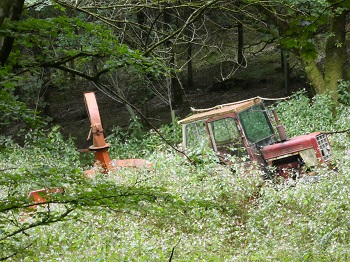
Abandoned tractor, Galloway SPS

Rebanks goes on to remark with regard to a later phase of this transformation: The economics books I read were all about how things changed for the better; they didn’t say much about the losers, the misery, and people hanging on for years, sometimes decades, because they knew nothing else.

Yet, as Rebanks explains, it is becoming clear that much greater damage has been done to our agricultural capital by industrialisation, than even this might suggest; a complex and poorly understood ecological system which exists in our soil, is being destroyed by modern farming with its pesticides, its fertilisers, it’s antibiotics, its monstrous buildings and machinery. In the final part of his book, Rebanks describes the steps he is taking in his own farming practice to push back and to restore a balance between our human needs and the needs of the environment, and offers a hopeful message. It seems doubtful, however, that this enterprise can succeed on the larger scale necessary, whilst agribusiness remains rampant. [7] An unconstrained free market, whatever bounties it may bring, does not reliably deliver the freedoms we crave, but rather is a tiger which must be tamed before it consumes the very world we live in; before, in a final declaration of independence, it consumes itself. 

The World Is Too Much With Us
By  William Wordsworth

The world is too much with us; late and soon,
Getting and spending, we lay waste our powers;—
Little we see in Nature that is ours;
We have given our hearts away, a sordid boon!
This Sea that bares her bosom to the moon;
The winds that will be howling at all hours,
And are up-gathered now like sleeping flowers;
For this, for everything, we are out of tune;
It moves us not. Great God! I’d rather be
A Pagan suckled in a creed outworn;
So might I, standing on this pleasant lea,
Have glimpses that would make me less forlorn;
Have sight of Proteus rising from the sea;
Or hear old Triton blow his wreathèd horn.


Like, share or comment at the Facebook link!

Acknowledgements

Me and Bobby McGee https://www.youtube.com/watch?v=G-J7mLyD3yc 

This link is to the Kristofferson original version of the song, which has however been covered by countless other artists. 

Everybody Knows  https://www.youtube.com/watch?v=8IfmiKnZi3E 

Sharon Robinson, one of Cohen’s backing singers, has a credit in the writing of this song but it has all the hallmarks of Cohen’s work.

Thanks to Elaine for help with proof reading, advice and comment. The final product, including errors, are mine.

References

1]  Trump Revealed by Michael Kranish and Marc Fisher 

2] Trump’s Latest Trolling Of Biden’s Mental State: Calling For Drug Tests Before Debates   Andrew Solender, Forbes

3] Trump’s 2020 strategy: paint Joe Biden as a puppet for the ‘radical left’   David Smith, The Guardian

4] The Case for a New British Bill of Rights  Industrial Systems Research Archive 

5] Talking Politics 24Sept2020  Professor Michael Sandel in a discussion, prompted by the publication of his book: The Tyranny of Merit: 

6] For an overview of Stalin’s Collectivisation of farms; https://en.wikipedia.org/wiki/Collectivization_in_the_Soviet_Union

7] English Pastoral —  James Rebanks  

8] Wilding —  Isabella Tree 

Whilst James Rebanks also refers to the problems of damage to soil, this is also a theme developed in Isabella Tree’s book, Wilding. 

In chapter 16  she describes in stark detail the damage done to our soil by the processes of industrial farming, but goes on to offer a way back to soil health through the strategy of rewilding by which she and her husband Charlie are returning their West Sussex farm to nature. One of the epigraphs to this particular chapter quotes Franklin D Roosevelt in a letter to state Governors on the matter of a Uniform Soil Conservation Law, 1937. He says: The Nation that destroys its soil destroys itself. 

Featured Image

Night view of the Georgia Pacific plant on the Fox River in Green Bay, WI 02-11-2017 035, picture Richard Hurd cc

Posted in Economics | Tagged , , , , | Leave a comment

The Nanny State, the Demon Food Industry and the Neglected Ectomorph

Perhaps under the influence of his brush with the more extreme end of Covid 19, our Prime Minister has decided that the health of the nation requires attention. Plans are afoot to to launch [a] major new anti-obesity strategy in [a] bid to reduce pressure on [the] NHS [1] 

This is an extraordinary turnaround. Just a year ago, in July 2019  the Telegraph reported, I imagine with some approval, that  Boris Johnson will end the ‘continuing creep of the nanny state’ if he becomes prime minister, starting with a review of so-called ‘sin taxes’ on sugary, salty and fatty foods.[2] 

Nanny state is a rather overworked metaphor, deployed by  those intent on convincing us that such measures are the thin end of a socialist wedge which would eventually reduce the British people to a dependent status, entirely lacking in initiative or enterprise. 

This is an absurd proposition. My star witness in brushing it aside is a well known septuagenarian who has spent his entire life on generous state benefit, who in March of this year shrugged off infection by Covid-19 with apparent ease whilst continuing to promote eccentric alternative health nostrums. I am of course referring to the heir to the throne, Prince Charles. [3] 

Open source image: Interior view of a supermarket showing aisles of shelves stocked with processed food items

It gives me some concern that the Prime Minister’s change of heart has been a truly Damascene event, not marked by reflection and research into the matter of diet.  Yet, along with one or two other recent and startling changes in his world view, this is a development we should welcome. I will feel reassured however when he begins to speak not of ‘the nanny state’ but rather the ‘demon food industry,’ purveyor of cheap and nasty food to those  on low incomes or without the time or the space to choose and prepare healthy options for their growing families. 

Anushka Astana’s interview with Felicity Lawrence, in a recent edition of the Guardian’s In Focus podcast, summarises the situation well and shows the food industry’s willingness to use the tobacco industry’s playbook to resist changes which might cut into its profits.[4]

The Neglected Ectomorph

Over several years, like many others, I have explored a variety of alleyways in the complicated and ever changing advice regarding what kind of diet will keep us healthy. A stumbling block in  my own research has been that my personal metabolism and physique present a challenge exactly  opposite to that which faces the Prime Minister. He is a classic endomorph whilst I am an ectomorph. Endomorphs typically have a tendency to gain weight; by contrast, ectomorphs can find it difficult to put weight on.  

We live in a time when many would consider it enviable to be able to indulge oneself without fear of weight gain; yet I have often reflected that in the event of food shortage, I would be one of the first to fall by the wayside, and that in any case, there must be other negative consequences of overeating, waiting to punish heedless ectomorphs, such as myself. 

The blunt truth is that ectomorphs must eventually succumb to one ailment or another and in my ongoing reflection on the matter of diet I have sought to find a way of eating which balances the pleasure and appreciation  of food with a reasonable prospect of good health and life span. It is my experience however that  the health challenges of the ectomorph are largely absent from literature on diet and health.

Low Carb Diets

One dietary paradigm which has gained a lot of attention in recent years is the benefit of reducing carbohydrate intake, or even, in extreme cases forcing the body into ketosis (the burning of stored fat) by eliminating all bread, potatoes and sugars — including fruit sugars — from the diet. Such a diet aims to extract necessary nutrients and energy from high quality fats and protein, in contrast to more traditional dieting for weight loss which has tended to restrict the intake of fat. 

Tom Watson, formerly deputy leader of the Labour Party, has been a high profile exponent of a low carbohydrate diet, and his experience suggests this has not only helped him to overcome an obesity problem, but also to reverse his diagnosis of type 2 diabetes.  Watson however is careful to say that his diet may not necessarily suit everybody: I think we need to move to an era where GPs are trained to give bespoke advice, and that’s a bit harder and requires quite a lot of change in the NHS. [5]   

Diet and Evolution

Modern dietary advice often looks at the evolutionary history of Homo Sapiens with a view to divining what a human diet might have been in that extended evolutionary period during which we were hunter gatherers. There is an assumption in this analysis that farming, a recent development in our evolutionary history, has introduced problem elements to our diet and that these problems have been compounded by latter day refined carbohydrates, food additives and other tinkering which occurs during the preparation and consumption of food with the intention of making it more irresistible to the modern consumer.

Public Domain Image from Needpix.com

Tom Watson’s dieting derives from one version of this analysis which argues that during our history as hunter gatherers, most of our calories came from nuts, seeds and game, and that cereals and fruit sugars would not have been prominent in the dietary mix. Certainly, there is growing evidence that, for some, a low carb diet does indeed offer benefits, at the very least in the short term. 

Feasting and Fasting

All the great religions have understood the wisdom of occasional fasting whilst also making a  space for feasting from time to time. The problem for many people who have the good fortune to live in the rich countries of the modern world is that they are in a constant state of feasting. In saying this it is important not to overlook the reality that diet related health problems are most common amongst the poorest members of these ‘rich’ societies, an underclass reliant on the cheapest food containing a concentration of the most questionable elements of modern diet. Amongst those however, who have money and time enough to reflect on such matters, the possible health benefit of intermittent fasting has begun to gain some traction, as promoted, for example, by Michael Mosely in the 5-2 diet.[6] This  is based on similar thinking to the diet adopted by Tom Watson,  but involves reducing or eliminating  carbohydrate intake for just two days of the week and then eating without this constraint for the other 5 days.  Again, this diet is targeted at weight loss and the many health problems associated with obesity.

When the time is right for feasting, if you happen to be in Castle Douglas, why not drop in to Earth’s Crust

Thus presented, such a diet has no obvious appeal for an ectomorph; however, it is quite possible to adopt a 5-2 diet which ensures a generous calorie intake across the seven day cycle, such that when carbohydrate intake is low, the diet is still rich in high quality protein and fat, both good energy sources: so, on the low carb days, the diet could include plenty of fatty meat, oily fish, eggs and cheese, supplemented with a good selection of green vegetables, tomatoes, peppers and so on. 

In this way possible benefits of the 5-2 diet may be available to the ectomorph, without fear that during the low carb phase they will be liable to lose weight. 

But if the purpose  is not to lose weight what interest can there be in following such a diet? 

The Seasonal Cycle

A possible answer lies in the  seasonal nature of plant sources of food and the way in which our metabolism has evolved to cope with this. The seasonal cycle varies, depending on latitude, but it is easy to imagine  in all  circumstances, swings in the availability of fruits, nuts and cereals. Animal sources of food, providing fat and protein, would, by contrast, be available with greater consistency across a typical year. 

Raspberries, available in our supermarkets all year round, but in this case picked in the garden, and only available in the month of July. All advice on the internet suggest raspberries cannot be ripened off the plant, but those in the left hand dish were picked about 12 hours previously when they looked much like those on the right. That way the birds don’t get quite so many.

When there was a plentiful supply of fruit, nuts, and cereals, our ancestors would have consumed these freely. (In reality, cereal consumption will have been a marginal part of the diet before agriculture and the development of the technology to process grains into flour and bread, made these food sources dramatically more available.) Excess would have been stored as fat, such that, during the period when these foods were not available in plenty it was possible to survive by burning a mixture of stored fat in addition to extracting additional energy from fish and game, the availability of which would be less affected by the seasonal cycle.  

The point of the proposed variation on the 5-2 diet is not to restrict intake, but rather to mimic   variations in diet which are best suited to the metabolism evolution has provided us with. 

It is in the balance of the gut microbiome, the trillions of organisms such as bacteria, yeasts, fungi & viruses that live in your digestive tract [7] that the impact of such dietary variation is most likely to be advantageous.  There is a good deal of evidence to suggest that the microbiome at the very least benefits from a diverse diet and that neglect of the biome can in turn result in the development of a range of common chronic conditions such as irritable bowel syndrome and many other problems which are linked to chronic inflammation. [8] [9] [10] 

The Microbiome and the Benefits of a Diverse Diet

This variation on the 5-2 diet is one I have recently been exploring, but at this stage have insufficient experience to draw any clear conclusions other than that I find it an interesting and satisfying way to eat and since adopting it have, perhaps, slept better and felt more energetic. 

I am sure there are many others out there who have an interest in healthy eating, but for whom weight loss is not a priority. 

Your thoughts and comments would be welcome.

Like, share or comment at this Facebook link!

Sources

1] https://www.politicshome.com/news/article/boris-johnson-set-to-launch-major-new-antiobesity-strategy-in-bid-to-reduce-pressure-on-nhs

2] https://www.telegraph.co.uk/politics/2019/07/02/boris-johnson-aims-put-end-nanny-state-sin-taxes-food/

3]In June 2019 Prince Charles became patron of the Faculty of Homeopathy, an alternative therapy which he has advocated over many years. Homeopathy was judged by Dr Brian Ingliss, in his book, Natural Medicine, published 1979, as having comparable efficacy to that of a placebo. By this measure, homeopathy is of little therapeutic value, but is otherwise, harmless, much like the Prince himself.

3.1] https://thenaturaldoctor.org/natural-health/alternative-medicine-and-the-prince-of-open-mind/

3.2] Book: Brian Inglis  Natural Medicine 

4] Guardian In Focus Podcast How did Britain get so overweight? 

 5] https://www.theguardian.com/lifeandstyle/2018/sep/12/tom-watson-lost-seven-stone-reversed-type-2-diabetes-interview

6] https://www.provitamil.com/healthier-lifestyle/intermittent-fasting-and-the-5-2-diet.htm#:~:text=In%20the%20light%20of%20new,for%20people%20to%20stick%20to.

7] https://www.symprove.com/gut-microbiome/?gclid=Cj0KCQjwgo_5BRDuARIsADDEntRqAoyQs_K1cMMbcoQptnmVXRUHaz-Ng7xVUZJ9a10UmomcyN2dmIIaAvEUEALw_wcB

8]  Book: The Gut Makeover Jeannette Hyde

9] Book: Tim Specto, The Diet Myth

10] Study:https://www.ncbi.nlm.nih.gov/pmc/articles/PMC5800875/

Acknowledgements

Thanks to Elaine for proof reading, advice and comment.

Featured Image

The Covid-19 Snake, as created by the pupils of Cargenbridge Primary School, Dumfries. To see this image displayed as the header to this article click here.
Posted in In the time of coronavirus, Misc | Tagged , , , | Leave a comment

André Leon Talley

I have never really taken much interest in the world of high fashion, and indeed had never heard of André Leon Talley, formerly director of American Vogue magazine, until I listened to this Hardtalk interview with Steven Sackur. Wow! This man should stand against Donald Trump. He has all of Trumps self assurance, but in addition, he is informed, articulate, intelligent, has a moral compass, and of course, style and flamboyance. The prompt for the interview was the death of George Floyd in Minneapolis, but André Leon Talley has a personal story to tell which is in itself, remarkable.

Hardtalk Interview with André Leon Talley

Featured image: Composite of pictures captured from a Google Image Search on André Leon Talley

View featured image as post header
Posted in Podcasts etc. | Tagged , | Leave a comment