Studying Keynes is more important than ever…

Studying Keynes is more important than ever

This podcast, an interview with Zachary Carter, author of The Price of Peace: Money, Democracy, and the Life of John Maynard Keynes, focuses on the theme of my previous post on Boris Johnson’s recent conversion to a “Rooseveltian project.” Whether you have the stamina for Carter’s book or not, this podcast is worth a listen…and by the way, I mean to return to listen to other editions of this Bloomberg podcast with Joe Weisenthal and Tracy Alloway, which has a strong economics theme but which is definitely pitching in a lively, interesting and progressive way to those, like myself, who feel the need to get a firmer footing in the economic strategies which may get us all out of our present difficulties.

Cattle grazing on the merse overlooking the Nith Estuary, to Criffel, Dumfries and Galloway, July 2020
Posted in Economics, In the time of coronavirus | Tagged , , , | Leave a comment

Can Boris Embrace his Keynesian Destiny?

Boris Johnson has, in an interview given to Times Radio on its first day of broadcasting, made a commitment to a Rooseveltian approach to the UK. This is a striking endorsement of Franklin Delano Roosevelt’s  New Deal, which was to be an engine of recovery for the United States from the Great Depression of the 1930s.  

That a Conservative Prime Minister should choose to associate himself with Roosevelt’s achievement fundamentally subverts the economic creed of his own party. Yet he now says:  We really want to … invest in infrastructure, transport, broadband – you name it. [2]

It is true that  in the 2019 General Election Johnson made promises to spend big, but those commitments had the ring of pork barrel politics, made possible only in the event of a resurgent economy and  liable to be modified and watered down in the context of harsh economic realities and a requirement to balance the budget. In that same election, Johnson was  happy to pour scorn on the ambition of the Labour manifesto which had at its core the offer of a Green New Deal and the roll out of a fibre optic broadband network.

His current rhetoric is in the context of what everyone understands to be an impending recession of such gravity that deficit spending can be the only means of funding such an ambitious plan.

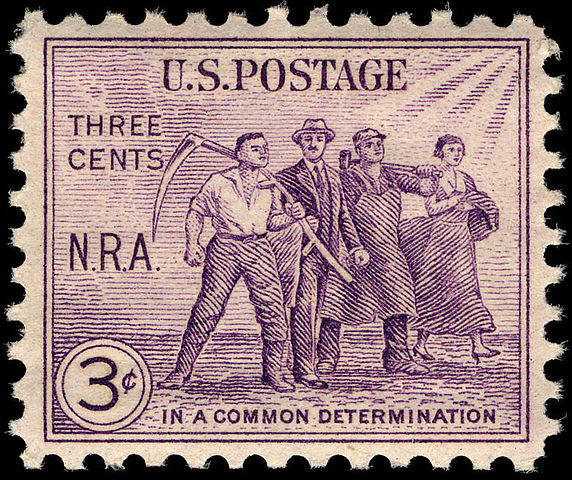
The National Recovery Administration was a New Deal agency established by FDR in 1933. Open source Image

Roosevelt’s New Deal was built on borrowing in order to create work for the unemployed and destitute, by planting trees in the dust bowl; running electricity to rural communities; building the Hoover Dam to generate hydro electricity and much more. The inspiration for these policies came from the ideas of John Maynard Keynes. Even as the Roosevelt administration was moving the US economy into a period of sustained growth, spreading and increasing prosperity, the conservative economist Friedrich Hayek, guru of Margaret Thatcher,  pushed back, insisting on the primacy of free markets and rejecting the idea that the state could profitably intervene in an economy. 

The Cold War and McCarthyism created a hostile environment for state sponsored enterprise  and the tide of economic thought was turned back to a theoretical commitment to balanced budgets, but more significantly, to favour the unfettered free market capitalism which emerged in the 1980s under the leadership of Margaret Thatcher and Ronald Reagan.

The extraordinary story of Roosevelt’s New Deal and its aftermath, is beautifully  told in Zachery Carter’s recently published book:  The Price of Peace: Money, Democracy and the Life of John Maynard Keynes.  Carter’s book is, in fact, a history of economic ideas in the 20th century, at the foundation of which is the development of Keynes’ thought, his role in key events, and ultimately the frustration of his vision and its eclipse by a mix of ideologically driven neo-liberal free market capitalism run through with a brazen but uncredited application of Keynesian spending to fund, amongst other things, the US military and Industrial complex and foreign wars. 

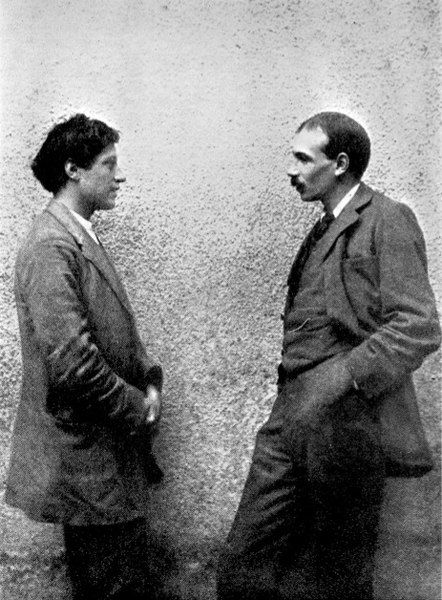
Painter and member of the Bloomsbury Group, Duncan Grant, with Keynes, 1912 – Open Source Image

The early part of the book gives a colourful picture of Keynes: his academic brilliance; his promiscuous gay relationships; his connections with the Bloomsbury group, and his eventual marriage to a world famous Russian ballerina, Lydia Lopokova.

But at the outset of the First World War, Keynes became drawn into public life, providing critical economic policy advice to the British Government.  Present as the Treaty of Versaille was being drawn up, he watched  aghast as an agreement emerged which humiliated Germany.  In his subsequent book, The Economic Consequences of the Peace, he was sharply critical of the settlement for its  failure to provide conditions which could allow Germany to recover. Keynes foresaw, as a direct consequence, the failure of German democracy and the rise of autocratic rule. 

Following the First World War,  the British economy struggled to pay its debts to the United States, and the Conservative Government became convinced that it was  necessary to return to the Gold Standard. In direct contravention of Keynes’ advice, Winston Churchill, as Chancellor of the Exchequer, was responsible for once again pegging sterling to gold.

Keynes was scathing and responded in a pamphlet,  The Economic Consequences of Mr Churchill, in which he disingenuously asks:   Why did he do such a silly thing?Partly, perhaps, because he has no instinctive judgment to prevent him from making mistakes; partly because, lacking this instinctive judgment, he was deafened by the clamorous voices of conventional finance; and, most of all, because he was gravely misled by his experts. [3

Churchill himself, in 1930, came to recognise the folly of his policy:  Everybody said that I was the worst  Chancellor of the Exchequer that ever was, and now I’m inclined to agree with them.  

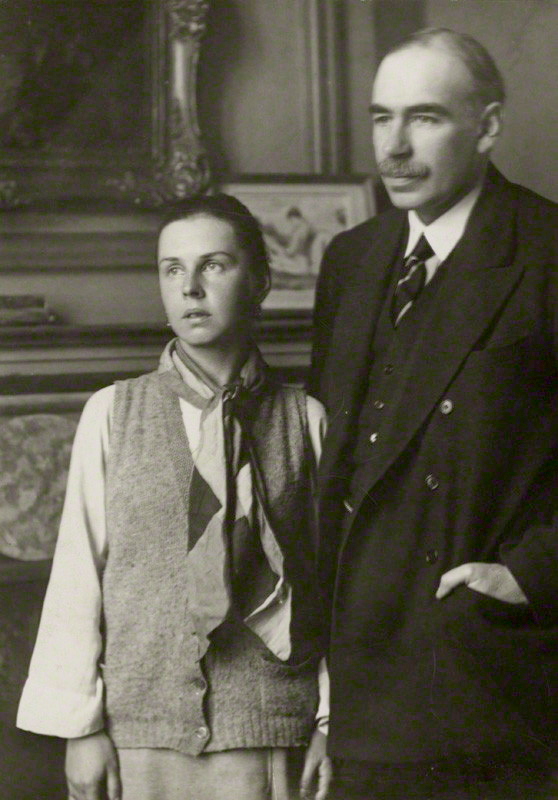
Keynes with his wife Lydia Lopokova. Open Source Image

Carter’s book quotes liberally from Keynes: his letters, his journalism, his books.  It is clear that Keynes had a gift for popular communication, with writing that was both clear and witty, but acknowledged as his masterpiece was The General Theory of Employment and Money, a book written expressly for professional economists, uncompromisingly dense and impenetrable to the common reader. Needless to say, I have not read it, and yet the central ideas of Keynesian economics seem remarkably straightforward: that a democratic government, in command of a currency, has the power to activate unused or misdirected labour, and  indeed all resources, at its disposal, to achieve any great or necessary project that may be in the general interest. Whatever is possible may be done, and where the money is not immediately available, but the resources are, then it is reasonable to create the money by such means as are available.  

The most visionary aspect of Keynes work was his proposal to the Bretton Woods conference in 1944, to create an international clearing currency, the Bancor, against which national currencies could be pegged and which could be managed in such a way as to ensure fair trade conditions across national boundaries. Sadly Keynes, in deteriorating health, was unable to persuade the conference to accept his proposal and instead the post-war economic settlement was built on the foundation of the US dollar being convertible to gold. Keynes accepted this as a workable solution, and the system survived until 1971 when the US, under the presidency of Richard Nixon, unilaterally withdrew, resulting in an international currency market, which could never offer a stable and fair international trading environment. 

For anyone with a serious political or economic thought in their head, who fears for the future of democracy and observes the emergence of political forces unwilling to confront or even acknowledge the huge challenges which face us, this book should inform public debate and deserves to be widely read. 

But returning to my opening theme:  the commitment of Boris Johnson to a “Rooseveltian” project. I share the widely expressed skepticism that his conversion may not be sincere. George Eaton, in his New Statesman article Why it’s absurd for Boris Johnson to compare his spending plans to FDR’s New Deal points out, that: As a share of the economy, Johnson’s spending plan is 200 times less ambitious than the New Deal.  [4] 

It is increasingly clear that  a Prime Minister,  trapped by the COVID19 pandemic and inevitable recession, has few options at his disposal. The economic theories of Hayek and his successors have run out of credible policy ideas. Keynesianism is resurfacing as an economic model with something concrete to offer for these troubled times.   But there is a deeper concern in that the crisis with which we are confronted is not merely an economic recession. 

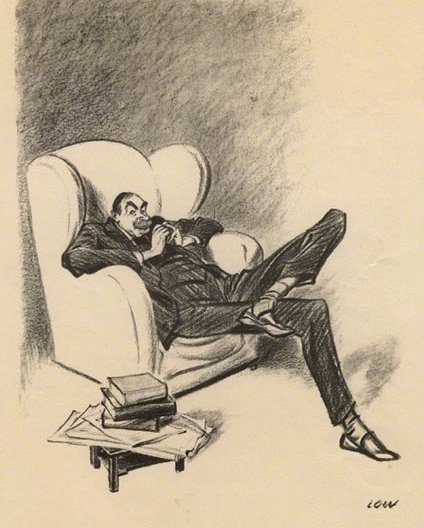
Caricature of Keynes by David Low – Open Source Image

Keynes, in a typically vivid but ironic example, suggested that, in the event of recession and unemployment, the Treasury could  fill old bottles with banknotes, bury them at suitable depths in disused coal mines which are then filled up to the surface with town rubbish, and leave it to private enterprise on well-tried principles of laissez-faire to dig the notes up again (the right to do so being obtained, of course, by tendering for leases of the note-bearing territory), there need be no more unemployment and, with the help of the repercussions, the real income of the community, and its capital wealth also, would probably become a good deal greater than it actually is. It would, indeed, be more sensible to build houses and the like; but if there are political and practical difficulties in the way of this, the above would be better than nothing.

However, in our current circumstances of climate crisis, any investment which does not align with the objective of reducing our carbon footprint, would be worse than nothing and a more considered and constructive response is required. It is obvious that many in the Conservative Party  will be happy to invest in fracking, new roads and airports and housing built to standards dictated by the narrow vision of construction companies. Such is the current character of the party Johnson has committed to build back better, to do things differently.  The real challenge we face is to create a carbon neutral economy and a world fit for all citizens to live a sustainable and good life and it is not at all clear that the Conservative Party is capable of delivering this. 

Yet the Labour Party must give a qualified welcome to Johnson’s “Rooseveltian” commitment for this is the basis on which its own ambitious commitments were set out in its 2019 Election manifesto. Labour must now hold the Prime Minister  to account and, if possible, guide  him towards his Keynesian destiny and the glorious place in British history which he so earnestly craves. This would indeed be a strange and  unexpected way for Jeremy Corbyn and John Mcdonnell’s reputation for economic competence to be rehabilitated. 

If however, as seems all too probable, he falls short of the scale of his own rhetoric, or is obstructed or brought down by his own party, then Labour must stand ready to do the job themselves. 

Reviews of The Price of Peace, Money, Democracy and the Life of John Maynard Keynes

https://www.theguardian.com/books/2020/jun/14/the-price-of-peace-by-zachary-d-carter-review-how-liberals-betrayed-keynes

https://www.washingtonpost.com/outlook/still-in-thrall-to-john-maynard-keynes/2020/05/21/a199245c-93ba-11ea-91d7-cf4423d47683_story.html

https://www.theguardian.com/books/2020/jun/14/the-price-of-peace-by-zachary-d-carter-review-how-liberals-betrayed-keynes

References 

[1] The Price of Peace: Money, Democracy, and the Life of John Maynard Keynes  Kindle Edition

[2] https://www.theguardian.com/world/2020/jun/29/boris-johnson-calls-for-rooseveltian-approach-to-help-uk-economy-recover

[3] https://www.gold.org/sites/default/files/documents/1925jul.pdf
[4] https://www.newstatesman.com/politics/economy/2020/06/why-it-s-absurd-boris-johnson-compare-his-spending-plans-fdr-s-new-deal

Thanks to Elaine for assistance with research and proof reading.

Featured Image

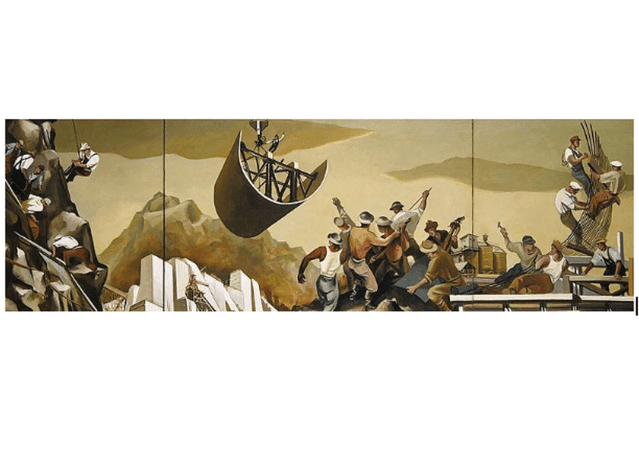
William Cropper, Construction of a dam, 1939 Public Domain Image

Posted in Economics, In the time of coronavirus | Tagged , , , , , | Leave a comment

Broadcasts, webcasts and podcasts

It was in the Autumn of 1972, that I bought my first radio. 

I had taken leave of my parental home in Newry, Co.Down and by boat and train had been cast adrift into a new life, installed in a hall of residence, as a student at Reading University. Early in my first term, the purchase of a radio felt like a rite of passage into the adult world. 

A good many of my fellow students were proud possessors of a hifi, but such glamour was beyond my means. When I did eventually purchase one, with earnings from a summer job, it never really came to have the same importance as my radio. The hifi and the record collection were really just a form of display, and there was in any case never a shortage of people happy to introduce me to the more arcane corners of their prized vinyl, whether stacked neatly or scattered tastefully about them like they were Bob Dylan on the cover of Bringing it all Back Home. There was in fact a feast of music available for me without any requirement to own a record collection or the means to play it.

Television at the time seemed only good for watching Monty Python’s Flying Circus, and every Thursday night the hall of residence common room would fill, to welcome each new and extraordinary episode.  Radio however, was my secret pleasure; it impressed nobody, but over the years its importance for me has grown.

What did I listen to? I can barely remember, though I am pretty sure, news, first thing in the morning, was a staple. Radio was never something I sat and listened to; it was just on in the background when I was going to bed or getting up, or not well or waiting for someone to come calling. Apart from the news, my listening was pretty middlebrow: the comedy slot on Radio 4 before the 7.00 o’clock news; a dip into Radio 1 for John Peel and Andy Kershaw,  and probably not much else, but as time has gone by, my listening has developed and become more eclectic. I have particularly enjoyed radio plays, both those written specifically for the medium, or adaptations of stage plays or novels.  Having struggled at school with A Tale of Two Cities — I don’t believe I ever read it from cover to cover —  I have, to a large extent through radio adaptations, developed a love for the work of Charles Dickens, and indeed listened recently with  enjoyment to an abridgment of Claire Tomlins fine biography of  Dickens, read for Radio 4’s book of the week by Penelope Wilton. Abridgement is doubtless a dirty word amongst the literati, but abridgements have been a source of enormous pleasure to this particular middle brow.  I remember with special fondness, Laurie Lee’s As I Walked out one Midsummer Morning, abridged for BBC Radio 4’s Book of the Week by Katrin Williams and read hauntingly by Tobias Menzies. 

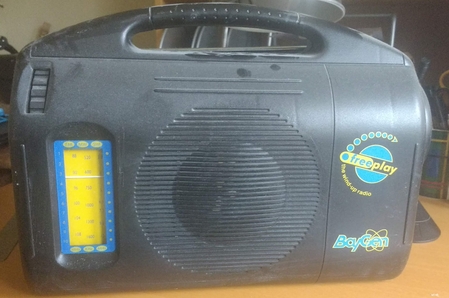
Freestyle windup radio invented by Trevor Bayliss [Picture – SPS]

I mentioned the weekday comedy slot, before the 7 o’clock news bulletin, and the Archers. It was there that I first heard Knowing me, Knowing you, with Alan Partridge, the original, and for me unrivalled, radio incarnation of Steve Coogan’s comic creation. Other shows I have enjoyed in this slot have remained firmly embedded in the radio format, but have nevertheless acquired a cult status: I am Sorry I haven’t a Clue; Just a Minute, The News Quiz; but there have been many others, some forgettable but many deserving of greater attention.  

When I first came to Scotland in the early 1980’s, I spent my first year or so labouring on the renovation of an old sandstone house, purchased by my brother Peter and his partner Deirdre. Whilst they were out at work, financing the project, I was earning my keep on the basis of an endless series and variety of odd jobs. However charming this may sound, the work was from my point of view, often tedious, yet it was my pleasure each day to be educated for an hour by my discovery of, McGregor’s Gathering, a BBC Radio Scotland production, in which Jimmy McGregor, with a leavening of music and wit, introduced me to every aspect of Scottish landscape and culture. 

The point of course is that work did not stop whilst I listened, and this is the beauty of audio broadcasts; they are a perfect accompaniment to those tasks and activities which can be accomplished without unbroken attention. I hear some voices in the background scoffing at this point, as if to suggest that had my attention to the assigned task been more complete, then a variety of imperfections or other insults to the finished article, might have been avoided. I cannot disagree, but in balance I think the trade off has been satisfactory to all concerned.

The development and miniaturisation of recording technology  permitted me increasing  control over when and how I listened. Before I took the pledge and committed to cycling to my work in Dumfries and Galloway College, it was my pleasure to listen to a recording of Start the Week during my daily commute. The frustration of interruption was gone as, on arrival, the programme was paused for the return journey. 

Creative commmons image from the Blue Diamond Gallery.

Start the Week is a favourite to this day, a discussion featuring a selection of authors and recently published books, generally with some loose theme hanging them together.  I started listening when Melvyn Bragg hosted the discussion, maybe even Russell Harty; I saw out Jeremy Paxman, and am now in the safe hands of Andrew Marr. I see Amol Rajan as the coming man — or will the slot be filled in the future by a woman? Kirsty Wark does fill in very capably from time to time. The format is simple and though it requires something heroic from the presenter in terms of getting to grips with the content of each programme, I am confident its future is safe, whoever the presenter may be.  Now I download the programme as a podcast and listen on my phone. In my days as a commuter I did not disdain the more usual fare of  Radio 1 or Radio 2 breakfast offerings, and it was generally to these that I would tune my dial when my tape had run out, to enjoy the whimsy of Terry Wogan, or the wit of Ken Bruce or the madness of the Radio 1 offering.  

As the technology has progressed, so I have been more able to explore a broad range of programme genres, and though the BBC still forms a large part of my listening, it has been a pleasure to explore the whole gamut of podcasts available free of charge from other sources.  The original purpose of writing this piece was to provide a list of those which I particularly enjoy in the hope that others may experiment with and enjoy the pleasures of listening to podcasts. It’s not for everyone, I know, but for some of you this format will open a gateway into a garden of delights.

General Podcast Advice

Download a podcast app onto your phone, search for podcasts and subscribe to the ones which catch your interest.  I use Doggcatcher, but there are many others. 

My Personal Podcast Recommendations

Start the Week

Authors discuss their recently published books, generally  grouped according to a theme or themes. 

The Week in Westminster

A different presenter each week, and a collection of politicians from across the House of Commons. If you are fed up with politicians dodging questions, the discussions hosted by The Week in Westminster bring together politicians past and present from across the political spectrum, and in general manage to keep the discussion open and avoid petty confrontation and obfuscation. 

Any Questions

This is the radio version of Question Time, which, since the departure of David Dimbleby, has, in my view, gone into decline though for my taste, the audience was always too dominant. I want to hear what the guests have to say, not the ill informed and attention seeking. Let’s be honest: panelists can also be ill informed and attention seeking, but Any Questions strikes a better balance than Question Time. There is a  follow up programme, Any Answers, in which the public phone in with their take on the questions and answers of the main programme. I generally find this post match analysis pretty uninspiring, though occasionally those who phone in have something really important to say, and  say it well. 

Revisionist History

Malcolm Gladwell makes superb podcasts, beautifully written, produced and presented and always with interesting ideas. His subject matter is diverse, from Elvis and his inability to sing one particular song without error, to an inquiry into mass hysteria, and much more. If you haven’t listened before, a treat awaits.  

Deconstructed with Mehdi Hasan

This is a great for keeping up with US politics.  Mehdi, originally from the UK, is very well informed and networked and gets great interviewees and does great interviews. He is a bit over focused at the moment — in my view — on taking down Donald Trump. That’s a perfectly understandable objective, but I fear, feeds the polarisation of US politics, which is the real obstacle to political progress in the States. 

Today in Focus

This podcast is from the Guardian, and covers a variety of topics but generally is focussed on the main issues of the day, though often looking at them from an unusual angle.  Standards of journalism, presentation and production are all very high, as one would expect from the Guardian.

Talking Politics

This is an independently produced podcast, hosted by Professor David Runciman, Professor of Politics at Cambridge University. This is my current favourite politics programme, very focussed on current UK issues, but with an international perspective. It is full of historical detail, interesting guests and an impressive panel of academics to inform the discussion. The associated History of Ideas podcast is also excellent.

Irish Times Inside Politics

This podcast offers excellent coverage of politics and other current issues in the Irish Republic. Distinguished journalists from the Irish Times, including Fintan O’Toole, a frequent contributor to British media, discuss the politics of the Republic but also feature commentators from north of the border and commentary on UK, European and US politics.

Desert Island Discs

I am a long time devotee of Desert Island Discs, and find it an enjoyable way of learning about a range of guests, some of whom I have heard of but many of whom I have not. I am rarely disappointed by their personal stories, and often surprised, impressed . The music in the podcast is shortened for rights reasons, but though the musical choices do interest me, it is the biography of the guests which I find engaging. Lauren Laverne, the most recent presenter, has come in for some criticism, suggesting that she is a bit light-weight where guests may be from the fine arts or the sciences, but I find her excellent, and she always seems well prepared and knowledgeable of the work and achievements of those she interviews, regardless of the field in which they have been successful. 

Private Passions

This is a variant on the Desert Island Disc format, but adapted for radio three, with greater attention given to discussion of the musical choices. It is introduced by composer, Michael Berkeley. I enjoy it for the same reasons as I enjoy Desert Island Discs, but in addition find the more serious approach to the musical choices interesting. The choices  are wide ranging  and absolutely not confined to the classical genre.  A recent episode featured Jools Holland, who impressed Michael Berkeley with his choices of obscure classical recordings.  Again, the podcast version shortens the musical element for rights reasons. 

Composer of the Week

I’ve started listening to this recently. I am  pretty illiterate in classical music, but this programme is a great way into what, for someone such as myself, is fairly daunting territory, given the long history and progressions of music from the baroque to modern jazz.  Donald McLeod is a wonderful presenter, and the programmes generally have a biographical and therefore historical structure, which is  in itself of interest.  Donald McLeod seems genuinely to appreciate his subjects, whether the composer is Mozart, Harrison Birtwhistle or Thelonious Monk. The programmes are immaculately researched, unflinching in their attention to the less appealing aspects of some composers’ lives, and told with great warmth and humour. Modern composers often feature an interview with the subject, Harrison Birtwhistle being a fascinating and engaging example, though I’d have to admit. I haven’t sought out any of his music since listening though I have found my way to Radio 3’s New Music Programme, where the playlist forsakes all orthodoxies and glories in the non instrumental noises of the world…it’s an oddly relaxing experience when the demands of daily life have been getting  a little out of hand.

There is a huge Composer of the Week archive, though once again the musical elements  are shortened for rights reasons. 

S Town

This podcast has been the source of some controversy and a lawsuit, perhaps not surprising in that the John B McLemore, who is at the very centre of its enquiry, commits  suicide at an early stage of the research on which the narrative is constructed. 

Gay Alcorn, in the Guardian, considered the podcast “morally indefensible” and “voyeuristic”.  She also says however: “ it is a good story, powerfully told with the best of intentions…. it has purpose. Occasionally something a bit like S-Town can nudge close to art in the way it peels away the layers of life.” 

John B McLemore approached This American Life to urge the program to investigate what he believed was the cover-up of a murder in his hometown in Alabama in America’s south. That town is Woodstock, or “Shit Town”, as he called it.” [1]   

The story I thought admirable for its penetration beneath the conservative shell of a small rural community to reveal a reality that is both disturbing and redemptive.

References 

1] https://www.theguardian.com/commentisfree/2017/apr/22/s-town-never-justifies-its-voyeurism-and-that-makes-it-morally-indefensible#maincontent

Featured Image [Masked version visible in the header if you click on the article title.] Screenshot of Google Search, SPS

Posted in Podcasts etc. | Tagged , | Leave a comment

This is not Idlib

Is this unprecedented? Maybe;
But this is not the Somme,
It is not Paschendale.
This is not Idlib.

We are in lockdown, we feel threatened by an unseen enemy;
But this is not Auschwitz,
This is not Sobibór.
This is not Idlib.

Many more families will lose loved ones before their time.
But this is not Dresden 15th February 1945,
This is not Hiroshima.
This is not Idlib.

Ted says to Dougal:
“OK, one last time,
These are small, but the ones out there are far away.”
Yes, this is unprecedented,
We are in lockdown, 
We are threatened by an unseen enemy,
Many more families will lose loved ones before their time.
But this is not Idlib.


Acknowledgements:

Father Ted is showing some plastic toy cows to Dougal.
Father Ted: …OK, one last time. These are small… 
but the ones out there are far away. 
Small… far away…


You might also be interested in...
A Plague of Poetry where poets from across Scotland
have been reading a sample of their work in this 
time of lockdown. Hosted by Hugh McMillan
Featured Image A Syrian walks among the rubble

of a building after a regime airstrike in Syria’s
last major opposition bastion of Idlib.
Photograph: Omar Haj Kadour/AFP via Getty Images
Posted in In the time of coronavirus, verse | Tagged | Leave a comment

Micawberism and the Post Covid-19 Economy

There is rising concern for the fate of our economy in the wake of the current crisis. The 6 o’clock news on BBC Radio 4, opened with some alarming headlines warning of the “unprecedented” recession which is awaiting us once we emerge from the current crisis. Unprecedented, apparently, since “the Second World War” … well that’s not unprecedented then, but I am writing not to carp about the use of this currently much over used word, but to quibble with the expert analysis, including comment from such as George Osborne, warning of huge debt, and unemployment, to rival the depression of 1929. 


I am not an economist, and yet I have some confidence that, properly managed, we can recover from the present crisis without the suffering that characterised the Great Depression; indeed I am confident that  hardship similar to that of the 2008 recession, can be avoided. 


The flaw in the analysis which predicts a recession to rival that of the 1930s is that it focuses on the problem of where we will get the money from,  rather than on the more critical matter of where the labour, the resources, the creativity will come from.


If we focus on the latter problem, it is obvious that we have a large and generally well trained workforce; we have enormous productive capacity, offices, factories, computers, machinery, particularly when considered in comparison to the production systems of the 1930’s.   Yes, some of our productive capacity is currently lying dormant, but clearly we have not suffered catastrophic damage to our infrastructure, our housing, our hospitals, our schools, our hotels, as happened, for example, in the Second World War.


One does not have to be a socialist to recognise that the policies adopted by the Roosevelt administration, which brought the USA out of its profound recession, and which funded the war economy, can be adapted to speed our own recovery. The financial system is the means to activate the true wealth of our nation, it’s workforce, it’s tools, its creativity. A balance between taxation, borrowing from our own central bank, and investment in those aspects of our future which are generally accepted as important; the environment, public transport, broadband, etc.; this investment can be the engine of our regeneration.    

It is only those who are trying to prepare us for a further round of austerity who apply the wisdom of Mr Micawber to our national economy, as though it should be managed like a household budget. The UK economy lacks none of the resources and financial levers that a developed nation has at its disposal; it is using them now to deal with the COVID-19 Crisis and it can use them again to restore our economy, when the time is right. 

The Micawber Principle From the Dickens character Wilkins Micawber, noted for his inability to work his way out of poverty. Two of his enunciations have become elevated to “principles”:

“Something will turn up.”

“Annual income twenty pounds, annual expenditure nineteen pounds nineteen and six, result happiness. Annual income twenty pounds, annual expenditure twenty pounds nought and six, result misery.”


Posted in Economics, In the time of coronavirus | Tagged , , | Leave a comment

If the fool would persist in his folly …

If the fool would persist in his folly he would become wise.

This aphorism from William Blake, amongst other things, supports the notion that to be playful, without the fear of error, is an important condition for learning.

Innocence and curiosity, rather than foolishness, are the qualities which make possible the astonishing development of children in their early years, but long before they have acquired what Blake might have considered wisdom, they also develop a self awareness which becomes an obstacle to achieving this goal. It is the great tragedy of our education system that it so often consolidates rather than resolves this learning paralysis. Clowning and foolishness are perhaps one way in which, as adults, we try to recover some of what has been lost.

As I observe Donald Trump in his evolving and erratic commentary on the coronavirus crisis, and his extraordinary ability to disregard his pronouncements of the previous day, or hour, or minute, and his readiness to express the truth as he sees it in this moment only, I strain to see any capacity for wisdom that could be the culmination of such foolishness. We can of course hope.

There is something of a vogue in “wackiness” amongst the leaders of the World’s nations at the moment, with President Duarte of the Phillipines an example that goes well beyond clowning into a much darker territory of unpredictable and extreme conduct. Our own Boris Johnson, who I am pleased to see recovering from his brush with the worst that coronavirus has to offer, is an example from the more innocent end of this spectrum. He has often been disparaged as a “clown” and a “buffoon”, but these are titles which, as Mayor of London, he embraced with relish. It is already clear that he does understand the need for a more sober demeanour in this moment of crisis and that he can do passable “gravitas” when called upon, and yet, there has remained a lingering doubt that he actually has gravitas. Perhaps, now as he emerges from the stark world of the ICU, we shall seem something more reflective and more fitting in his public manner.

UK Government special adviser, Dominic Cummings, caused something of a stir when he called for “weirdos and misfits” to apply for jobs in the Government team. “We need some true wild cards, artists, people who never went to university.” Cumming’s description of the type for which he was searching contains both positive and negative elements, but the central idea of an individual unconstrained by convention is clear; a person unafraid of being thought foolish. The risky nature of Cumming’s enterprise was laid bare by the controversy arising from his employment of Andrew Sabiskey, who it emerged had made previous statements linking intelligence to race. Sabiskey resigned.

In Shakespeare’s King Lear, the fool is a character who exists within the inner circle of the court but who is able through comedy and sarcasm to point out the faults of the King. The survival of such a jester depends on their clear lack of ambition to be anything other than who they are.

Those unconstrained by the usual conventions which regulate lives, we call eccentric, but like the fool in King Lear, eccentrics do not in general compete for power. In challenging times, they may have something critical to offer, an ability to point the way out of the maze in which we have all become trapped.

No one suggests however that the fool should be put in charge.

Sources

https://www.theguardian.com/politics/2020/jan/02/dominic-cummings-calls-for-weirdos-and-misfits-for-no-10-jobs

https://www.theguardian.com/politics/2020/feb/18/no-10-under-pressure-andrew-sabisky-hired-cummings-race-intelligence

Posted in Comment, In the time of coronavirus | Tagged , , , | Leave a comment

Uncharted

From a clear blue sky

The mist came down, 

Pebbles in the bed of a stream

Unheralded by the sirens

That play loud in our ear.

We turn to peer at our companions, confounded.

And now, uncertainly,

We take our first steps into this new reality,

Destination unknown

— 8th April 2020

Posted in In the time of coronavirus, verse | 2 Comments

Into the Mystic with Donald Trump?

You remember Rory Stewart? He was the slightly geeky one who made a pitch for the UK Conservative Party leadership in June and July 2020, very much an outsider who nevertheless made a significant impact with his unorthodox campaign, based on walking the streets of UK cities, seeking personal encounters and conversations with passers by, and filming these and putting them on social media. Suffice to say, this originality did not have sufficient appeal to the Party faithful: he lost.

It was not long before he fell victim to the purge of rebel Tory MPs under the leadership of Boris Johnson, and Stewart has subsequently resigned from the Party and put his name forward to stand for Mayor of London.  I might have thought that London had a perfectly good Mayor in Sadiq Khan, but Rory is at the very least an interesting challenger. 

With London now at the epicentre of the UK COVID-19 pandemic, it is unsurprising that Rory Stewart has had a good deal to say about the Government’s strategy for combating the spread of the infection. In today’s Evening Standard he sets out with some clarity the rationale of the Government’s approach, to slow the spread of infection, and to protect the most vulnerable, albeit with some inevitable casualties.  Rory Stewart however argues that the example of China, suggests that a more aggressive programme of resistance can actually arrest the spread of the virus  and thus dramatically reduce levels of mortality and ultimately  limit damage to the economy.  

Why should we listen to Rory Stewart?  Well, there is plenty of evidence that he a person of capability, but really it is a matter of judging for yourself, and contrasting his proposals with the variety of others that we can see in play, from, on the one hand, the uncompromising centralised management of the Chinese to, at another extreme, the mystic workings of Donald Trump who has, within the space of a couple of months pivoted from calling coronavirus “a hoax” [Feb 28th]  which “we have ..totally under control” [Jan 12th] to “This is a pandemic. I felt it was a pandemic long before it was called a pandemic.” [March 17th]. So for the citizens of the United States of America, it looks very much like a journey into the mystic with Donald awaits; but another approach may still be possible, and may be preferred.

Rory Stewart: Aggressive action comes at a huge cost but it will save lives immediately

Acknowledgements: Van Morrison — Into the Mystic

We were born before the wind
Also younger than the sun
Ere the bonnie boat was won
As we sailed into the mystic

Posted in Comment, In the time of coronavirus | Tagged , , , , | 1 Comment

Known Unknowns, Unknown Unknowns and the Importance of Social Distancing

The UK Government has come under some critical scrutiny in the face of a response to the advance of coronavirus that has differed significantly from the consensus emerging from policy being implemented across many countries.

Robert Peston, writing on the ITV website, draws attention to the what he calls “ …the most important thing they [the UK Government] don’t know….. the proportion of people who will get the virus but will show no symptoms.

That is what Donald Rumsfeld might have called “a known unknown” and it is clearly a data set which has important relevance to the rate of spread of COVID-19 and to the task of developing the best strategy for its containment. I seem to remember Rumsfeld, Secretary of State for Defence under George W. Bush, being widely derided for the statement he made containing this phrase: but it certainly makes sense in this context.

Glen Kiln Reservoir
View over Glenkiln reservoir, Dumfries and Galloway,
where the first case of COVID-19 was confirmed
on 17th March 2020 Current cases in Scotland.
[Latest numbers published at 2pm GMT each day.]

More testing, would seem the obvious way to throw light on what is happening and Tobias Ellwood MP on Politics Live today was adamant that the Government is performing well in this respect, relative to other countries. However, if this testing is focussed on those with declared symptoms, then the asymptomatic cases, to which Robert Peston refers, will not become part of the picture.

At this stage however, meaningful randomised testing of the population would be a huge operation, and therefore may not seem realistic or a priority.

South Korea have done a great deal of testing and have low mortality amongst those infected — about 0.6% — but this is probably due to the fact that they have a younger age profile in their population, whilst Italy, by comparison has experienced relatively high mortality — more like 6% — and has a strikingly different age profile:

According to a UN report in 2015, 28.6% of the Italian population was 60 years old or older (second in the world after Japan at 33%). This compares to South Korea, where 18.5% of the population is at least 60

My conclusion is simple, and I regret to say, not terribly enlightening: predicting the spread of the virus and optimising our response to it, is complicated; we could doubtless add Rumsfeld’s “unknown unknowns” to the aforementioned “known unknowns” to create an inscrutable picture which will in any case almost certainly vary country by country.

At some time in the future there will doubtless be a reckoning as regards who called it right and who called it wrong. In the meantime I would point you in the direction of the UK Government Guidance on social distancing for everyone in the UK and protecting older people and vulnerable adults which offers sound advice on how we should alter our behaviour. The summary table at the conclusion is I think particularly helpful and I reproduce it here. I suspect the guidance could be of interest even to those few international travellers who come knocking at the door of this blog.

Social distancing summary
If you are having difficulty reading the table, try CTRL+

And for those with additional appetite for this type of thing, the Guardian article by Petra Klepac, assistant professor of infectious disease modelling at the London School of Hygiene and Tropical Medicine, What we scientists have discovered about how each age group spreads Covid-19 is well worth a look. In summary: “For some, workplaces are hotspots. For the over-65s, it’s shops and restaurants. We urgently need to change our behaviour

Sources

The most important fact about coronavirus that the government does not know

Politics Live 17th March 2020

Why South Korea has so few coronavirus deaths while Italy has so many

Posted in Comment, In the time of coronavirus | Tagged , , | Leave a comment

The suffering of fools

Bullying is a subject very much in the news at the moment, with mounting allegations directed at Priti Patel that her behaviour is arrogant and domineering; members of her staff have reportedly been signed off with stress, and Sir Philip Rutnam, has resigned with the stated intention to pursue the matter in the courts.

Not being a particular friend to the Conservative Party, I would admit to some schadenfreude as I witness these tribulations, and yet one does not wish to trivialise the matter; to be bullied may be devastating, but equally to be unjustly accused of bullying is quite likely to have life changing consequences.

At the summing up of their achievements, those who have risen to positions of leadership, in business, in education, in politics, are often, and with obvious admiration, spoken of as “not having suffered fools gladly.” This accolade rings with the suggestion of high intelligence, a determination to get the job done, and perhaps just a hint of impatience, but always in the face of trivial, unreasonable or stupid behaviour.

I recall a story of Clement Attlee, Prime Minister of the 1945–51 Labour Government, who when asked on one occasion why he had sacked a member of his cabinet, responded with just two words: “No good“. Perhaps the sacking itself was carried out with greater delicacy, but the underlying suggestion is clear; leadership at times requires a certain ruthlessness, even brutality.

The savage satirical ITV series Spitting Image, depicted Margaret Thatcher, in one memorable sketch, referring to her Cabinet as “the vegetables”. There was indeed evidence to suggest that many of her Ministers were in awe of her, and Geoffrey Howe in particular came in for some rough treatment: “Her displays of contempt for him in cabinet became so naked that they had other ministers wincing.” Howe got his revenge with a resignation speech which was to be the trigger for her downfall.

Mrs Thatcher’s personal assistant, Cynthia Crawford, gives a very contrasting picture. “I don’t think it ever came across during her premiership that she had this soft, sympathetic side. It was always that she was the Iron Lady.

Gordon Brown when he was Prime Minister came in for some hostile attention with regard to his treatment of staff and Andrew Rawnsley in the Observer reported “allegations about Brown mistreating staff, including assertions that he swore at staff, grabbed them by lapels and shouted at them.” These were “hotly disputed“; nevertheless, this was a perplexing picture, that this sober and serious son of the manse might behave in such a manner.

And then of course came his nemesis, Mrs Duffy, of whom he spoke so indiscreetly, his mic still running for all to hear. “She was just a sort of bigoted woman who said she used to be Labour.” Perhaps though, the most damning element of this story was not his assessment of Mrs Duffy, but his obvious displeasure with the staff who had delivered her to him. “that was a disaster – they should never have put me with that woman. Whose idea was that? Ridiculous!” And yet at the conclusion of all this, I find myself with a lingering respect for Gordon Brown, a person of high intelligence, and, I am somehow persuaded, of significant integrity, and good intention.

Boris Johnson does not show any obvious appetite for bullying, but his Chief of Staff and just possibly, Dominic Cummings, has acquired a fearsome reputation, for example calling David Davis “Thick as mince and lazy as a toad.” It is not clear whether this was said within Davis’s hearing, but Davis seems unperturbed and smiles affably when it is mentioned.

Cummings has spoken warmly of the Mark Zuckerberg maxim, “move fast and break things” as a means of pushing forward a radical project of reform; I seem to recall Mao Tse Tung initiating the Cultural Revolution in China on the basis of somewhat similar thinking.

According to  i News however, though “Mr Johnson’s new right-hand man is prone to swearing  … ‘no more than the next man’ —  he is ‘not a shouter’ and is not the ‘psychopath’ he is being depicted as.” Earlier in the same piece I find a further defence of Cummings’ character, offered by a colleague, who says it is a myth that he works through instilling fear in his staff.

“… [He] will always listen to your argument and he will change his view if he hears a good argument.” Sound reasonable, yes, but this particular quote is introduced with that aforementioned tribute: “It’s true, he doesn’t suffer fools gladly.” Hmm … I am not entirely reassured.

Admiration for strong leadership gives cover for the abuse of power, such that even those who are not bullies by nature, when frustrated in their ambition may slide into expressions of anger, intimidation and ridicule. Of one thing we can be sure: it is not they who “suffer” the malignant consequences of such outbursts.

Sources

Posted in Comment | Tagged , , , , , | Leave a comment