The consensus amongst poets….”We’re stuffed!”

Greta Thunberg in her speech today in Bristol did not stray far from her usual stark summation of matters:

Still this emergency is being completely ignored by politicians, the media and those in power… Basically, nothing is being done to halt this crisis despite all the beautiful words and promises from the elected officials.” [1]

Windfarm near Portpatrick picture by the Carlisle Kid

Kate Andrews, associate director at the Institute of Economic Affairs, on Politics Live [2] responded predictably enough, by challenging the veracity of this statement, and I might even think she has a point when I see the number of windmills in the Galloway Hills – despite much local hostility to their visual impact. Something, I might have thought, is being done.

But George Monbiot, also a panelist, was quick to fill in the gaps of Greta’s rhetoric: “Nothing commensurate with the scale of the problem is being done.

Simon Stevens and Simon Armitage Picture from the BBC

Extinction Rebellion do have a tendency to reach for hyperbole in relation to their vision of what awaits us if we fail to take appropriate action; however, I stumbled across a radio programme this week, Only Artists [3], in which the playwright Simon Stephens was in conversation with the Poet Laureate Simon Armitage. In the midst of a thoroughly interesting exchange, Simon Armitage said, with reference to the environment, that he’d felt

“…for a number of years: we’re stuffed.

Ah! This is the kind of thing I like to hear from my Poet Laureate.

Armitage’s poetry, has a similar quality of the demotic and in this case there is no mistaking his meaning. I’m thinking: perhaps we’ve been listening too closely to the scientific consensus; I’m willing to bet that there is a consensus – perhaps even a unanimity – amongst poets, in relation to what is happening to the environment, though few would sum up the matter quite as bluntly as Armitage.

He does go on, by the way, to explain why he thinks “we’re stuffed: I can’t really see a way out of this, there are too many interested parties who have no appetite or incentive for taking their foot of the gas.

But then he says something a little more hopeful; that his despondency in relation to the environment has “slightly been toned down recently by the amazing radiance that’s coming out of young people and how for them environmentalism is not a marginal activity, it actually exists in the middle of their thinking.”

This is a great programme by the way, if you have any interest in poetry or theatre or indeed contemporary music: before he became a playwright, Simon Stephens was a member of Scottish art punk band The Country Teasers. I’d have to admit I’d never heard of them. Armitage too is a musician and a founder member of his band, the Scaremongers, so there is a fair amount of chat on this theme, particularly on their shared interest in the music of Mark E Smith and the Fall.

If I were you, I’d just pass on the Politics Live and listen to their conversation, and find out, amongst other things, why the word “playwright” is spelt the way it is.

And let’s hope that “amazing radiance” is not just a poet’s fancy.

  1. Greta Thumbergs Bristol Speech in full
  2. Politics Live: [28Feb20]
  3. Only Artists: [26Feb2020]
  4. The Uncertainties of the climate forecast [Previous post from this blog]

Posted in Environmental | Tagged , , , , , , , , | Leave a comment

The conversations that just can’t get started

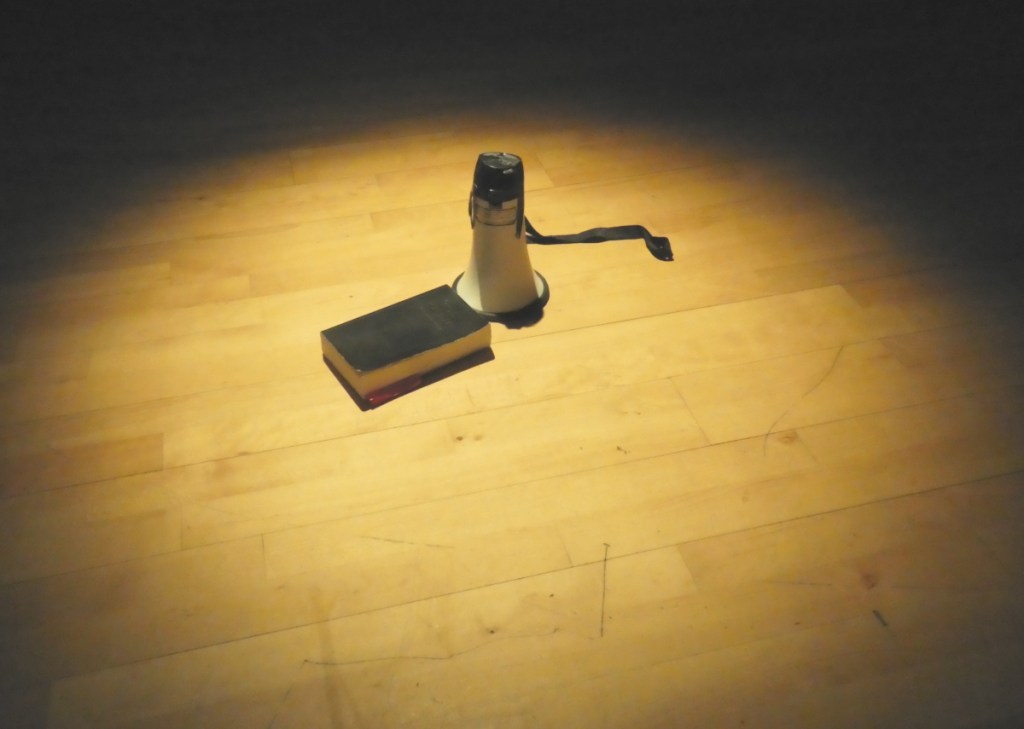
Bible and megaphone

John McCann’s one man show, DUPed, with its focus on the role of Ian Paisley and the Democratic Unionist Party in the recent history of Northern Ireland, was always going to be interesting to someone like me who grew up in Newry, Co. Down, in the 1950s, and 1960s.

McCann’s perspective on this history is an interesting one. Born in 1972, he lives now in Fife in Scotland, but grew up in Portadown, Co Armagh, a Catholic in a predominantly Protestant and Unionist town. He recalls, as an adult, asking a group of Catholic teenagers, how it may be possible to tell Catholics from Protestants. At the end of a list of fairly stock answers relating to hair styles and pronunciation of the letter “h”, one lad offered a further thought on the matter: “You can tell by the way they drive.”

Exploring this curious and unexpected distinction, McCann was further told: “They drive as if they own the place.” Further enquiry elicited a fuller description of young lads, driving through the town centre, presumably in fine weather, in laid back style, window wound down, right elbow resting lightly on the sill, and left hand resting casually on the steering wheel:  as if they own the place. 

This actually describes a scene of youthful masculine display, not uncommon in many parts of the United Kingdom; however, the young Catholic man had made the unconscious assumption that that he was witnessing not simply ostentatious pride in the ownership of a vehicle, but an assertion of ownership of the streets on which the vehicle was being driven.

On the other hand McCann also tells how, at the end of one of his shows, a young man came over to him and leaned in, speaking quietly in a voice he recognised as being somewhat like his own, and passed a judgement on the performance: “Absolute Shite!” This mysterious commentator did not pause for a response, but instead, headed for the exit.  McCann recalls: “I chased after him, and said: ‘Come and have a coffee. My treat!'” But the fellow was not to be drawn in. “No point!”

Perhaps this critic was one of those young car drivers, who really did think he owned the place. Or perhaps he had his own story to tell and did not have sufficient conviction that it could be heard in such a context. 

McCann’s story though, is rooted not just in sectarianism, but in engagement in the struggles for acceptance of the LGBT community, and a woman’s right to free and safe abortion, in Northern Ireland.  The DUP have resisted change in these matters, along with other changes in the life of Northern Ireland, making it a place apart in the United Kingdom, not just physically, but also in terms of its political and social life.  We all have some sense of this of course, and yet McCann’s case is that, in truth, we are barely conscious of this separate reality.

DUPed is humorous, shocking and touching. McCann had some acquaintance with Lyra McKee and his narrative includes actual recordings of her voice.  At the time of her murder, I heard many people say what a wonderful person she was, and could not help feeling that these words were inevitably a somewhat sanctified version of the reality, justified naturally by the circumstances of her death.  Hearing her voice, and more importantly the sentiments which she was expressing, created a more significant impression of her integrity and courage,  perhaps best expressed in the story told by  McCann of the friendship which had developed between Lyra and DUP MLA, Pam Cameron, following a Twitter spat in which McKee had commented with some frustration on the use – more accurately mis-use – by the DUP, of a petition of concern, to block equal marriage legislation, which at that point had actually been passed by the Stormont Assembly.  Pam Cameron though, had shown some openness to the idea of equal marriage and so this looked like hypocrisy, and Lyra did not hold back in passing judgement.

At the suggestion of her husband, Ms Cameron asked McKee to meet up for coffee.  Lyra agreed to the meeting and on encountering Pam Cameron, immediately apologised profusely for the tone of her tweet; from that point a friendship between the two had developed. 

This story is fundamental to McCann’s thesis that it is the lack of such face to face encounters which is holding change back in Northern Ireland. He engagingly explores the reasons why such conversations are difficult and how they may actually take place. 

Such difficulties are not unique to Northern Ireland and any person with an interest in the road to a more open and tolerant society, will learn something from this show. 


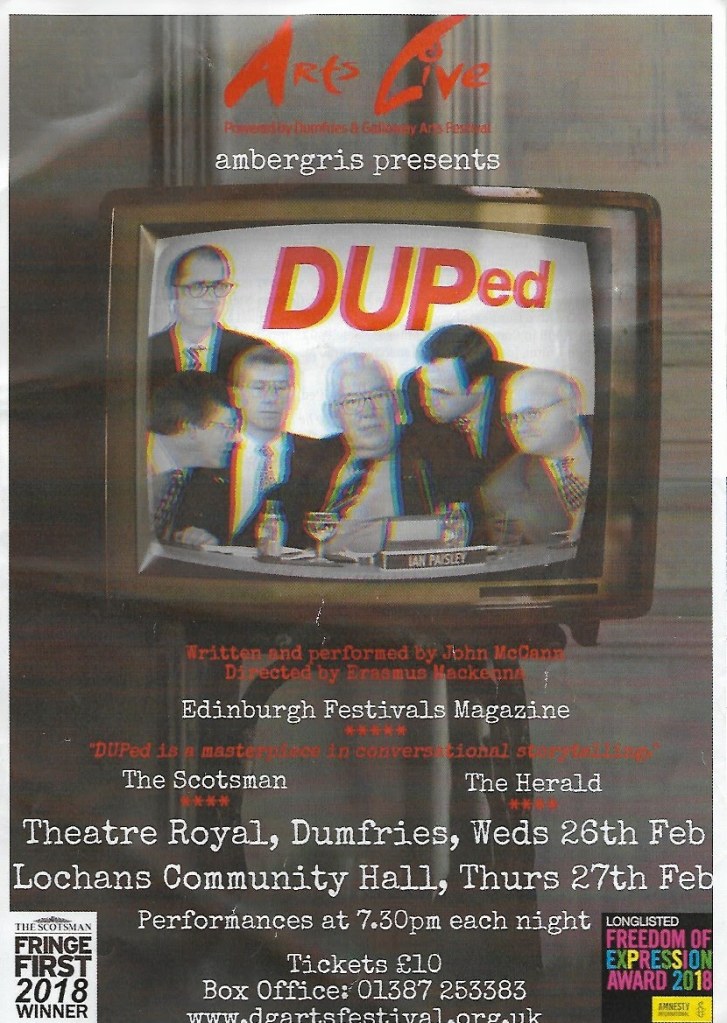
DUPed
Written and performed by John McCann
(Scotsman Fringe First Award-winning Show 2018)

Show reviewed:  Theatre Royal, Dumfries, Weds 26th February

Also on at Lochans Community Hall, Thursday 27th February

Dumfries and Galloway Arts Festival

Posted in Podcasts etc. | Tagged , , , , , | Leave a comment

Correlation and Common Sense

Politics Live today [BBC 2- 25Feb2020] brought up that old adage: “correlation is not the same as causation.” On this occasion it was deployed by panellist and Daily Telegraph journalist, Madeline Grant, as a push back against the findings of the Marmott Review which suggests that health in England is ‘faltering’ after 10 years of Conservative driven austerity. [1]

Ms Grant further suggested that the author of the Review, Professor Sir Michael Marmot, has an ideological axe to grind, and represents a left point of view, essentially unaltered from that of his previous report on the same public health topic, of 10 years ago.

Dame Helena Kennedy, also a panellist, was quick to point out that Professor Marmott has previously been critical of the Labour Party. I would also hazard, that to critique someone’s arguments on the basis that they are left wing is, in itself, an ideological argument.

Ms Grant’s insistence that Professor Marmott’s findings establish no causal link between austerity and a decline in public health is a poor defence of the policies of the coalition and Conservative Governments over the past 10 years. To establish that someone was in the room at the time of the murder does not, it must be admitted, prove that they committed the crime; but it certainly makes them a suspect.

Public health is a complex area of study. To establish, for example, a causal link between cuts to Sure Start [2] and subsequent health outcomes, is probably never going to be possible. Common sense tells me however, that the kind of things being offered in Sure Start, “initially targeted at the 20% poorest wards in England,” [3] were likely to lead to better health outcomes in the short, medium and long term. The onus, I would suggest, should be on those who cut the programme to disprove the common sense understanding, as supported by correlational evidence, of the impact it has had.

It’s true that common sense once told us that the world was flat, and we are all indebted to Christopher Columbus for putting the matter properly to the test; but common sense is the foundation of scientific hypothesis, and until arguments are developed or studies designed to overturn that common sense, it remains the proper basis on which to proceed. The existence of correlational evidence is important in that it may support, or on the other hand, challenge, our common sense understandings, and thus refine and develop them.

Common sense, to be sure, may be a disputed territory, and Madeline Grant’s common sense understanding of the issues most important in determining public health outcomes may reasonably differ from my own and those of Professor Marmott. An intelligent discussion can move our understanding of common sense forward. Accusations of ideological thinking, allied with what, in this case is a truism – that correlation is not causation – is not the basis of an intelligent discussion.

Posted in Comment | Tagged , , , , | Leave a comment

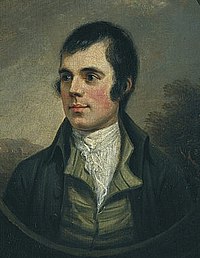
O wad some Pow’r the giftie gie us ….

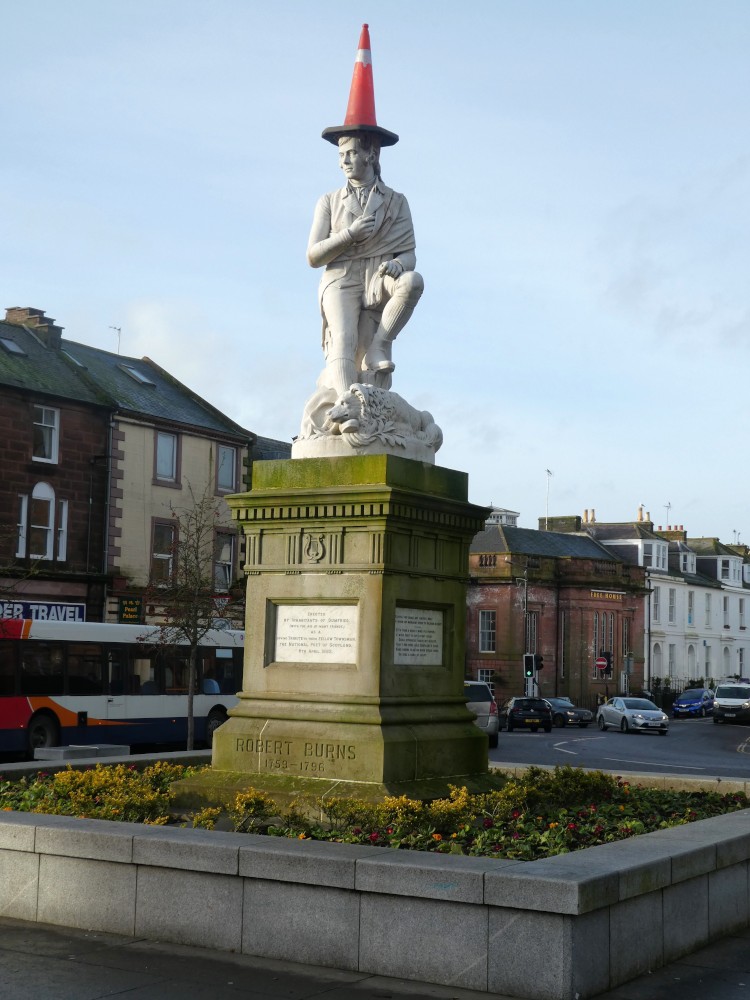
Burns statue, Dumfries, Friday 10th January, 2020

O wad some Pow’r the giftie gie us
To see oursels as ithers see us!
It wad frae mony a blunder free us,
An’ foolish notion:
What airs in dress an’ gait wad lea’e us,
An’ ev’n devotion!

From: “To A Louse, On Seeing One on a Lady’s Bonnet at Church” 

I am guessing that Burns might have enjoyed this particular joke, but perhaps have been pleased to note that when I returned to the scene of the crime shortly after taking the photo, that the local authority had removed the offence.

In July 1793 Burns embarked on a tour of Galloway with his friend John Syme. Syme records this story in a letter “written soon after” their return.

“’We left Kenmure, and went to Gatehouse. I took him the moor road, where savage and desolate regions extended wide around. The sky was sympathetic with the wretchedness of the soil; it became lowering and dark. The hollow winds sighed; the lightning gleamed; the thunder rolled. The poet enjoyed the awful scene: he spoke not a word, but seemed rapt in meditation. In a little while the rain began to fall. It poured in floods upon us. For three hours did the wild elements rumble their bellyful upon our defenceless heads. Oh, oh! ’twas foul. We got utterly wet; and, to avenge ourselves, Burns insisted, at Gatehouse, on our getting utterly drunk.” [1]

I imagine that the events leading up to the latter day crowning of the poet, as depicted in the photograph above, bore some resemblance to that night in Gatehouse. Drunk or sober I’d guess the escapade was not without hazard.

Robert Burns, National Poet of Scotland, born Alloway, 25 January 1759, died Dumfries 21 July 1796

Posted in Misc | Tagged , , , | 2 Comments

Solid Ground

Sometime during the 1980s, I was lucky enough to hear Dougie MacLean perform at the Dumfries Folk Club, in the rather unglamorous setting of the Cairndale Hotel, ….audience, I am guessing, less than a hundred. I was impressed. I don’t know whether he still includes the didgeridoo in his act, but really it seemed likely that he could get music out of anything that came to hand.

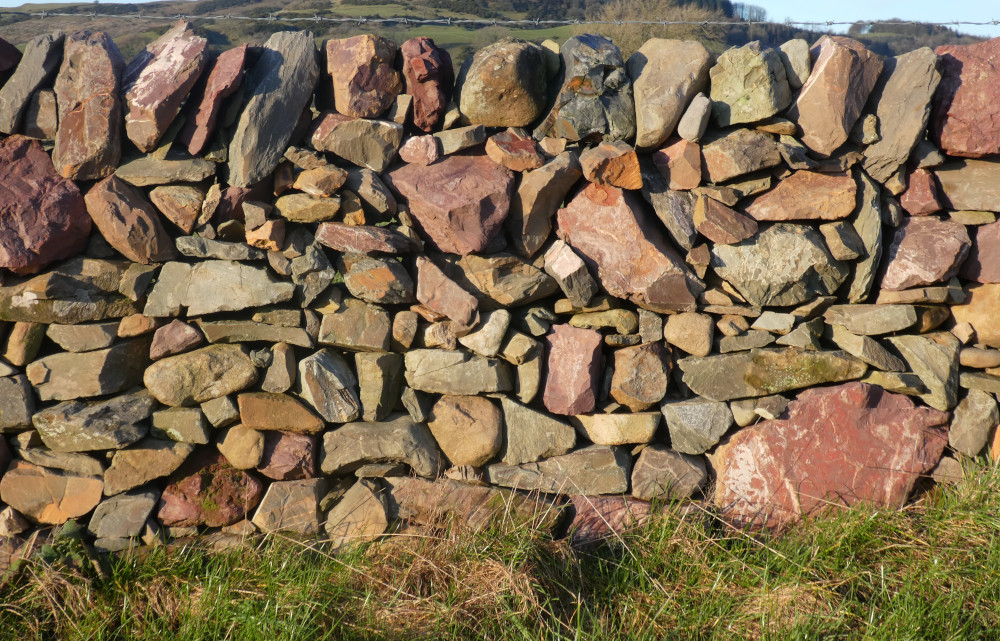
Dry stone dyke, west of dumfries near the top of the glen.

MacLean is best known for his song Caledonia, but the song which has resonated most for me from that performance, was Solid Ground.

Down the Buckney den the burn crashes brown from
The Autumn spate

A “spate” I note is “a sudden flood in a river”, and just at this moment the idea of sudden flood is very much in the news. But in McLean’s song, the flood is a natural part of the seasonal cycle and something to be enjoyed rather than feared.

The title of the song recurs in the repeated line “We stand on Solid Ground on Solid Ground” . It is a reassuring image. And yet the song hints at the importance and vulnerability of our relationship to this “solid ground.”

We stand on Solid Ground
It’s the land-it is our wisdom
It’s the land-it shines us through
It’s the land-it feeds our children
It’s the land-

But I have stopped short: for it is the concluding words of this stanza – just one and a half lines – which have struck an indelible mark on my memory, perhaps because they overturn any complacent notion we may have about our responsibilities to the ground on which we stand.

…you cannot own the land
The land owns you

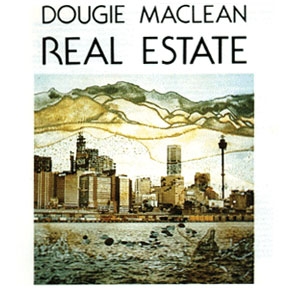
Listen to Dougie McLean singing Solid Ground from his album Real Estate.

And on a rather more prosaic note, though I think not unrelated, you might like to listen to this recent edition of the The Life Scientific where Jim Al-Khalili interviews Professor Myles Allan on Understanding Climate Change. Available as a podcast.

Posted in Environmental | Tagged , , | Leave a comment

Not enough pride in Charlie Pride…

I stumbled across this programme recently, having some awareness of Charlie Pride’s career as a black Country and Western singer, but knowing  little about him or even that he was still alive and touring.

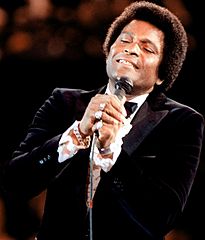
Charlie Pride sings to the honored guests during the gala celebration at the Capital Center, on Inauguration Day. January 1981

Growing up in Northern Ireland, country music was a big deal, but not something I was personally paying much attention to. Indeed I rather looked down my nose at the whole genre, seeing it as terminally sentimental and conservative. The conservative aspect  was confirmed by my encounter with Merle Haggard’s Okee from Muscogee:

We don’t smoke marijuana in Muskogee

We don’t take our trips on LSD

We don’t burn our draft cards down on Main Street

We like livin’ right, and bein’ free

Yet, I’d have to admit, Merle Haggard,  has a distinctly unsentimental style and perhaps I even detect a little irony in his delivery.  

Gradually my view of country music has altered. Perhaps Dylan’s Nashville Skyline had some influence, or Leonard Cohen’s Tower of Song. 

I said to Hank Williams, how lonely does it get?

Hank Williams hasn’t answered yet

But I hear him coughing all night long

Oh, a hundred floors above me in the Tower of Song

But where does Charlie Pride fit into this. “He was born to sharecroppers in Sledge, Mississippi in 1934.”   In one of several interviews in this programme he recalls walking four miles to school, and being overtaken by the white kids – who were all bussed  – and who would lean out the window and jeer at him. “Nigga”.    

However, the music his father listened to on the radio was the Grand Ole Oprey and it was through this education  that he acquired his love and developed his talent for country music.  

A particular detail of this programme that appealed to me is the esteem in which he is held, to this day, in the country music scene in Ireland, on both sides of the border and on both sides of the political and religious divide. 

So how, in the first place,  did he become a revered figure in American country music?  Country is a genre dominated by white musicians and rooted in the communities of the deep south where, as Charlie Pride’s career was just starting off,  segregation was still openly defended and the old attitudes of prejudice still lingered. 

Somehow Charlie Pride navigated these alligator swamps without anger, or bitterness. If you are at all interested in his story, then give Jacqueline Springer’s beautiful programme a listen.  

https://www.bbc.co.uk/sounds/play/m0009b00

Posted in Podcasts etc. | Tagged , , , | Leave a comment

The programme I’d most like Donald Trump to watch.

I am sure that many of us have our own ideas of a particular argument or situation which might prise open the US President’s weird and insular view of the World. He’s
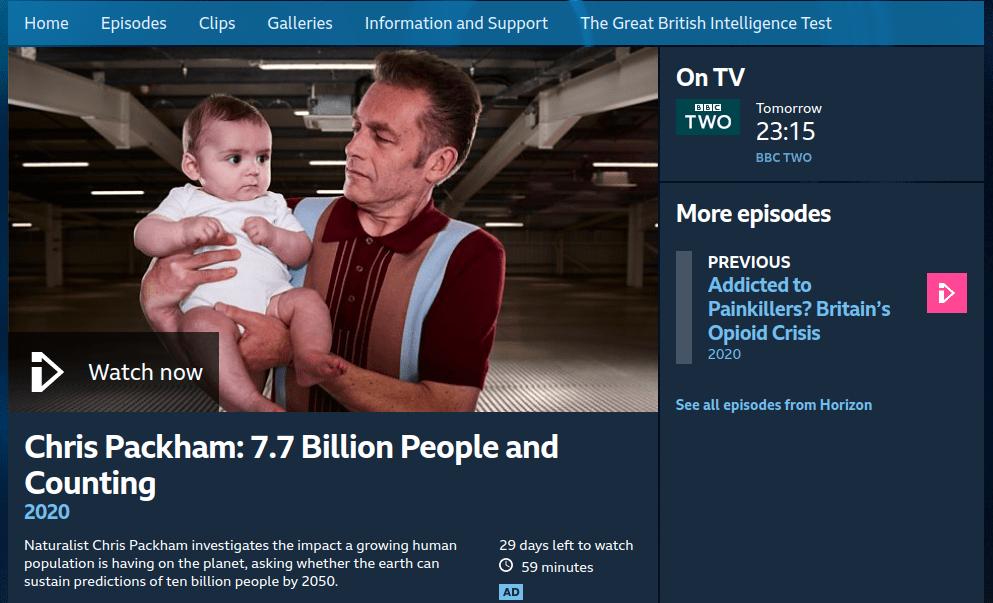
currently at the World Economic Forum in Davos, telling us there’s nothing to worry about, and were he to be confined briefly to solitary confinement, this edition of Horizon, presented by Chris Packham, is definitely the programme I’d most like him to see. It’s focus on population growth and on the destruction of habitat to create farmland to feed our growing global population,is not new, but this presentation of the argument is brilliantly stark, with some excellent interviews and amazing location shooting – the housing built on a lagoon outside Lagos being a particularly special example of human ingenuity in the face of adversity. The programme is marked by Chris Packham’s quirky character and finds him reflecting at one point on the 10 vacuum cleaners he owns, which unsurprisingly he is forced to conclude, is an unjustifiable indulgence.

If you haven’t seen this programme it is definitely worth a look.

https://www.bbc.co.uk/programmes/m000dl6q

Posted in Podcasts etc. | Tagged , , , , | Leave a comment

How Many Political Parties do we Really Need?

A central purpose of political parties is to bring together people of similar mind so that an agreed and accessible synthesis of their ideas can be offered at an election. 

One of the few advantages of the First Past the Post [FPTP] electoral system is that it simplifies the choices set before the electorate by the rather brutal device of  limiting the number of parties which have any meaningful chance of winning seats. A proportional system inevitably brings more marginal parties into contention for seats and so has the opposite tendency.   


At moments of extreme political challenge, as we have recently seen in the UK, divisions within parties are amplified and the threat of fractures is great. FPTP however holds parties together, whereas Proportional Representation [PR] would make them liable to splinter under such internal tensions. Such splintering has the negative consequence that it can result in a dizzying set of choices being set before the electorate, and following the election, can make the building of a governing coalition a difficult task. 

The purpose of my argument, though, is not to defend FPTP; indeed many systems of PR address this problem of  party proliferation by creating thresholds at a constituency, regional or national level. However, at moments of crisis, even this device may fail to prevent an unruly collection of parties from capturing a PR Parliament and turning  its politics into a stormy struggle between constantly shifting and unstable alliances. Such parties are liable to be founded on an appeal to narrowly sectarian interests, perhaps exploiting dog whistle racism, religious mania or other forms of questionable snake oil.  Italy would appear to offer a current example of just such an unholy mix. This is by no means a typical outcome for PR, but there is little point in denying that it does sometimes occur.

It is with this in mind that I ask the question: how many political parties do we really need?  There will be many responses to this question, ranging from “one” – that would be the Marxist-Leninists and the Nazis, to:  “Any limit to the number of political parties is an affront to democracy.” I will suggest however, that the principle of democracy need not be sacrificed by proposing an intervening number, which for sake of this argument I will suggest, should be  five.  

Whatever the agreed number of  parties might be, a schedule of parties entitled to go forward to UK National elections, could be established on the basis of data arising from  local government elections, where no such restriction need apply. The precise mechanism for establishing the schedule need not concern us here, but promotion and relegation from the Premier League might be a useful analogy to keep in mind.  Lest there be any doubt, I should also make it clear that this proposal is directed only at the UK Parliament, and not regional Parliaments, where, as in the case of local government elections, a formal limit on parties standing for election would serve no obvious purpose.

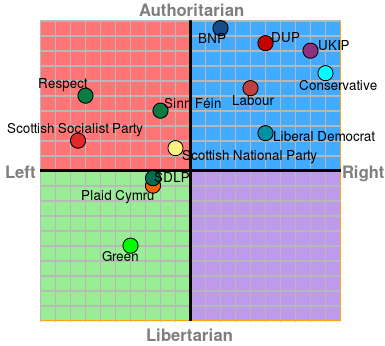
In our current politics, the five parties which I would expect to emerge from the data would be:  Green; Labour; Liberal Democrat; Conservative; Faragistes. It is possible that the SNP could make the cut, but parties such as Plaid Cymru,  and other regionally based parties such as Sinn Fein, the DUP and the Alliance Party, would not. A party such as the DUP might affiliate to the Faragistes, the Alliance Party perhaps to the Liberal Democrats, and thus maintain their right to stand in Westminster elections.  Affiliation would be more difficult for separatist parties, who would be consequently liable to lose out on influence in the national Parliament. This said, I would personally consider it important that the right of the SNP, and Plaid Cymru to seek independence should be protected,  perhaps by legislation which would trigger an independence referendum following a majority vote in the relevant devolved parliament. It would be reasonable, however, for this legislation to place a formal limit on the frequency with which such referenda could be conducted, let’s say, no more than once every 25 years. 

But why five parties?  Why not six? Or four? Well there is of course room for debate as regards the ideal number of parties, and to some extent I am looking at a left right spectrum, with two parties on the right, two on the left and one from the center as the likely candidates to emerge from the data gathered in local elections.  Five parties should be able to offer a spread of policies from which only the constitutionally unclubbable and disaffected will be unable to make a selection. In the context of the actual election, a manageable set of options would then be on offer. Following the election, the formation of coalitions should be relatively straightforward and arise easily from negotiations reflecting the relative strength of the parties.  It is easy to imagine the Green Party in Coalition with the Labour Party, but equally easy to imagine both of these parties in coalition with the Liberal Democrats: and so on. 

Under this regime, there would be a clear interest in parties holding together, though I can imagine there being drift between parties at the margins of policy.  Those parties which were losing influence would be under pressure to reinvent themselves, to develop fresh ideas, or a sharper organisational base to connect more effectively with the electorate, or risk relegation and replacement by a  newer and fresher force emerging from the politics of local government. 

I must be honest: the chances of such a proposal actually being adopted, are on a par with the survival of  the proverbial snowball in hell. But perhaps there are better solutions to the problem to which I am drawing attention? And perhaps, as was suggested in the Labour Party’s 2019 Election Manifesto, there should be a Citizens Assembly to consider such constitutional matters: who knows what might emerge from such an Assembly?

Posted in Comment, Electoral Reform | Tagged , , , | 2 Comments

Reading the Entrails of the Election

Tony Blair has been prominent in the voices of those seeking to divine the meaning of the 2019 election, dismissing Labour’s current incarnation as “a brand of quasi-revolutionary socialism [that] never has appealed to traditional Labour voters….The takeover of the Labour Party  by the far left turned it into a glorified protest movement with cult trimmings, utterly incapable of being a credible government.[1]

Whilst in general, this analysis has been received with uncritical alacrity by the media, I do notice some pushback in the Guardian letter pages under the heading: Tony Blair needs a further period of reflection. A series of correspondents point out in some detail that the vagaries of our electoral system disguise the strength of Labour’s performance and that across the UK as a whole, in this election, the Tories have one seat for around every 38,000 votes, Labour have one seat for more than 50,000 votes, and the Lib Dems one seat for about 330,000.”[2] 

I would add to this complex picture the fact that Scotland was largely lost to Labour in the 2015 election [3] when the SNP managed to successfully portray Ed Miliband’s Labour Party as “Red Tories.”  The Corbyn Labour Party actually pulled some of this back in the 2017 election [4] but clearly, the split in the Labour vote between leave and remain and the consequent difficulty Labour have had with Brexit policy, was something that Nicola Sturgeon has been able to exploit from her stronghold of a remain supporting Scotland, where, by the way, it required a mere 25,882 votes to return each newly elected member of the SNP to Parliament.[5]

I was a supporter of Blair as he led New Labour into its 1997 landslide.  The Labour Party has always encompassed a struggle between those who tend to define themselves by principle and those who focus on that old adage: politics, the art of the possible. It is clear that Jeremy Corbyn’s tendencies are towards the principled end of this spectrum and he stolidly resists any temptation to be jingoistic or bellicose, even where this might enhance his popularity, at no obvious cost to his actual project.  Blair, by contrast, continues to believe that his more realistic grasp of the social and economic conservatism of the potential Labour vote is an unarguable and pragmatic case against the unrestrained, socially liberal and economically radical agenda of the Corbyn left. 

There is much to be said in favour of both the principled and pragmatic tendencies but, equally, both tendencies have their failings.  Those who stand on principle are apt to be inflexible and ideological in their thinking and sanctimonious in their rhetoric. Pragmatists, on the other hand, get drawn into their own project and lose sight of the bigger picture. I am reminded of the film, The Bridge over the River Kwai, where Alex Guinness, playing Lieutenant Colonel Nicholson, sees the survival value of cooperating with his Japanese captors, and so leads his men to engage positively with the construction of the bridge. In the denouement, we see him resisting the attack mounted by British soldiers on the bridge and it is only when he is mortally wounded in this action, that he understands his own folly and collapses on the detonator to blow up the bridge himself.

The bigger picture in the present moment is climate change, a looming threat which demands immediate and dramatic action.  It was this, above all, which justified the ambition of the Labour manifesto. Perhaps, as Keir Starmer has said, the manifesto contained “policy overload”. Starmer, however, goes on to qualify this criticism:  “The case for a bold and radical Labour government is as strong now as it was last Thursday. We need to anchor ourselves in that.[6] 

In mitigation of the failure of Labour to win power, it should also be remembered, that despite his purge of moderates, Boris Johnson has committed the Conservative Party to a programme of spending which right wing idealogues must surely be boggling at. Even in electoral defeat, one can see Labour’s contribution to the redefinition of the ground on which politics is contested, a fact which gives some substance to Corbyn’s contention that “Labour won the argument.” 

 Almost everything about Brexit and the election of a Conservative majority has been understood in hindsight, and yet there are still many intent on obscuring the reality of what has happened, Tony Blair amongst them.  He should certainly, for a start, reflect on why electoral reform did not form part of the New Labour project and why Blair and Brown proved, ultimately, so ineffective in the regeneration of Labour heartlands.

He is wrong to speak contemptuously of the way in which Labour has moved to occupy the key battlegrounds of the present moment and to develop policies which are on a scale that are equal to the challenges: climate change; extremes of inequality; the way in which the most recent iteration of capitalism has so conspicuously failed to renew itself and spread wealth and prosperity to all.    

Blair  was one of the stronger advocates of a second referendum, and though clearly in favour of remain, presented his case with due deference to those who sought a hard Brexit and showed an admirable willingness  to accept such an outcome.[7] Why then can he not acknowledge that Corbyn’s advocacy of a second referendum, in which he would remain neutral, was a credible positioning, given the difficult hand which Labour had been dealt? Had Corbyn taken this stance at an earlier stage and presented it with greater authority, its impact could have been significant. Blair is correct, however, in saying that Labour failed to convince the electorate either of its positioning on Brexit or of its competence to deliver on the scale of its manifesto offer.   

With respect to the competence of UK Governments in general, Dominic Cummings, in a lecture to the IPPC [8] in 2014, points to a generally overlooked aspect of the problem: the civil service.The average citizen, I imagine, like myself, has not given much thought to the civil service as a brake, or even the principal obstacle to governments achieving their objectives. Cummings, however, makes an informed case that the Whitehall establishment is profoundly dysfunctional and resistant to change and that our antiquated and bureaucratic system of government is totally ill-equipped for the challenges of the modern era. His proposed revolution would ensure relevant expertise was engaged at the highest level of policy development and that effective management would drive implementation. In addition, Cummings observes that the typical MP skillset is ill-fitted to their responsibilities of oversight, when in office, and holding to account, when in opposition: he suggests MP training in such matters as statistics and science. Well, who could disagree with that? Whatever misgivings we may have about his wider objectives, Cummings is now at the heart of the current administration, and it will be interesting to see if this rogue individual can deliver on his agenda, the implications of which may be significant for all those who seek power in the future. 

Those who have been keeping a wary eye on Cummings may have been amused to see that he has topped GQ’s list of worst dressed men of 2019.  The photo they feature [9] is a particularly wonderful example of how he has stolidly refused the dress code of those in high office.  It is interesting to compare this outfit with his appearance in the aforementioned lecture to the IPCC in 2014, when he was less in the public eye and where he is rather smartly turned out in a dark suit and tie.  Whilst his slightly funereal look might not have catapulted him into the GQ’s list of best dressed men of 2014, it would certainly have kept him well clear of the worst dressed list.
It is fairly obvious that Dominic Cummings is not in search of popularity, and his sartorial choices in recent times are undoubtedly part of his anti-establishment message.  His riposte to journalists at one point during the election campaign: “You guys should get outside London and go to talk to people who are not rich Remainers[10] is further evidence that he is an alien presence at the heart of the Conservative Party. Of course at least some Labour candidates were doing just what Cummings was advocating:  Caroline Flint and Sarah Champion, to name but two, but it was Cummings who has capitalised on working class leave disaffection and who has delivered a prize to the Conservative party.  We can now only hope that his subversive instincts will make something of this opportunity, from which we may all benefit.

Oh, and by the way Dom: have you noticed those election statistics?

Posted in Brexit | Tagged , , , , | 4 Comments

Leadership in the 2019 Election: the Good, the Bad and the Indifferent

Let me start by putting in a word for Nicola Sturgeon. Were she to concede to be Prime Minister of the United Kingdom she would probably make a better hand at the job than the other candidates on offer. Once the nation had got over the obvious dissonance of the UK being led by a Scottish Nationalist, her political skill set could be set to work on uniting the nation. She is not just a good performer in debate: she relates well to the general public when she encounters them, knows when to strike a serious tone and yet doesn’t take herself too seriously, as is shown by her participation in the Scottish Leaders interview with Chief Commissioner Cameron Mickelson. True, she was done over by Andrew Neil, but that is a badge of honour which she can share with Corbyn and Swinson, who got a similar doing, unlike Johnson, who, as is now clear to everyone, ran away.

There are of course a number of obstacles to Nicola Sturgeon taking the top job, not the least of which is that, despite her high profile in the campaign, she is not actually standing for election.

I think we can all agree that Jo Swinson’s early tactical errors have all but sunk her campaign and though she struggles gamely on, her support is ebbing away. Doubtless the Lib Dems are continuing to challenge in some areas, but this will be despite rather than because of Jo Swinson’s contribution.

The final leadership debate between Johnson and Corbyn, [BBC, 6Dec19] was widely reported as a no score draw, but I think this fails to represent some important differences in the quality of the performers. If I may develop my football metaphor; Corbyn was weak in both defence and attack but played a solid game in mid-field. Johnson on the other hand was just hopeless, hanging round the opposition penalty area, but showing no creativity, charging about without style or substance, desperate to put the ball in the net, but shooting wildly. This was a man not just in the wrong position, but actually in the wrong game. He should stick to comic journalism for the comfortably off, speeches to the Tory faithful, or scrabble – a game for which I am led to believe, he has a prodigious talent.

To be more exact, what he offered us was tired slogans, a very poor attempt at humour in response to the question about a suitable fate for dishonest politicians, and a lame attempt to ridicule Corbyn’s position of neutrality on Brexit. This was a point at which Corbyn’s defence let him down. It is perfectly reasonable to say that, faced with two options, one can see merit in both and can therefor work with either outcome. Boris wishes to obscure the simplicity of this rational and reasonable position, and to some extent, he succeeded.

Boris was also keen to rubbish the Labour plan to negotiate a “credible” new deal given that – according to Boris – the Labour negotiating team will be openly remain supporters. Reality check! Labour will negotiate a Norway style deal, frequently referenced in the 2016 referendum and providing an exit from the march towards a federal Europe. Plenty of leavers will be happy with this, though not all. Some erstwhile remainers might even find it appealing, or see it is an acceptable concession which should be made to honour the 2016 vote. Plainly this is a soft Brexit and will therefore be easy to negotiate and to implement should it win out over remain in a second referendum.

Corbyn failed to distinguish between borrowing for investment in infrastructure, which generates a national asset – and increased spending on running costs, which must be paid for by higher taxation. This is an important distinction and helps to make sense of how Labour’s ambitious plans can work. Corbyn fluffed the opportunity, which can only be a frustration to his watching lieutenants McDonnell and Long Bailey, who have both been more effective in explaining the credibility of Labour’s project.

Similarly Corbyn failed to neutralise Boris when he returned to that well worn smear, “the mess that Labour left us in”. I have heard Rebecca Long Bailey strike this down on a couple of occasions recently, reminding people that the financial crisis was international and whatever blame may attach to Labour for its failure to regulate the banking sector, the Conservative Party were in fact one of the opponents of any such regulation.

If the print media are to be believed, it is Boris who has triumphed at every stage of the election process. Broadcast media on the other hand have been more inclined to call it a draw with neither Corbyn nor Johnson being able to get the upper hand in debate.

This panel of one however, takes a different view. Corbyn, demonised and derided by the media and all of his political opponents, though far from stellar, has delivered a credible performance. Johnson, of whom much was expected, has gone off like a banger in a box of fireworks. Neither politician deserves an award, but Corbyn is the clear winner. Whether this reality will have any effect on how the nation votes on Thursday is another matter.

Posted in Brexit | Tagged , , , | Leave a comment