The Uncertainties of Climate Forecast

It would appear that Boris Johnston does not share the sense of emergency regarding climate change as  felt by the youthfully inspired Extinction Rebellion, who he shrugged off early this week as “Uncooperative crusties!”     His father Stanley, by contrast, has come out in support of the insurgents: he’s obviously spending time with the grandchildren.  
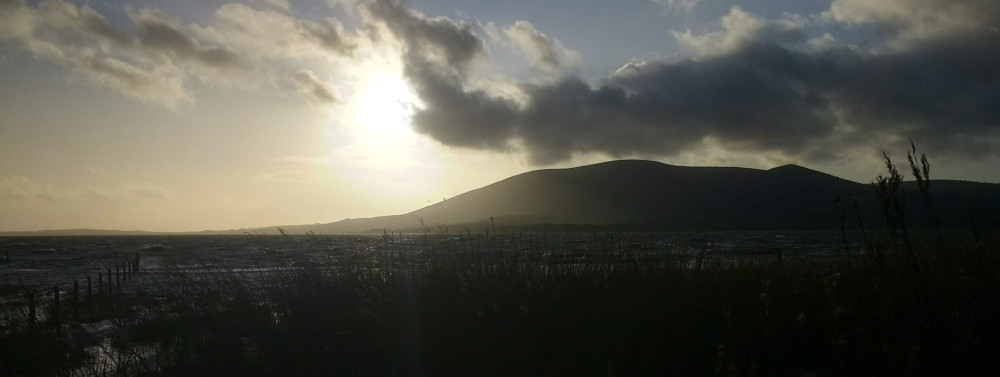
Criffel, from across the Nith Estuary which feeds into the Solway Firth

Politics Live on Tuesday  [7Oct2019]  referred to the Boris insult, by way of an introduction to a discussion of the protests with a panel which included Rupert Read of Extinction Rebellion. Rupert was quick to draw attention to his uncrusty appearance – a smart jacket and tie, constrasting strikingly with the tieless Nigel Evans MP, who frankly, struck me as rather disheveled; too many late Brexit nights perhaps.  

It wasn’t long though till Rupert put his sartorial status at risk, rolling up his  sleeve and baring his forearm to show us, not tattoos, but the names of his nieces, hand written, rather roughly,    in marker pen. It was concern for their future which was the source of his campaigning energy, he told us with some emotion.  

 Other panelists  were journalist Madeline Grant and  Labour MP Jess Philips. In summary the discussion  was a tussle between the rather relaxed approach of the politicians and the passionate commitment of Rupert Read.  Madeline Grant just seemed uncomfortable to be seated so close to the slightly unhinged zeal of Rupert Read.  

None of the panelists denied the  threat of climate change: however, Nigel Evans was content with the Conservartive Party target of carbon zero by 2050,  Jess Phillips with the Labour target of 2030, whilst Rupert was adamant that we all need to be prepared for sacrifices to achieve the Extinction Rebellion Target of carbon zero by 2025.  Indeed he was insistent that in a mere 5 years time we must forsake air travel, private motor cars and instead commit to travelling by public transport, bicycles or walking. “What!” Madeline Grant screamed. “If this is what saving the planet means, then I’m out”….well actually she didn’t say that, but her rather expressive face suggested this may have been the thought which came first to her mind.

When challenged with Rupert’s 2025 plan, Nigel’s first instinct was continuing advocacy  for a third runway for Heathrow whilst Jess staunchly defended HS2.

Though a little unusual on Politics live, the media in general loves a debate to be livened by   theatrical behaviour and emotion, preferably tears. Personally I think that emotion, or passion as it is often styled,  in the context of debating important issues, is much overrated. But Rupert did indeed express himself with obvious passion as he advocated democracy and citizens assemblies, not really explaining how the two processes would interface in this case, without one compromising the other. I found it hard not to dismiss him as a bit too keen to be down with the kids, and to further dismiss the Extinction Rebellion target of carbon neutral by 2025, as a fantasy. 

Yet the truth is, for all my discomfort with his presentation of the arguments, I am with Rupert Read on this one. Accurately forecasting our unfolding climate crisis is a challenge, subject to the same vagaries as forecasting our weather.  The storm may arrive exactly as predicted, but it may just as likely arrive late, or on the other hand it may come early, and be more severe than anticipated: some of us can remember the Michael Fish forecast of 15th October 1987, which spectacularly underestimated the storm which was on its  way at the time. I note just one comment at the bottom of the YouTube video of his embarrassment: “The next morning, our summerhouse was in next door neighbours garden.

With climate change, the stakes are a great deal higher; it’s just common sense; why take the risk? We should of course try to be carbon neutral by 2025, however improbable a target that may be.  The idea, as Madelaine Grant interjected at one point, that pursuing this objective will “send us back to the stone age” is foolishness.  Failure to act is more likely to take us there.

Ann Pettifor in her book The Case for the Green New Deal proposes a Keynsian methodology for getting to carbon neutral,  based on the use of all of our available resources. It offers an opportunity to spread prosperity that is not currently available  from our moribund economy. That does not sound like the stone age to me. Ann Pettifor does suggest that we may have to forgo some of our habits of consumption, but there is every reason to suppose that the outcome could ensure that we are well fed, clothed and housed,  have excellent health and social care, education, training, public transport and a well cared for public domain. So, a very modernised version of the stone age. 

When we do eventually arrive at carbon neutral, we may of course conclude that the 2050 target would have been just fine:  but really, will that be a problem? Once we are in the clear, we can relax and and start to enjoy ourselves, though my prediction is that at no point in this process need we stop enjoying ourselves. 

So yes, I stand with  Stanley Johnston and the grandkids (whatever their number) on this one:  I support Extinction Rebellion’s ambitious targets, even though I fear their members are too often  happy to lead with worst case scenarios and exaggerated claims and are careless of disrupting the lives of others.  The exhilaration of taking part in such activities is a dangerous intoxicant. Meanwhile the sober onlookers, are irritated or dismissive: “uncooperative crusties” is probably one more of the more repeatable descriptions of the protesters circulating.   

Later in the week, Zion Lights of Extinction Rebellion, was grilled on the Andrew Neill Show.  Neil reasonably enough demanded evidence supporting claims by some members of Extinction Rebellion,  that “billions of people will die.” Zion kept her nerve, stuck carefully to the science and made it clear that such extreme predictions were indeed supported by some credible scientists, but readily accepted that they did not represent a scientific consensus. 

Still, when one really starts to think about the possible impacts of climate change, with displacement of people and increasing competition for scarce resources, it is not hard to imagine the world sliding towards a Hobbsian nightmare.  I’m well into the second half of my lifetime but I’ll be happy to see out the rest of it in an economy governed by the values of Ann Pettifor’s Green New Deal.
Posted in Environmental | Tagged , , | 1 Comment

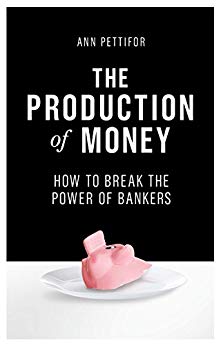
The Production of Money: How to Break the Power of Bankers

The production of money cover

This book by Ann Pettifor is a clearly written explanation of how the financial system can be used, to activate or redirect the resources of the state in favour of whatever great project may be deemed important. Her arguments are a huge challenge to the idea that national economies must be run like a domestic household where expenditure is  tightly controlled and is inevitably constrained by income or  debt  burdens. On the contrary, she explains how the ambition of a nation should be limited only by the extent of its actual resources in terms of its available labour, education and its physical and geographical assets. I note complaints in a number of reviews that she does not provide a complete implementation plan, in particular for those aspects of her proposals which require supra national reform of the banking system; for that to happen however, the obvious failures of the current system need to be challenged by a credible alternative. Ann Pettifor offers such an alternative,  which has a track record of success in prewar regeneration of the US Economy by the new deal, the financing of the British War economy, and the post war Labour Government and the relative stability of the post war international economy – a framework which was a somewhat diluted version of Keynes prescriptions and ultimately overtaken by the so called “Nixon shock” which ended the regulation of the post-war economy provided by the Bretton Woods system.

If you’re not inclined to read a book on economics, then this interview with Ann Pettifor on the Sustainablility Agenda Podcast is worth a listen.  Whilst the interviewer does not ask particularly searching questions, he does allow space for Ann Pettifor to set out her case.  The interview is linked to the release of her most recent book The Case for the Green New Deal  which is definitely on my reading list.

Posted in Books | Leave a comment

Letter to Alistair Jack MP

My MP, Alistair Jack, recently wrote to me, and other constituents,  explaining why it was his intention to support Teresa May’s deal.  The full text of his letter may be found here. In his letter he argues  against a second referendum, saying that “we cannot play the best of three, five or even seven, with the results of a democratic referendum.”  This argument is frequently deployed to undermine the credibility of a second referendum, but in truth we now know   clearly what the choices are facing us, and there is every reason to suppose that the outcome of a second referendum would be decisive whatever the result might be.

Here is my full response to Mr Jack.

Dear Alistair Jack

Thank you for your letter summarising your reasons for supporting the Prime Minister’s Brexit deal.  I have read your letter carefully, and I too am of the opinion, that the  deal is a tribute to the “resolve, stoicism and resilience” of Mrs May.
I have a problem, however, in that I consider the deal unlikely to satisfy many of those who voted in favour of Brexit, and am concerned that, when these numbers are put together with those who clearly still wish to remain, an exit on the basis of Mrs May’s deal is unlikely to be one with which most people will  be satisfied. It will in fact represent the one compromise we should not accept; the compromise of our democracy.
Your arguments against a second referendum are unconvincing.  Three former Prime Ministers are in favour of a referendum, as are a significant number  in the Conservative party, including Justine Greening and Joe Johnson.
Tony Blair, when recently interviewed on Andrew Marr, made it clear that he would, at this point, feel able to  accept the outcome of such a referendum, even were it to result in his least favoured option, that of exit on WTO terms.
Of course there are those attempting to muddy the waters as regards what may be considered democratic, but my own feeling is that the British people must own the decision, and that this can only be achieved by a second referendum; ultimately, this offers the best prospect for the future health of our democracy, regardless of outcome.
In so saying, I do not underestimate the potential of some serious social unrest, amongst those who would inevitably feel cheated were the outcome to be unfavourable from their point of view.  I think however, that we store up problems in our future, if we do not use a fundamentally democratic instrument to determine our way out of the current impasse.
Yours sincerely


Posted in Brexit | Leave a comment

Brexit, Confusion, Fanaticism and Democracy

Having previously advocated a second referendum on the Brexit deal, it is gratifying to see growing support for the idea; yet something concerns me:   enthusiasts for a second referendum seem more concerned with overturning the 2016 vote than with achieving a democratic outcome.   We should be clear: a second vote may confirm Brexit: not to acknowledge this discredits those who call for such a vote.

But what of the lies that we were told? The problem of the Irish border?  The threats to our prosperity? As a remainer, I naturally have concerns on all of these points,  and continue to be unconvinced by the Brexiteer arguments; and yet I would be lying if I pretended to truly understand the complexities of our current impasse .

In a recent Hardtalk interview, Yanis Varoufakis, with reference to Brexit, observed: “This is a confusing issue. If you’re not confused when you’re facing a confusing issue, you are fanatical.”      

The call for a second referendum must reject fanaticism, embrace democracy, and be prepared to leave the EU with good grace.

Posted in Brexit | 2 Comments

Brexit – A way out of the impasse.

On March 11th 2017 I suggested that, following the finalisation of a Government deal on Brexit, there should be a preference based referendum offering choices between deal, no deal and remain.  At the time of posting this suggestion I was filled with naive optimism that this idea would immediately catch fire, which it most definitely did not.   There has been some enthusiasm, though also much mockery of the proposal for a second referendum offering just two choices, exit with Government deal, or remain;  but including a third option to leave with no deal has not been discussed. The idea however is showing itself to be more of a slow burn, and now Justine Greening has advocated something similar and it is suggested that “other senior Conservative MPs also support the idea.”

Philip Davies, commenting in the Guardian says “her suggested three-way preferential voting scheme promises to be more obscure and confusing than the Brexit options themselves.”

Really? Is this task of assessing three options,  and selecting two of them on a preferential basis, really such a difficult or “obscure” task?  Is it not fair to say that, for all the controversy and dispute surrounding them,  the options at this point are in general better understood than hitherto? A valid choice would of course be to put an X against just a single option, though that would squander the opportunity to influence the outcome if that choice proved the least popular.

We are frequently assured that those who voted for Brexit knew what they were voting for; politicians of all parties are fond of telling us, the the electorate are not stupid. Whilst I may have some scepticism on this point, they are certainly not that stupid.

Still,  I would myself admit that the choice offered in the first referendum was far from simple.  I voted to remain, but would not pretend to understand all of the issues or possible consequences. My decision, I can see, was based on a range of considerations, at least some of which one might even call prejudices.  I acknowledge that Europe is a flawed project, but then I feel that the British constitution too is far from perfect, and do not see this as a reason to give up on it and support the SNP in Scotland, where I currently live.

The Brexit debate it seems to me is characterised by unhelpful hyperbole on all sides, and I will take this opportunity to challenge the apocalyptic predictions regarding an extreme Brexit,  made by many of those who, as I did, voted to remain. The idea that we may be reduced to some medieval backwater in the event of crashing out into the world of WTO rules seems to me as unlikely as that the average citizen of the UK will regain any significant sense of control over their lives, or that their sense of British identity will somehow be burnished as a consequence of the UK striking trade deals across the coming years. There will of course be winners and losers, whatever may be the outcome, and I don’t doubt that that leading figures on both sides of the argument have clear sight of their own advantage, without necessarily offering a balanced view of the larger picture.

In the end I believe what will matter is that British people accept the outcome of our current predicament, and currently there seems to me a real danger that we are going to exit on a basis which will leave a majority of people frustrated and feeling that they have been duped. Democracy will be weakened by such a fiasco.  It is in the interests of an outcome which will be widely accepted as fair, that a preference based referendum is necessary.  The three choices:  to remain, to go out on the basis of a government deal, to go out on WTO terms:  whilst I will still vote to remain, whatever might be the outcome, the result would be clearly democratic and I would gladly accept it, even should it be Government fudge or the probable roller coaster ride[as it seems to me] of a more radical separation. A third referendum in search of a different result will not be required.

And by the way: as someone who grew up in Northern Ireland,  the possibility of a border, hard, soft or virtual, would seem to me an unfortunate regression, very vulnerable to the kind of attacks on customs infrastructure, which were perpetrated by  the IRA in the 1950’s.  But that is very different than  a full scale resumption of the campaign of the Provisional IRA, beginning, as it did, in the 1970s. This campaign was built on unrest following the failure of the Civil Rights marches of 1968 to bring an end to the unjust basis of the devolved Unionist Goverment.  The conclusion of the IRA at that point, and the justification for the escalation of murderous attacks on the British State and its agents,  was that Northern Ireland was an irredeemably sectarian state.

Lest there be any doubt: it is my view that, had it not been for the campaign of the IRA, needed reforms to the Government and administration of Northern Ireland would have gradually been accepted at an earlier stage, without the need for bloodshed.

Whilst there is still much progress to be made, Ireland has changed, both north and south of the border.


Posted in Brexit | Leave a comment

Brexit and the Irish Border

With the current focus on negotiations over Brexit and the Irish Border,  the Government’s partner, the DUP,  have been very loud in their objection to the argument that an open border with the Republic of Ireland should be the primary objective of negotiations.  They fear, we may suppose, that in order to achieve this outcome,  the Government will agree to some kind of internal UK border running down the Irish Sea, which, from a DUP perspective, would be a dilution of their status as British.

What has been given scant attention in this discussion, is that a majority of the Northern Irish population voted in favour of remaining in the European Union.  It follows that significant numbers of Unionists voted to remain.   The DUP therefore, in their stance on Brexit, represent a minority Northern Irish  opinion.
An arrangement which is acceptable to a majority in Northern Ireland should be the objective of negotiations, rather than an arrangement which suits only the DUP.  Needless to say, this presents a problem for a government reliant on the support of the DUP to stay in power.
Posted in Brexit | 2 Comments

Scotland’s Energy Future – Upgrading our Housing Stock

On the 8th November 2017  I attended an RSE Community Engagement Event,   on Scotland’s Energy Future,   Community Engagement   Event, in Dumfries Easterbrook Hall, on the 8th November 2017.

A  point arising from the discussion  was the importance of space heating as a component of energy use in Scotland and the possibility of addressing this problem by raising the insulation standards in housing stock.  

New build offers great opportunities, which are currently, as far as I can judge, under-exploited.  My contribution to this discussion at the debate was to suggest that prefabrication  can achieve very high standards of finish and has the potential, if adopted as the required standard  for the provision of social housing, to deliver high grade housing, competitively priced and built to the highest environmental standards and designs.   My knowledge of this mostly derives from watching Grand Designs, and the example of the Huf Haus, fabricated in Germany but built in the UK.  The idea, it would seem, is growing in popularity and I note that the company Dan-Wood offers a UK based option for this type of construction, with a branch in Edinburgh.

The real challenge though, is how to upgrade older housing.  The following suggestion summarises an approach to this problem which occurred to me following the event.

The basis of this proposal is that no house which falls below a the optimal  EPC  for its category should be traded on the open market.  An option for a  property falling below this standard, would be:  independent  valuation and sale  to the government.    

The government would then contract out the upgrading of the purchased housing using accredited businesses to carry out the work.   Upgrade would be  based on designs, strategies and materials developed specifically  for the purpose.   

This would hopefully lead to efficiencies and economies in the process which would enable a radical upgrade of empty houses, before once again placing them on the open market.  

A proportion of the housing stock thus upgraded could be retained by the government for social housing.  

Of course all householders would be at liberty to invest in their own house in an attempt to improve their EPC Grade and thus access the option of trading it on the open market.   

Additional Links

RSE Community Engagement Event

Prefabricated construction in China  Innovation is providing China with sustainable solutions for its building boom, which helps to shed its image as a major polluter.

Posted in Environmental | Leave a comment

Donald Trump First, Donald Trump First, Donald Trump First

 Recent events in Charlottesville have shone a light on the attitude to race of President Trump and his now departed political strategist, Steven Bannon.  

For a moment Trump seemed to be making his position clear:

“When we open our hearts to patriotism, there is no room for prejudice, no place for bigotry, and no tolerance for hate.” [source]

And then, as if uncomfortable with this clarity, Trump slid into an equivalence between the white supremacists and – his own coinage – the “alt left”:

You had a group on one side that was bad. You had a group on the other side that was also very violent.” [source]

Those who demonstrated in opposition to the white supremacists would probably admit righteous anger;  there is indeed a Christian tradition of such anger, rooted in the occasion when Jesus went into the temple to overturn the tables of the merchants and the moneylenders.

What about violence though?  Is it possible to offer any proof that, as a group, the white supremacists intended violence and that those opposing them came with no such intention? We know that one of the white supremacists intended violence which led to the shocking murder of Heather Heyer, but perhaps, as Trump implies, this was an exception.

The white supremacists came armed with a pretty mighty array of weapons, at least in the television footage that I witnessed. Doubtless, the cameras were more drawn to the assault rifle bearing “collection of clowns and losers”, [as Steve Bannon has called them], than to other less heavily armed sections of this protest.

In some cases, those expressing anger at the white supremacists felt it necessary to bring with them weapons of self defence, which I believe included clubs, and in some cases, knives.

Criminal intent is a tricky thing to establish, as ultimately it resides in the mind – but speaking personally, I would say the white supremacists looked a lot more like a gang of dangerous criminals than those opposing them; but then I am, in my own way, prejudiced; I believe the statues of General Lee were only erected in more recent years as an expression of unresolved underlying racism.

Prejudice, is at the heart of this issue, and I believe, to properly understand what is happening, we should accept that we are, each one of us, susceptible to prejudice.  

In 1979, Psychologist  Henri Tajfel, together with John Turner, proposed Social Identity Theory, at the centre of which lay the idea of in-groups and outgroups, and our tendency to favour those in the groups of which we are a member against those who are outside such groups.

Tajfel devised the Minimal Groups study, and was able to gather evidence that instinctive hostility to the outgroup, prompted self harming discrimination.

A little self examination seems appropriate, in the light of this idea.

I do not have people of colour as part of my closest social groupings,  I do not encounter many people of colour in my workplace or in the area where I live. According to Tajfel’s theory, it follows that I will have a tendency to be racially prejudiced. But can this really be the case? After all, I was a consistent opponent of apartheid South Africa; I revere Nelson Mandela, and  regard Martin Luther King as one of the great heroes of United States history. For me, the idea that I harbour prejudice is a difficult one;  yet I would  acknowledge that from time to time, I do recognise prejudiced tendencies within my own impulses.  

In my defence, I would say that I have an underpinning value system based on the idea enshrined, as it happens, in the American constitution that “All men are created equal”.  My more immediate inspiration for this egalitarian thought, given my residence in South West Scotland, would be Robert Burns, who applying himself to the question of social class divisions wrote:

The rank is but the guinea’s stamp,

The Man’s the gowd for a’ that.   .


[gold]

If we accept this idea, then where society becomes more fully integrated, where in-groups becomes less distinguishable from outgroups; my prediction is, that prejudice will diminish.  But such a process of integration, is difficult to manage, frequently resisted by both dominant and  minority groups, which, in their different ways, value their own way of life and fear its dilution.  Furthermore, in a free society,  there is the counterbalancing tendency of schism, where groups evolve their own oppositional identity;  punk rock in the 1970’s UK is an example of this par excellence.

But let me return to my original concern:  are Trump and Bannon closet racists?  

At some level, they have the same tendencies towards prejudice as the rest of us, but my guess is that they will work and socialise with people regardless of race or religion, so long as they find them to be congenial, and in harmony with their own interests.  Trump, though apparently born into the Protestant religion, has married a Slovenian Roman Catholic, has a Jewish son-in-law, Jared Kushner,  and a daughter, Ivanka, who is a convert to the religion of her husband. Kushner is at the very heart of Trump’s administration.  My concern about Trump and Bannon is not that they discriminate in their personal conduct, but that they lack any underpinning value system, other than: “America first, America first, America first.”  

In the case of Donald Trump it is obvious to many observers that even this value is a piece of theatre, thinly disguising his true core value: “Donald Trump first,  Donald Trump first, Donald Trump first.”  Once we understand this core value, the unscrupulous driver of his and Bannon’s  conduct is thrown into relief.  They may not themselves be racist in their thinking, but they are instinctively ready to appeal to the prejudiced impulses which they know lie festering beneath the surface of their core support, a seam which has been fed, in some cases, by an unmonitored  nostalgia for the emblems and myths of the old South.  

Unlike the white supremacists, I imagine that white working class America, for the most part, knows that racial discrimination is wrong, but like any in-group, white America, to the extent that it has a separate existence from black America, is susceptible to the idea that people of other races and ethnicities are to blame for the decay they have witnessed in their community and across the United States.  This susceptibility explains the attraction of many to the fantasy, promoted by Donald Trump, that Barack Obama had not been born in the United States, and therefore was not legitimately president;  Trump exploited this falsehood to reach a neglected and credulous constituency, which was to form the base that carried him to the White House.

But, I remind myself:  we all have a tendency to be prejudiced. In my summing up, have I been true to the values of the the United States Constitution, that all men are created equal”  Have I been true to the values expressed in Burns’s song, A Man’s a Man for a That?

You must judge for yourself.

What though on hamely fare we dine,   [homely]

Wear hoddin grey, an’ a that;   [coarse, homespun cloth]

Gie fools their silks, and knaves their wine; [Give]

A Man’s a Man for a’ that:

For a’ that, and a’ that,

Their tinsel show, an’ a’ that;

The honest man, tho’ e’er sae poor, [ever so]

Is king o’ men for a’ that.

Posted in Comment | Leave a comment

Freedom Ride

http://www.bbc.co.uk/programmes/w3cstzb3

This is a beautiful little half hour programme I listened to this morning on the BBC World Service. Of course I knew about Rosa Park, but the story told in this programme is a timely reminder of what the struggle for change in the Confederate states of the USA, in the early sixties, really meant. Prepare to be shocked and humbled by the courage shown.

Posted in Podcasts etc. | Leave a comment

I Hate the Whiteman

Posted originally to You Tube as a comment on the rather confused discussion arising from this song.  https://www.youtube.com/watch?v=zXPFfgdxp9o&list=RDzXPFfgdxp9o 

I hate the white man – now that’s a title that in the age of the Internet was always going to attract some hostile attention. And on searching for this song, which I have known from the early 1970s, it was no great surprise to find that amongst those treasuring it for its anti establishment bite, there were also those unable to see past a literal view of the title.

Roy Harper Image Man Alive!

Anyone who pays attention will understand that Roy Harper does not hate white people or intend to apologise for being white skinned. His bile, I’d say, is directed principally at colonialism and  consumer capitalism. In the 19th and first half of the 20th Century, from the point of view of those colonised,  it was “the white man,” who was their oppressor. It was in that same period of colonial expansion, that  factories in the great cities of England and Scotland were employing thousands of men, women and young children, who worked for long hours, in dangerous conditions for starvation wages. The exploitation of the British Working classes went hand in hand with the exploitation of the colonies. Unregulated capitalism and the development of the British Empire were a joint enterprise and, in the view expressed in the song, the destroyers of traditional culture and values across the globe.  

Whilst I Hate the White Man is global in its attack, Roy Harper’s music is more typically a celebration of Englishness.  Who knows whether Harper is pro brexit, anti brexit or just doesn’t care, but his music is concerned with English identity in ways which to my ear, transcend ethnicity.  

Posted in Uncategorized | Tagged , | Leave a comment